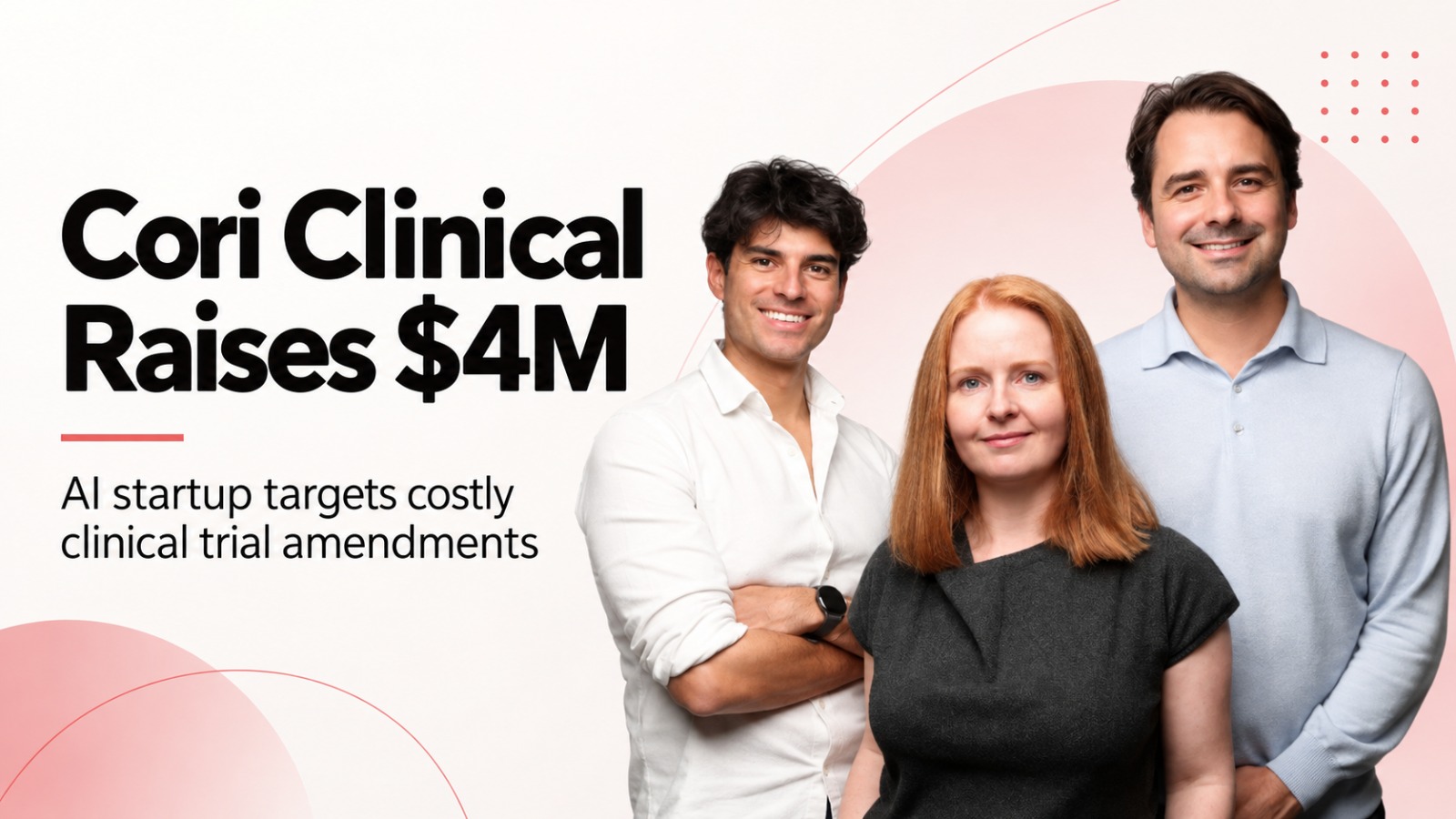
London-based Cori Clinical has raised $4 million in seed funding to expand an artificial intelligence platform designed to help pharmaceutical companies and contract research organisations identify problems in clinical trial protocols before studies begin.
The round was led by Breega, with participation from Enzo Ventures, Heartfelt, Together Ventures and Bynd. Cori plans to use the capital to increase delivery capacity, expand its clinical, engineering and commercial teams, and add more regulatory and clinical intelligence to its platform.
The financing puts Cori into a growing group of health-tech companies applying AI to one of drug development’s less visible sources of delay and expense: changes to trial protocols after a study has already been designed.
Research from the Tufts Center for the Study of Drug Development provides some indication of the scale of the problem. A survey conducted in 2022 and published in 2024 found that 76% of clinical trial protocols underwent at least one amendment, compared with 57% in an earlier study. A separate Tufts analysis published in 2016 estimated the median direct cost of a substantial protocol amendment at $141,000 for Phase II studies and $535,000 for Phase III trials.
Cori is betting that more of those problems can be detected before patient recruitment starts.
Building an AI workspace for trial design
Founded by Jorn Jansen Schoonhoven and Patricio Fernández, Cori brings together a company’s internal clinical-trial information with external sources such as trial registries and regulatory guidance.
The platform is designed to help teams move from an initial trial brief to a protocol, submission package and operational plan while considering how individual design decisions could affect recruitment, costs, timelines and regulatory requirements.
Cori says its system incorporates information from public sources including the US Food and Drug Administration, the UK’s Medicines and Healthcare Products Regulatory Agency and the European Medicines Agency. The company describes the resulting workspace as a continuously updated “living blueprint” for a clinical trial, while maintaining that clinical teams retain responsibility for final judgement and approvals.
“Clinical trials are built through a series of interconnected decisions about how a study should be designed and run,” Schoonhoven, Cori’s co-founder and CEO, said.
He said the knowledge behind those decisions is often dispersed across previous studies, internal systems, teams and separate documents, arguing that bringing those sources together could help teams address avoidable problems before they become delays.
Cori claims 82% detection rate in internal evaluation
The startup says its technology could reduce average clinical-trial set-up costs by at least 33%. That figure is based on Cori’s own modelling of set-up costs, historical modification rates and the time required to reach the first participant, rather than an independently published clinical study.
Cori also says an internal evaluation using amendments from completed trials found its AI reviewer identified 82% of protocol errors that had been classified as avoidable. These performance figures should therefore be treated as company-reported results until independently validated at broader scale.
Commercial adoption is also at an early stage. Cori says it works with two of the world’s five largest enterprise CROs, although it has not publicly identified those organisations or disclosed whether they are paying customers.
One named customer is Erasmus MC, the academic medical centre and university hospital in Rotterdam, where Cori says it has supported two trials in neurosurgery and neuro-oncology.
AI competition grows around clinical trial design
Cori is entering a market where investors are already backing several approaches to making clinical research more efficient.
Barcelona-based Biorce, for example, raised a $52 million Series A in February 2026 for Aika, an AI platform built around a large historical clinical-trial dataset and also aimed at reducing protocol amendments. Cori is pursuing a somewhat different model by combining external information with customers’ own protocols, budgets and bid data.
However, the use of AI in protocol design carries a higher burden of proof than merely applying AI for automated administrative tasks, since ultimately the designs will influence regulatory applications, feasibility and participation of patients.
Cori’s founding team combines technology and pharmaceutical experience. Schoonhoven previously worked at Amazon and IBM and later invested in AI startups at Octopus Ventures. Fernández, Cori’s chief technology officer, previously held data-science roles at Sanofi and AstraZeneca, including at AstraZeneca’s Evinova business, according to company information cited in the funding announcement.
For the young company, the next test will be less about demonstrating that protocol amendments are expensive and more about proving that its software can prevent a meaningful share of them in real-world trials.
Also Read: iPhone Theft in India: Woman Says Thief Asked for Stolen Phone Passcode