

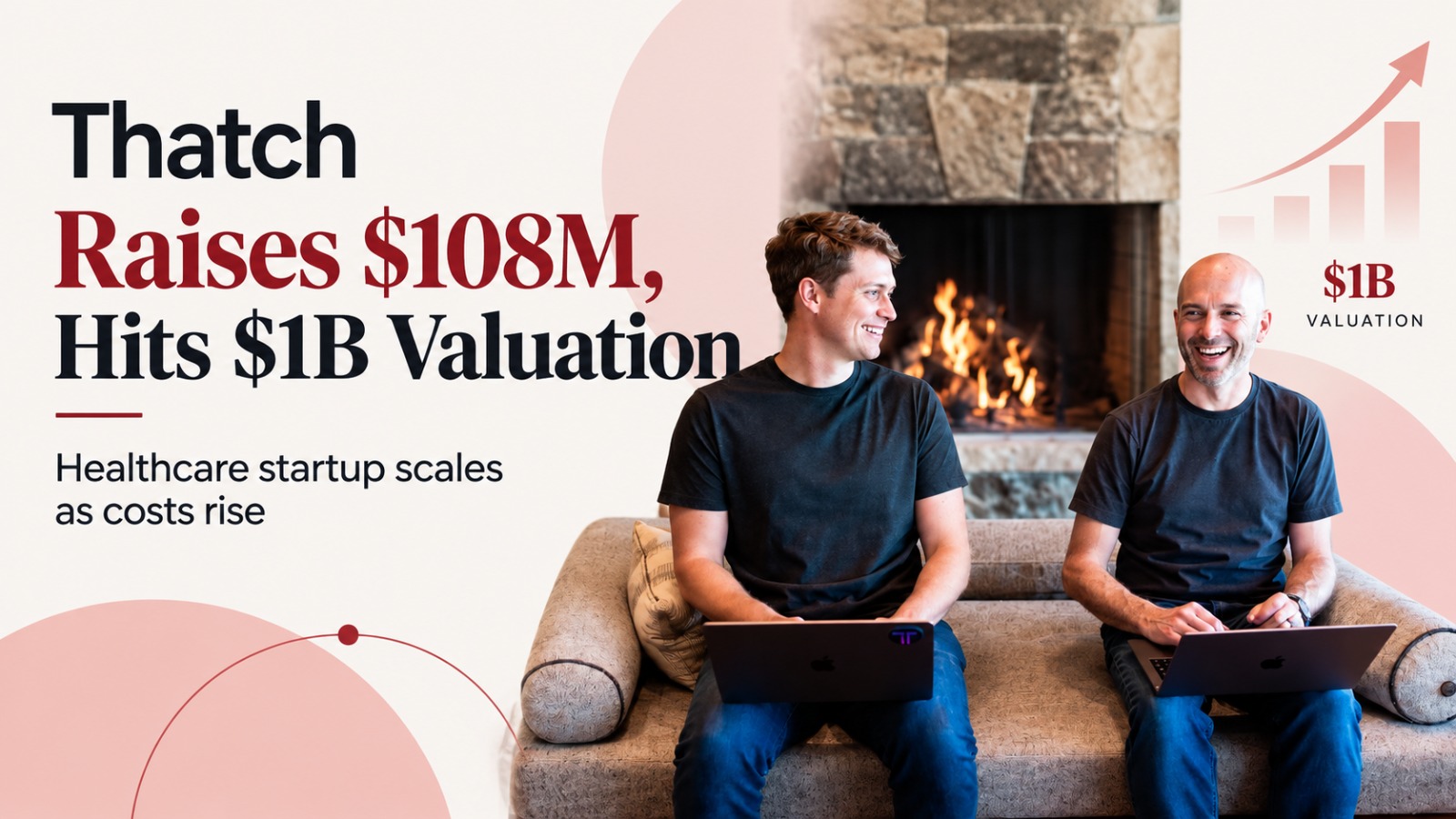
Health benefits platform Thatch has raised $108 million from its existing investors, pushing its valuation to $1 billion as employers look for new ways to control healthcare spending while giving workers more choice over their coverage.
Thatch has secured $108 million in fresh funding at a $1 billion valuation, marking a sharp jump in the value of the healthcare benefits company in less than a year and a half.
The round came from existing investors The General Partnership, Index Ventures, General Catalyst and Andreessen Horowitz. Just 17 months earlier, Thatch had raised a $40 million Series B at a valuation of $410 million, with that earlier valuation attributed to PitchBook.
The latest financing follows a period of rapid business growth. Co-founder and CEO Chris Ellis said Thatch’s annual recurring revenue has increased roughly sevenfold. Ellis started the company in 2021 with Adam Stevenson, a former Stripe engineering executive.
Rising healthcare costs are creating an opening
Thatch’s growth comes at a time when employers are facing increasing pressure from healthcare expenses.
Healthcare costs for employers in 2027 are projected to rise by more than 8%, described as the largest increase since 2003. At the same time, employees are showing greater interest in treatments such as GLP-1 drugs, including Ozempic and Wegovy, which are used for diabetes and weight loss and are not commonly covered by traditional health plans.
Thatch is positioning its platform around that tension: companies want more predictable benefits spending, while employees increasingly want greater control over the healthcare plans and services they use.
How Thatch’s health benefits model works
Instead of putting an entire workforce into a single company-sponsored insurance plan, Thatch operates an individual plan marketplace built around an Individual Coverage Health Reimbursement Arrangement, or ICHRA.
The model, created through federal regulation in 2020, allows employers to provide money that employees can use to purchase their own individual health insurance rather than placing everyone into one company-wide plan.
ICHRAs have recently been rebranded as CHOICE. Under the model, an employer establishes a fixed healthcare budget for each worker. Employees can then use those pre-tax funds to select from health, dental and vision plans available through Thatch’s marketplace, rather than having the employer negotiate a traditional plan directly with individual insurance carriers.
Thatch also uses artificial intelligence to recommend plans based on an employee’s individual needs.
Workers who expect to need more extensive care can spend beyond the employer-funded allowance to obtain broader coverage. Those choosing lower-cost plans can use remaining eligible funds through a Thatch debit card for other healthcare expenses, including GLP-1 medications or an Oura Ring.
Thatch is betting on more choice for employees
Ellis argues that allowing employees to choose and change their own insurance plans could improve competition among insurers.
Under the model, employees who are dissatisfied with their coverage are able to move to another option. Ellis said that could put more pressure on insurers to improve service and retain members.
For employers, he said the structure removes the need to renegotiate directly with insurance carriers every year while still allowing companies to offer comparable levels of coverage, often at a somewhat lower cost.
The approach gives Thatch a business model tied not simply to selling insurance plans, but to changing how companies allocate healthcare benefits in the first place.
Thatch faces competition as the model gains attention
Thatch is not alone in pursuing the market created around ICHRAs.
Take Command, Remodel Health and Zorro are among the other startups offering employers alternatives to conventional healthcare benefits arrangements.
Ellis believes rising costs are prompting more companies to examine the model, with some employers then concluding that it offers a more efficient way to provide healthcare benefits.
For Thatch, the $108 million round and $1 billion valuation represent a significant step up from its previous financing. More importantly, the company’s growth suggests investors are placing substantial value on platforms seeking to reshape employer-sponsored healthcare at a time when both cost control and employee choice are becoming increasingly important parts of the benefits conversation.
Also Read: OpenAI Reportedly Acquires Glass Imaging in Deal Worth Over $300 Million