

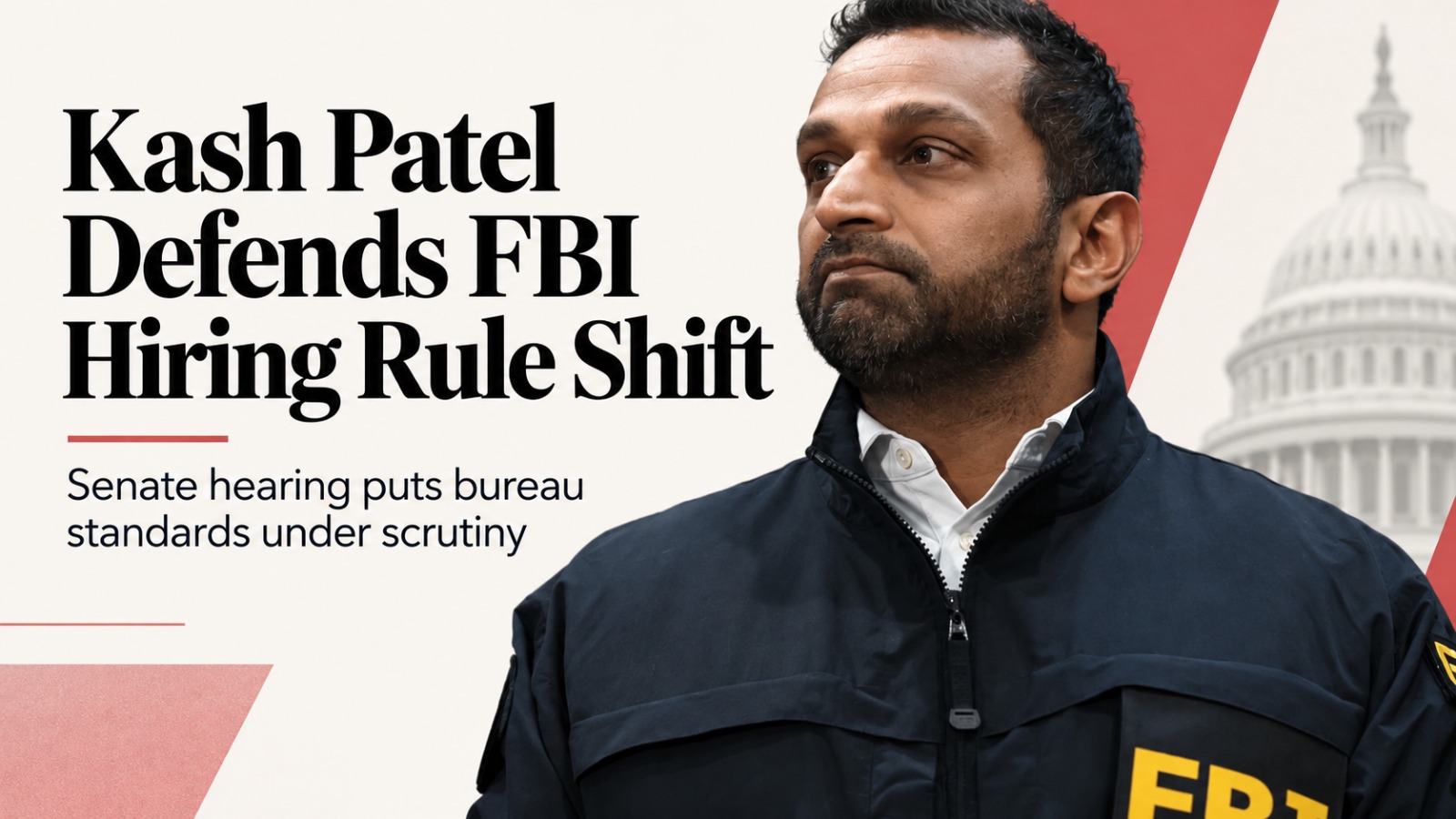
FBI director Kash Patel tells Senate panel that changes involving prostitution and bestiality were designed to prevent victims from being automatically rejected, not to lower the bureau’s employment standards.
FBI Director Kash Patel faced pointed questions on Capitol Hill on Tuesday over changes to the bureau’s hiring guidance involving applicants with past links to prostitution and bestiality, a policy debate that quickly became one of the most unusual exchanges at a Senate Judiciary Committee oversight hearing.
Patel’s central argument was straightforward: the FBI did not want people who had been victimized or trafficked into such conduct to be automatically barred from seeking employment with the bureau.
The FBI issued guidance in the spring removing a categorical hiring ban for applicants who had previously engaged in prostitution. Rather than treating every case as an automatic disqualification, the bureau said the circumstances surrounding the conduct could be considered in at least some cases. A similar change was made concerning bestiality.
That distinction became the heart of Patel’s defence when senators questioned whether the FBI had weakened its hiring requirements.
Patel rejected that characterization. He told the committee that the policy was intended to account for people who had been forced into such acts and who might otherwise be excluded without any consideration of what had happened to them.
“We did not want to punish victims of bestiality, victims who were trafficked. We did not want to make it an automatic disqualification for the FBI to consider you,” Patel said during the hearing.
John Kennedy presses Patel on the reasoning behind the change
Republican Sen. John Kennedy of Louisiana was unconvinced by the explanation and pressed Patel on how the proposal had reached him in the first place.
Patel said the change had been recommended by subordinates. Kennedy responded with one of the hearing’s sharpest questions, asking why Patel had not reacted to the recommendation by asking, “what planet did you parachute in from?”
Patel said that reaction was, in fact, close to his own initial response. But he said he eventually came to view the policy differently because of its potential impact on victims.
The exchange captured the tension around the policy. On the surface, removing an automatic disqualification involving conduct as serious and unusual as bestiality can easily be interpreted as a relaxation of standards. Patel’s testimony presented a narrower rationale: the FBI wanted the ability to distinguish voluntary conduct from situations involving coercion or trafficking.
It doesn’t mean that the applicants are automatically accepted. The alteration explained in the hearing is about whether the particular past actions make a person automatically disqualified. Instead, it leaves room for taking into account the whole situation. The available information does not show that the FBI discontinued additional background checks.
Rolling Stone’s coverage of the same hearing also highlighted senators’ questioning of Patel over the removal of a rule that had disqualified certain applicants, underscoring how quickly the hiring issue became a focal point of the session.
Hiring controversy unfolded during a wider FBI oversight fight
The hiring policy was only one part of a broader and politically charged hearing.
Republican members sought to focus attention on Patel’s work involving violent crime, drug trafficking and the Trump administration’s law-enforcement agenda. Democrats, meanwhile, used the hearing to challenge Patel over turmoil inside the FBI during the previous year.
Sen. Dick Durbin of Illinois, the committee’s ranking Democrat, delivered a sweeping criticism of Patel’s leadership in his opening statement, calling him “the least qualified and most partisan FBI director in our nation’s history.”
Durbin accused Patel of using the bureau’s powers against President Donald Trump’s political opponents and in pursuit of the president’s grievances. Those remarks were Durbin’s allegations during the hearing, not independent findings established in the material reviewed for this report.
The hearing also came against the backdrop of an already contentious relationship between Patel and Democratic senators.
At a previous Senate Judiciary Committee appearance, Patel and Sen. Adam Schiff of California traded personal insults, with Patel calling Schiff an “utter disgrace” and a “coward.” Schiff responded: “You can make an internet troll the FBI director, but he will always be an internet troll.”
Tuesday’s session therefore began with political tensions already high. The unexpected hiring-policy discussion added another layer to a hearing that was ostensibly about oversight of the country’s premier federal law-enforcement agency.
The key issue is automatic disqualification
Beyond the provocative language surrounding the hearing, the substantive question is narrower than some of the headlines might suggest.
The FBI did not describe the policy as an endorsement of prostitution or bestiality, nor did Patel testify that such conduct was irrelevant to hiring decisions. The change described in the hearing concerned whether a past connection to those acts should automatically end an applicant’s chances without considering whether the person had been coerced or trafficked.
Patel’s defence rested almost entirely on that distinction.
The controversy is therefore less about whether the FBI examines an applicant’s past and more about whether specific conduct should function as an absolute bar in every circumstance.
Kennedy’s questioning showed that even lawmakers from Patel’s own party were prepared to challenge the judgment behind changing the rule. Patel’s response showed why the bureau believed an exception to automatic disqualification was necessary.
Whether that explanation satisfies lawmakers remains another question. At Tuesday’s hearing, it clearly did not end the debate.
Also Read: Why Did HYROX Change Its Rules? Beijing Race Controversy Explained