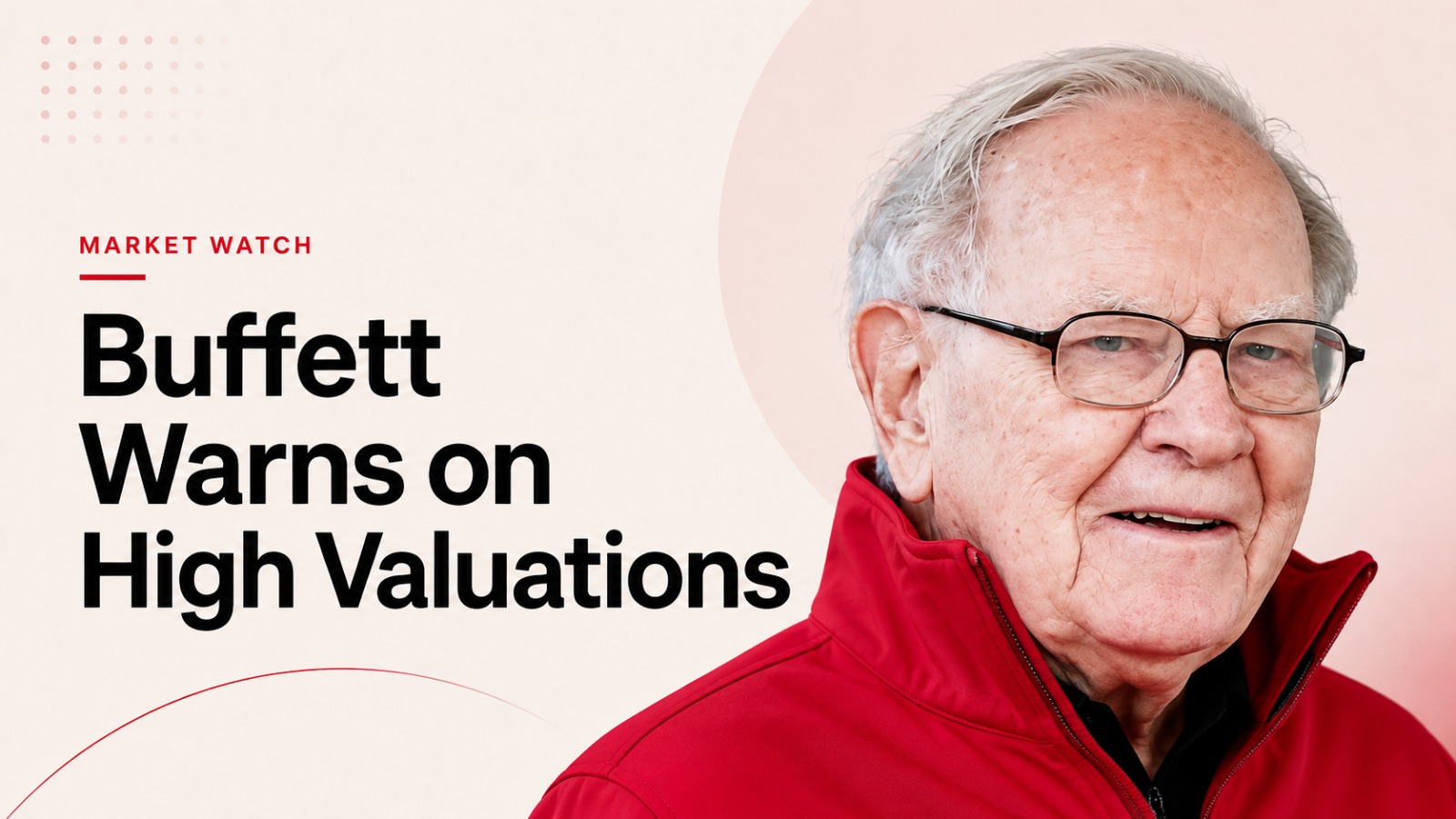
Warren Buffett is not predicting a stock market crash. What he is doing is sending a much more practical message to investors: prices matter, speculation can become dangerous, and having money available when opportunities finally appear can be more valuable than trying to guess the market’s next move.
That distinction has become increasingly relevant as US equity valuations sit at historically elevated levels.
Buffett recently summed up his concern about the market in unusually direct language during a CNBC conversation with Becky Quick: “It’s tough to find values when everybody is preferring gambling.”
In another discussion of increasingly speculative market behaviour, Buffett said, “We’ve never had people in a more gambling mood than now,” while warning that speculative bets had left many valuations looking “very silly.”
The important part of Buffett’s message, however, is what Berkshire Hathaway is doing alongside those warnings.
Warren Buffett is cautious, but Berkshire is not abandoning stocks
Berkshire Hathaway was a net seller of equities for 14 consecutive quarters before reversing course in the second quarter of 2026. Buffett has also indicated that Berkshire would rather have less cash and more money invested in equities, but only when attractive opportunities are available.
That makes his warning less of a call to flee the market and more of a demand for discipline.
Buffett’s approach has never depended on accurately forecasting the next recession, correction or bear market. He has repeatedly maintained that he cannot predict short-term market movements. Instead, one of Berkshire’s defining defensive tools has been liquidity.
The company’s cash position has been reported at roughly $365.5 billion, including cash, cash equivalents and short-term investments in US Treasury bonds.
That figure helps explain a part of Buffett’s investing philosophy that is sometimes misunderstood.
Cash is not necessarily the investment. It is the capacity to invest.
When asset prices become attractive, having readily available capital allows Berkshire to move without first having to sell something else or raise financing. Buffett has compared that liquidity to oxygen, saying cash needs to remain available because investors cannot know what will happen next.
The strategy is therefore not “sell everything before the crash.”
It is to remain financially prepared enough to act if falling prices create unusually good opportunities.
Two valuation measures show why Buffett is demanding more from stocks
The caution comes at a time when widely followed market valuation measures are sitting near levels rarely seen historically.
The so-called Buffett indicator, which compares the total value of the US stock market with gross domestic product, has been reported near 238%. TheStreet described that as the highest level on record.
That number has particular significance because Buffett discussed the measure more than two decades ago. In a 2001 Fortune article, he warned that investors would be “playing with fire” if the ratio approached 200%. The ratio was near those levels around the dot-com peak and again in November 2021 shortly before the subsequent bear market.
Another gauge is also unusually stretched.
The Shiller cyclically adjusted price-to-earnings ratio, or CAPE, measures market prices against average inflation-adjusted earnings over the previous 10 years. One set of figures places the ratio above 41, while July’s monthly reading was reported at 40.6, its highest level since September 2000.
Since the S&P 500 was created in 1957, a monthly CAPE ratio of at least 40 has occurred only 30 times, representing roughly 3% of the period examined.
None of those figures proves that stocks are about to fall.
They do show why finding the kind of valuation Buffett prefers has become more difficult.
History after CAPE 40 is uncomfortable, but it is not a forecast
Historical returns following CAPE readings above 40 have been weak.
Data attributed to Robert Shiller and YCharts showed an average S&P 500 return of negative 3% after one year, negative 19% after two years and negative 30% after three years following such readings. The best three-year outcome in the sample was still negative 10%, while the worst was negative 43%.
Those statistics deserve attention, but they should not be presented as a prediction that the S&P 500 will fall 30%.
The same analysis notes an important limitation. CAPE looks backward because it uses a decade of historical earnings. If corporate earnings continue growing strongly enough, valuations could moderate without requiring a major decline in stock prices. The analysis specifically notes that continued earnings momentum could allow the market to rise while the CAPE ratio moves lower.
That caveat matters.
History can show what happened after previous extreme valuations. It cannot determine what happens next.
Also Read: Top 5 Crashes in Indian Stock Market!
The Alphabet purchase reveals the other half of Buffett’s message
Perhaps the clearest evidence that Buffett’s comments are not a blanket warning against equities is Berkshire’s activity in Alphabet.
Berkshire’s biggest purchases during the second quarter were concentrated in Google parent Alphabet, and Buffett said he was personally responsible for those purchases. He also said he works with Berkshire CEO Greg Abel and does not make decisions Abel does not approve.
At the time referenced in the reporting, Alphabet was trading at roughly 16.8 times forward earnings, compared with about 19.9 times for the S&P 500. It also carried the lowest forward price-to-earnings multiple among the Magnificent Seven companies cited in the analysis.
That purchase may be the most useful way to understand Buffett’s current position.
A market can be expensive without every company being equally expensive.
Buffett can dislike the overall level of speculation while still buying an individual business when its economics and valuation meet his standards.
Berkshire’s behaviour therefore points toward selectivity rather than retreat. The company is still willing to buy stocks, but it appears prepared to wait when suitable prices are scarce.
The warning is really about the price investors are willing to pay
Buffett’s use of gambling language draws a line between two very different reasons for owning a stock.
One is buying an interest in a business because its economics and price make sense.
The other is buying because a rising share price creates an expectation that somebody else will pay even more later.
That distinction becomes more consequential when valuations are already elevated. A highly valued company has less room for operational disappointment because strong future results may already be reflected in its share price.
It also explains why Buffett can simultaneously hold an enormous pool of liquid capital and continue buying selected businesses.
The two decisions are not contradictory.
The cash gives Berkshire patience. The stock purchases show that patience does not mean paralysis.
Buffett’s playbook does not require knowing when the next crash will arrive
Investors looking for a date or a prediction will not find one in Buffett’s approach.
Even with valuations close to historical extremes, the material examined here does not establish that Buffett has forecast an imminent stock market crash. One account explicitly notes that he has not relied on predicting previous downturns and that nobody knows with certainty whether a market meltdown is approaching.
His response is more straightforward.
Keep enough liquidity to preserve flexibility. Demand more from the price paid for a business. Avoid confusing rising prices with improving fundamentals. And when markets eventually offer genuinely attractive businesses at compelling valuations, have the capital and conviction to act.
That is a less dramatic message than calling the top of the market.
It may also be the more consequential one.
Also Read: Gold Prices Rise Sharply as Global Cues Lift Safe-Haven Demand