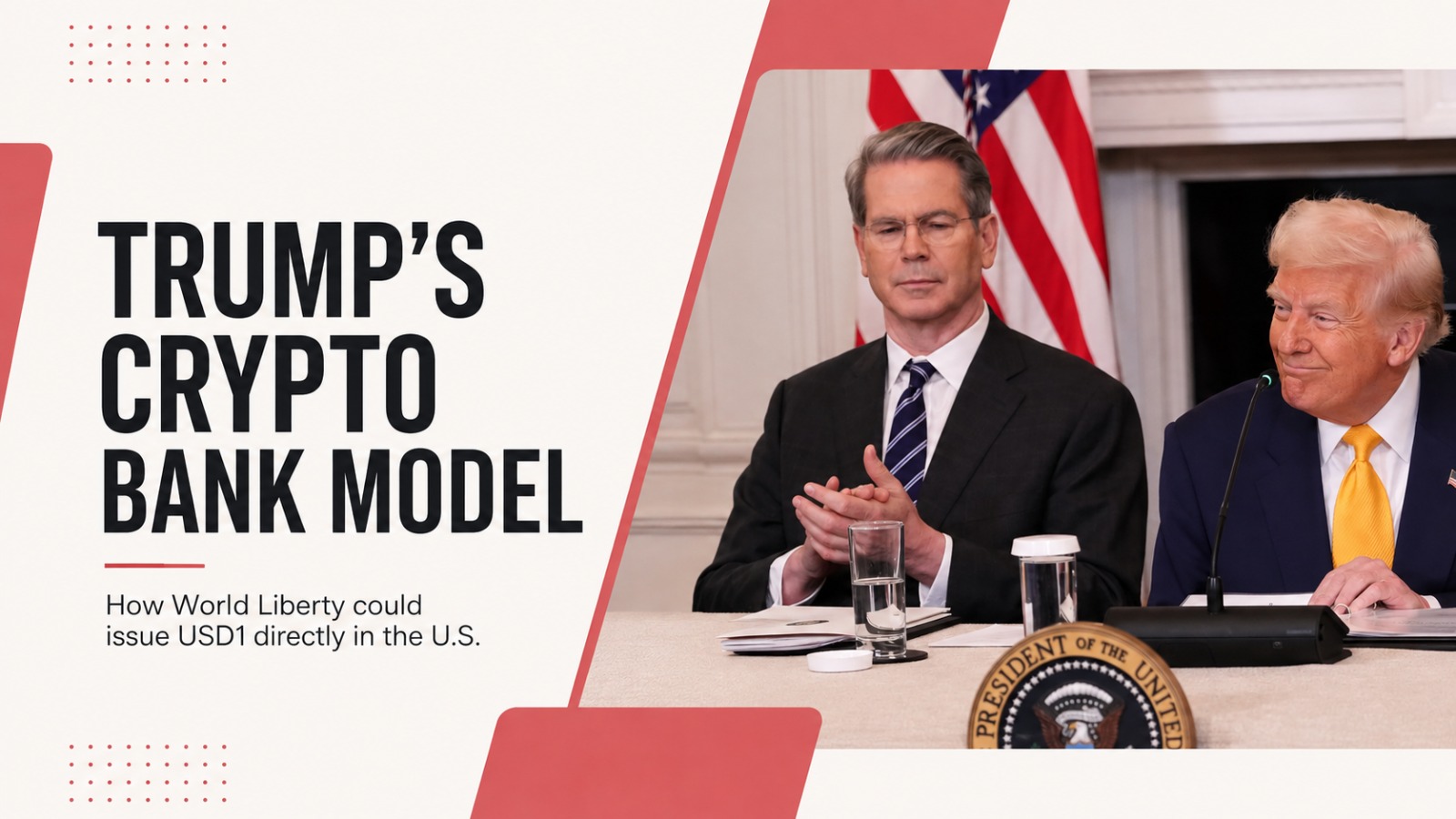
World Liberty Financial, the cryptocurrency venture controlled by President Donald Trump’s family, has moved a step closer to operating with the powers of a federally chartered bank.
The Office of the Comptroller of the Currency, or OCC, has given the company conditional approval that puts it on track to receive a banking charter. If the process is completed, World Liberty Financial would be able to issue its USD1 stablecoin in the United States without relying on an intermediary.
That is the part of the story that matters most for understanding the business model.
World Liberty Financial is not simply seeking another regulatory approval for a crypto product. A federal charter could change how directly the company is able to operate its stablecoin business in the U.S., while also bringing the venture closer to the traditional banking system.
So, what is Trump’s crypto bank model?
At the centre of the model is USD1, World Liberty Financial’s stablecoin.
The OCC’s conditional approval could allow the company to issue USD1 directly in the United States rather than using another institution as an intermediary. That would give World Liberty Financial a more direct role in the issuance of its digital dollar product.
For World Liberty Financial, the banking charter therefore represents more than a change in regulatory status. It could become an important part of the infrastructure behind how USD1 is issued and operated in the American market.
The approval remains conditional, meaning the company has not yet received a final banking charter.
Still, the decision marks a significant regulatory step for a crypto venture closely connected to the president’s family.
Why USD1 matters to World Liberty Financial
World Liberty Financial has made clear that it wants USD1 to become a widely used digital dollar.
Zach Witkoff, co-founder of World Liberty Financial and the son of Trump’s special diplomatic envoy Steve Witkoff, welcomed the OCC decision and outlined the company’s ambition for the stablecoin.
“Our ambition is clear: to build the most trusted and widely used digital dollar in the world while strengthening the role of the U.S. dollar across the global economy,” Witkoff wrote on social media.
It is a helpful insight for the company’s strategy since the USD1 stable coin is not considered as an additional service but rather a central component of the strategy of the World Liberty Financial Company.
A federal charter could support that strategy by giving the company a direct route to issuing USD1 domestically.
Why the banking approval is attracting scrutiny
The regulatory decision carries an unusual political dimension because Trump and his family retain a substantial financial interest in World Liberty Financial.
The approval could give the venture additional federal credibility and new operating powers at a time when the president’s private financial relationship with the company remains significant.
That connection has turned what might otherwise have been a technical banking decision into a broader debate about presidential finances and federal regulation.
Based on an article, Trump earned $65 million in 2025 from selling stock in World Liberty Financial. In addition, his financial disclosures showed that Trump made close to $600 million from stablecoins and other forms of digital currency sold via World Liberty Financial.
Those numbers explain why the charter decision is drawing attention beyond the crypto industry.
If World Liberty Financial secures its banking charter and expands the reach of USD1, the company could gain greater commercial opportunities while Trump and his family continue to have a financial interest in the venture.
The political reaction has already begun
Democratic lawmakers have sharply criticised the decision.
Senator Elizabeth Warren of Massachusetts responded to the OCC announcement by calling it “the most brazen act of self-dealing our system has ever seen.”
Her criticism focuses on the overlap between the president’s private financial interests and a regulatory decision made by an agency within his administration.
The OCC is led by Jonathan Gould, a Trump appointee.
For critics, that combination raises questions about how the government handles regulatory matters involving businesses tied financially to the president.
For World Liberty Financial, however, the immediate business implication is straightforward: it is closer to obtaining a charter that could allow it to issue USD1 directly in the United States.
What happens next?
The key word in the OCC decision is conditional.
World Liberty Financial has moved closer to becoming a federally chartered institution, but the approval described so far is not the final charter itself.
Until that process is completed, the company’s banking ambitions remain a work in progress.
What is already clear is how the model is taking shape. World Liberty Financial wants USD1 to become a major digital dollar, and a banking charter could give the company a more direct way to issue that stablecoin in the U.S.
That makes the story bigger than another crypto regulatory approval. It is about a Trump family-linked digital asset company attempting to combine a stablecoin business with the regulatory structure of American banking, while the president and his family retain a significant financial interest in the venture.
Whether that model ultimately develops into a full-fledged federally chartered operation will depend on what follows the OCC’s conditional approval.
Also Read: iPhone 18 Pro Max Pre-Order Date, 5 AM Los Angeles Time, Price, Battery Leaks