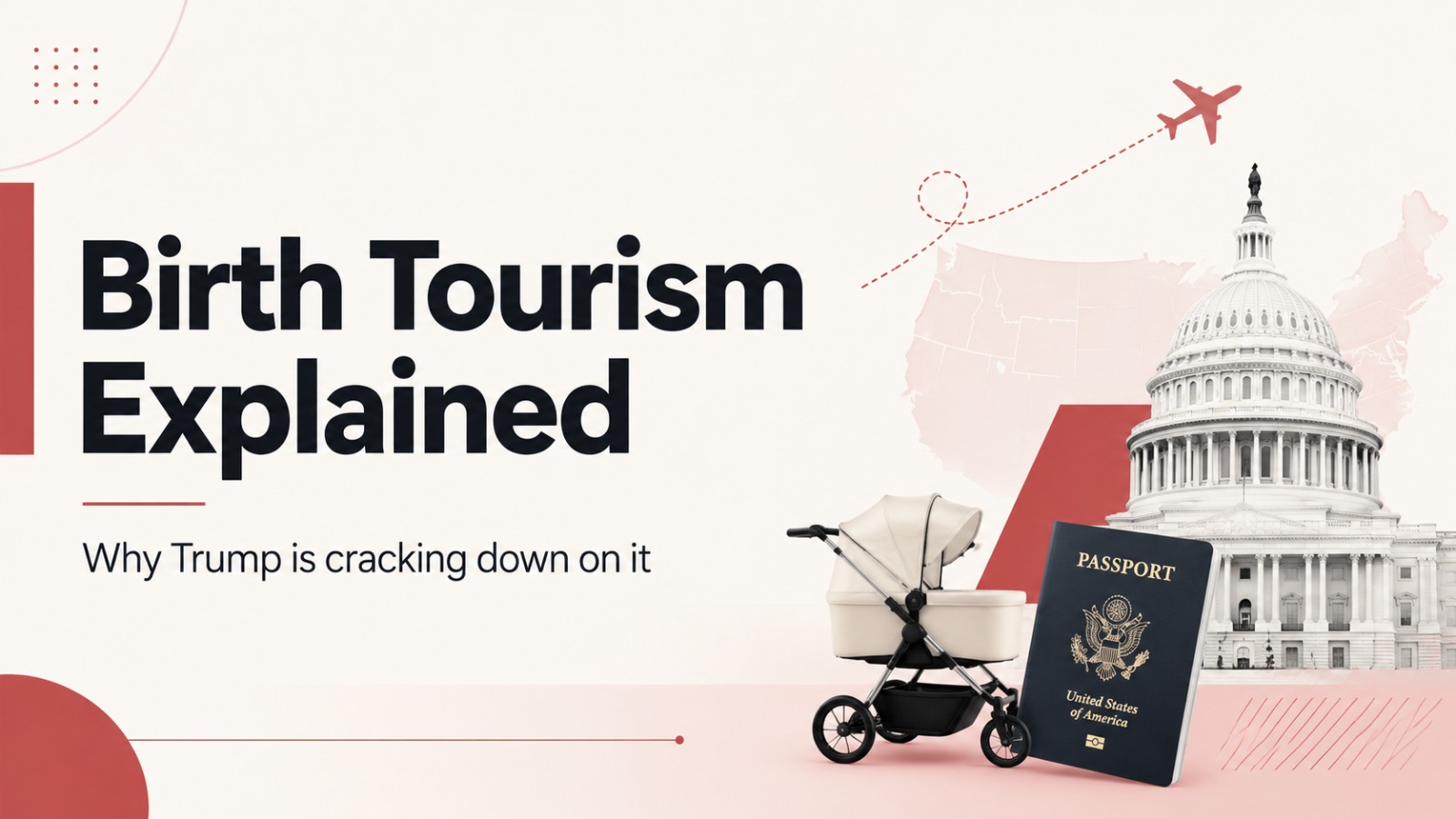
Donald Trump’s latest immigration push puts “birth tourism” back at the centre of the US birthright citizenship debate. The new measures focus on people accused of entering the country primarily to give birth, along with those who help arrange such travel. But the move does not automatically mean that every foreign worker or international student who has a child in the United States will lose citizenship rights for that child.
US President Donald Trump has opened another front in his long-running battle over birthright citizenship, this time by targeting what his administration calls “birth tourism.”
On August 6, 2026, Trump signed measures aimed at restricting the use of temporary US visas by people whose primary purpose for entering the country is to give birth and obtain American citizenship for their child. The Hindu reported the move as two executive orders intended to crack down on birth tourism and narrow eligibility for birthright citizenship.
The distinction matters.
Trump’s latest approach is not simply about a foreign national giving birth while legally present in the United States. The central issue is intent: whether someone sought entry on a temporary visa specifically for childbirth and the citizenship that generally follows for a US-born child.
That puts visa screening, travel purpose and immigration enforcement at the heart of the policy.
What exactly is birth tourism?
In simple terms, birth tourism refers to a foreign national travelling to the United States with the primary purpose of giving birth there so that the child acquires US citizenship.
The new order defines the practice as entering the United States on a nonimmigrant visa for that purpose. It also extends the definition to people who help another foreign national enter the country for such a trip.
The reason the practice exists at all is closely tied to America’s system of birthright citizenship.
Children born in the United States generally receive American citizenship at birth under the 14th Amendment and federal law, subject to limited exceptions.
For families deliberately travelling to the US for childbirth, that citizenship can therefore become the main objective of the journey.
Why does Trump want to stop it?
The Trump administration’s argument is less about childbirth itself and more about what it considers misuse of the immigration system.
Officials argue that some travellers obtain or use temporary visas while concealing that their real purpose for travelling is to give birth in the United States. Birth tourism businesses and facilitators are also part of the administration’s focus.
Importantly, travelling to the United States specifically to secure citizenship for a child was not entirely outside existing visa enforcement before Trump’s latest action.
The Migration Policy Institute has noted that seeking a visa specifically for that purpose can already amount to fraud and provide grounds for denying a visa.
Trump is now attempting to make that enforcement broader and more explicit.
One of the orders directs US authorities to use tools including visa denials, visa or travel-authorisation revocations, entry restrictions and action against individuals or organisations accused of facilitating birth tourism.
In announcing the policy, Trump also framed US citizenship as something that should not become a commodity obtained through organised birth tourism.
So, has Trump “banned” birth tourism?
Calling it a ban is useful shorthand, but it needs qualification.
The policy is better understood as an attempt to stop suspected birth tourism at the immigration and visa stage.
That means authorities could refuse a visa, stop someone from entering the United States, revoke travel permission or act against facilitators when officials determine that childbirth is the real purpose of the proposed travel.
The order also provides room for exemptions on humanitarian grounds or when entry is considered to be in the US national interest.
In other words, this is not a general prohibition on pregnant foreign nationals entering the United States.
The deciding factor is supposed to be the purpose of the trip.
How big is birth tourism in the United States?
There is no official government count establishing exactly how many US births result from birth tourism.
That uncertainty is important because estimates should not be presented as confirmed numbers.
A 2026 Migration Policy Institute analysis estimated that roughly 26,000 births a year could fall within the category, compared with about 3.5 million births nationwide.
Another report citing MPI placed the estimated scale at around 22,000 to 26,000 people annually.
So while the administration portrays the practice as a significant immigration loophole, the available figures remain estimates rather than an official count.
Why is the 14th Amendment at the centre of this fight?
Because birth tourism cannot really be separated from the larger question of birthright citizenship.
The 14th Amendment says:
“All persons born or naturalised in the United States, and subject to the jurisdiction thereof, are citizens of the United States.”
The legal framework has long been interpreted broadly. The 1898 Supreme Court ruling in United States v. Wong Kim Ark affirmed birthright citizenship for children born in the United States to non-citizen parents who were lawfully present. Historically, the recognised exceptions have been narrow, including children of foreign diplomats and children born to enemy forces occupying US territory.
That constitutional foundation is what makes the current fight much larger than a visa-policy dispute.
Trump had already attempted a broader restriction on birthright citizenship in 2025. That effort encountered immediate legal obstacles and did not take effect. The 2026 strategy is narrower, focusing more heavily on travel intent, particular classifications and enforcement against alleged birth tourism.
What does the new policy mean for citizens on H-1B visas?
This is where the distinction between living in America for an authorised purpose and travelling to America specifically to give birth becomes especially important.
An H-1B professional is in the United States principally for specialised employment. An L-1 holder is there through an intracompany transfer. An F-1 holder is primarily in the country for education.
Those circumstances are fundamentally different from entering on a short-term trip whose principal purpose is childbirth.
The analysis available on the 2026 measures says the new orders do not explicitly remove birthright citizenship protections from H-1B, L-1 or F-1 visa holders simply because of their visa category.
Under the existing legal framework described in the reporting, a child born in the United States to Indian parents legally present on temporary visas such as H-1B, H-4, L-1, L-2 or F-1 generally receives US citizenship at birth.
So an Indian software engineer working legally in the US on an H-1B visa and having a child there is not automatically the same thing as a visitor entering specifically for birth tourism.
The same intent-based distinction applies to people legitimately present for work, study or other authorised purposes.
Could students and temporary workers still face greater scrutiny?
Potentially, yes.
One report on the orders says the administration has referred broadly to nonimmigrant visa categories, including student, exchange, temporary employment and tourist visas, when discussing possible exploitation by birth tourists. It directs immigration authorities to use measures including visa denial and entry restrictions against people attempting birth tourism.
But being in one of those visa categories does not, by itself, establish birth tourism.
What becomes crucial is whether immigration officials believe the visa or entry was being used primarily to facilitate childbirth for citizenship purposes.
That distinction is likely to make intent, travel history and the circumstances surrounding a visa application increasingly important in screening.
Why has Trump changed strategy?
The shift reflects the legal difficulty of directly undoing birthright citizenship through executive action.
The Trump administration previously pursued a much broader approach. After that effort became tied up in court, the 2026 measures moved toward a narrower enforcement strategy centred on birth tourism and particular categories of cases.
Rather than relying only on a sweeping declaration about who is entitled to citizenship, the administration can now try to intervene earlier, before a suspected birth tourist enters the country.
That makes the border and visa system the first line of enforcement.
Is another legal battle likely?
Yes, and the constitutional question has not disappeared.
The American Civil Liberties Union has argued that citizenship for people born on US soil is protected by the 14th Amendment and has challenged the administration’s approach. The White House, meanwhile, maintains that its measures can operate without violating constitutional protections.
That creates a basic tension that courts may ultimately have to examine: how far can a president use immigration and entry powers to prevent birth tourism without effectively creating new restrictions on birthright citizenship itself?
The 2026 orders may be narrower than Trump’s earlier attempt, but they remain part of the same larger constitutional debate.
Trump’s latest birth-tourism crackdown does not mean every child born in America to foreign parents suddenly loses US citizenship.
The immediate focus is more specific: people suspected of entering the United States primarily to give birth and obtain citizenship for their child, along with businesses or individuals accused of facilitating that travel.
For Indian H-1B and L-1 professionals and F-1 students legally living in the United States for work or education, the information currently available does not show a blanket removal of their children’s birthright citizenship protections. Their position is materially different from that of someone travelling primarily for childbirth.
What Trump has done is move the fight from a broad attempt to redefine citizenship toward a more targeted battle over who gets to enter the country, why they are entering, and whether temporary visas are being used to obtain citizenship through planned childbirth.
And that is why “birth tourism,” a relatively narrow immigration practice, has once again become part of one of America’s biggest constitutional debates.
Also Read: Is Zendaya Pregnant? Viral Baby Bump Photo With Tom Holland Appears on Social Media