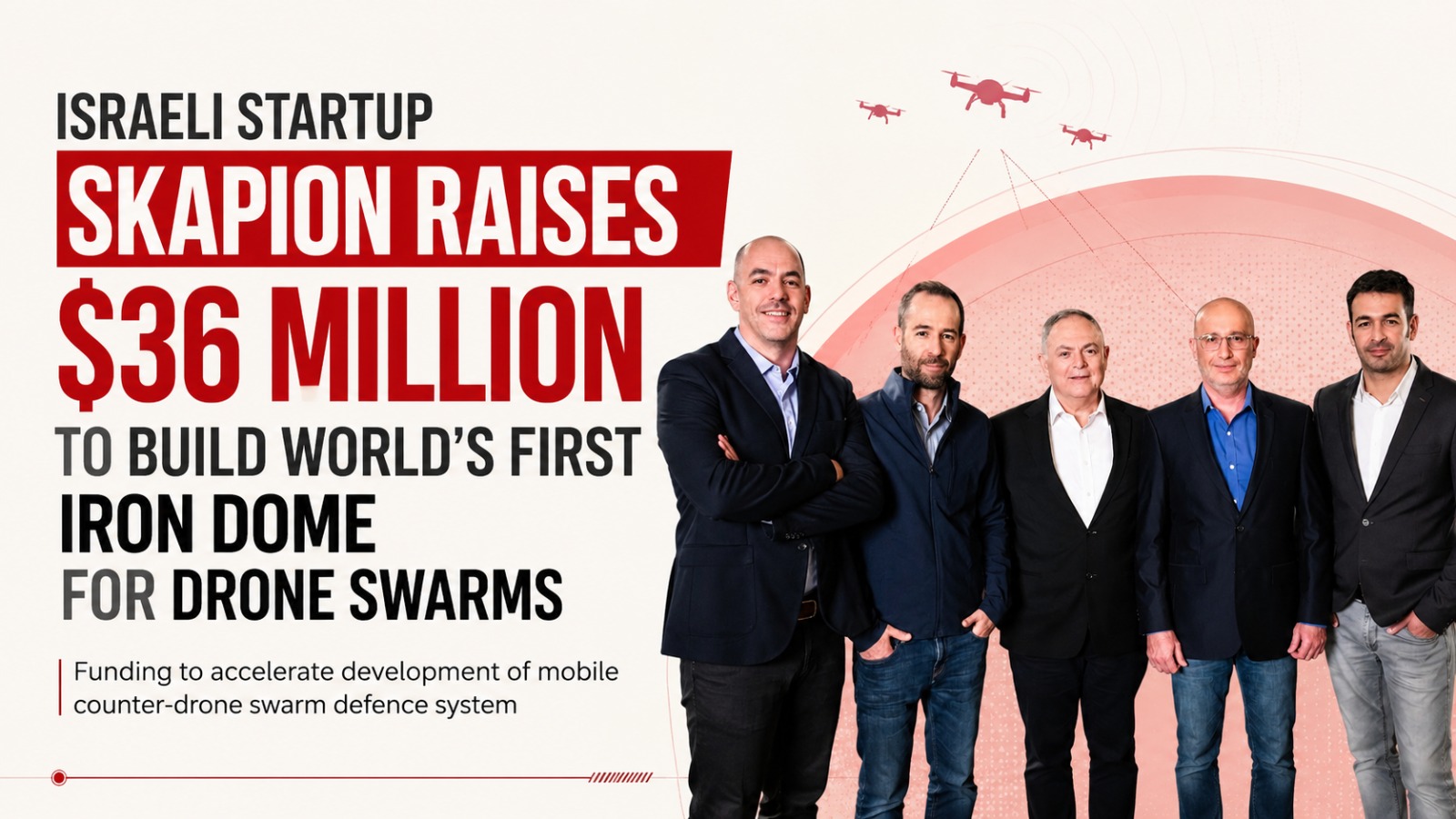
Israeli defence technology company Skapion has raised $36 million in a seed funding round to accelerate the development of a mobile system designed to detect, engage and neutralise large groups of drones.
The round was co-led by UP.Partners and Khosla Ventures. Fusion VC, Stratos Ventures, TBD VC and q Fund, which had previously backed the company, also participated.
Skapion is developing what it describes as a Native Counter Swarm system, built specifically for a battlefield where multiple low-cost drones can attack at the same time. Unlike traditional air-defence platforms that are often designed to intercept individual and comparatively expensive threats, the company’s technology is being developed to respond to mass drone attacks at a lower operational cost.
The system is intended to offer an end-to-end response, covering detection, engagement and neutralisation. It is also being designed to function in areas where communications are restricted or environmental conditions make conventional operations difficult.
According to the company, the platform could be deployed with moving military units, around permanent installations and near critical infrastructure.
Skapion: A defence challenge shaped by scale and cost
The growing use of inexpensive unmanned aerial systems has created a difficult equation for military forces. Attackers can deploy large numbers of disposable drones, while defenders may be forced to respond with systems and interceptors that cost significantly more than the incoming threat.
Skapion believes this imbalance has exposed a gap in existing air-defence networks, particularly when several drones approach a target simultaneously.
Ido Bar-On, co-founder and chief executive of Skapion, said the central challenge is no longer limited to detecting or destroying a single drone. The more urgent question, he said, is whether defence forces can stop entire swarms at the speed, scale and cost demanded by modern warfare.
The company plans to use the new capital to expand its engineering operations, hire additional employees and continue developing and validating the system. The funding will also support work with governments, defence organisations and commercial partners in Israel, the United States and other allied markets.
Experienced defence and engineering team
Skapion’s founding group brings together experience in air defence, military operations, engineering, robotics and complex technology systems.
The team includes Brigadier General (Res.) Pini Yungman, the company’s founding architect and co-founder. Yungman previously served as general manager of Rafael’s Air and Missile Defense Systems division and as president and chief executive of TSG Group. He has also been associated with the development of the Iron Dome and David’s Sling programmes.
Bar-On previously led defence and government business across international markets at XTEND. He also served as a lieutenant colonel in the Israel Defense Forces reserves.
Gal Goren, Skapion’s co-founder and chief technology officer, has experience in multidisciplinary engineering and the development of complex technological systems. The founding team also includes Zafrir Yoeli, a former co-founder of Enlight Renewable Energy, and defence entrepreneur Yaron Karp.
Ben Marcus, co-founder and managing partner at UP.Partners, compared the scale of the drone-swarm challenge with the earlier shift in missile defence. He said air defence must now adapt to threats built around cheaper platforms attacking in greater numbers.
Expansion planned in Israel and the United States
Established in late 2025, Skapion has already built a workforce of several dozen employees across engineering, defence, aerospace, robotics, autonomy and deep technology.
The company is headquartered in Washington, DC, and operates a research and development centre in Ramat Gan, Israel.
With the latest funding, Skapion is positioning its platform as a mobile counter-drone system designed for one of the most demanding features of emerging warfare: the ability to respond to several low-cost aerial threats at once without relying on an economically unsustainable interception model.
Also Read: ‘Honeymoon suite’ in First AC coach sparks Railways inquiry after video goes viral