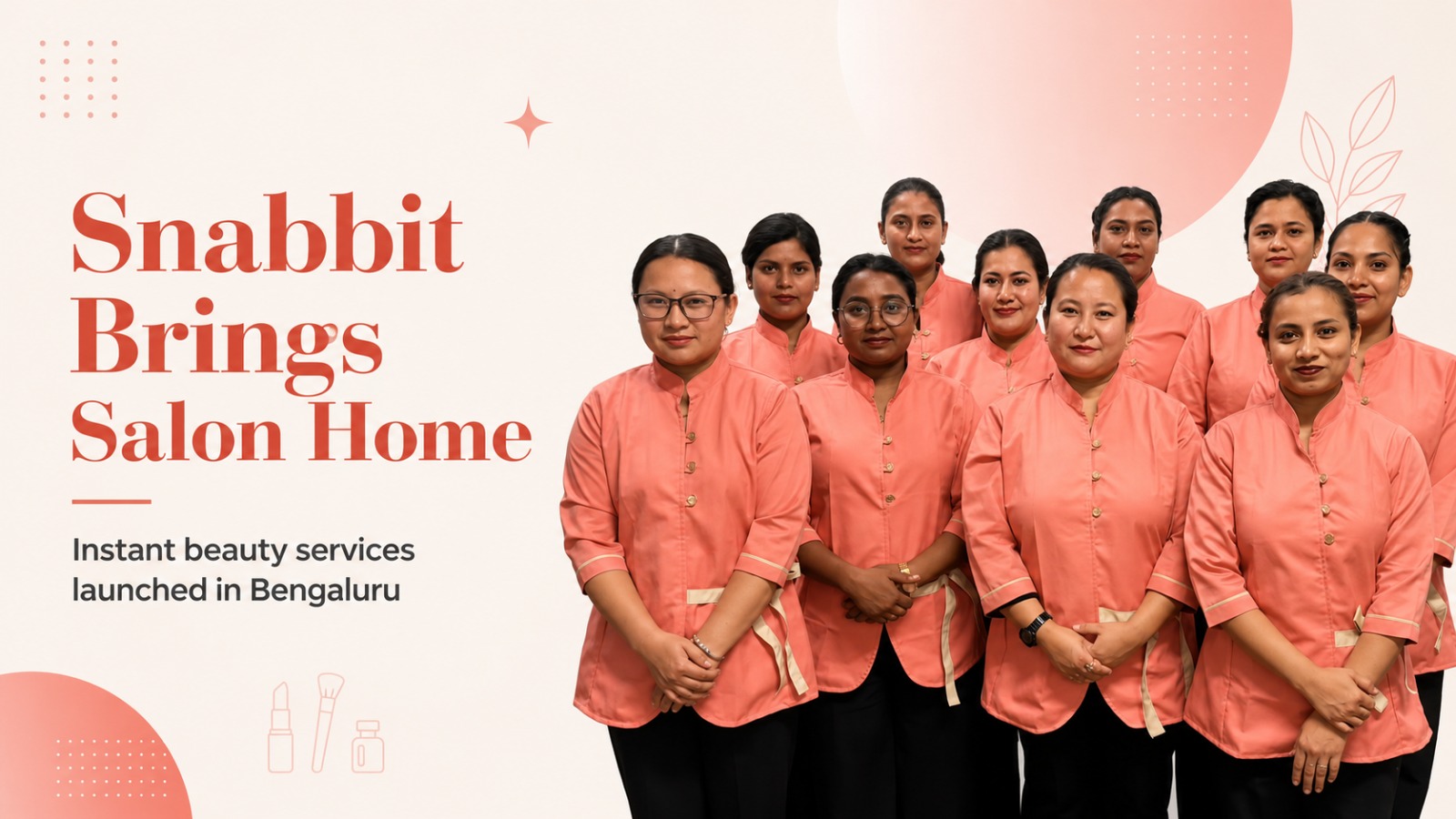
After building around quick home services, Snabbit is now trying to make salon-at-home work like an instant-use category, starting with Bengaluru’s Sarjapur market.
Bengaluru’s quick-service race is moving from groceries and household chores to personal care. Snabbit, the quick home services platform, has entered the beauty services category with an instant salon-at-home offering that promises trained beauty professionals at customers’ homes within minutes.
The launch follows a six-week pilot in Sarjapur, one of Bengaluru’s dense urban micromarkets. During the pilot, Snabbit says it completed more than 2,000 beauty service jobs, with average fulfilment time remaining under 15 minutes. The service is currently running with 25 active beauty professionals and is averaging nearly 50 jobs a day.
For Snabbit, the move is not just about adding another category. It is an attempt to bring the logic of instant fulfilment into a segment that still largely runs on advance bookings, fixed slots and waiting time. Beauty services, especially regular-use services such as threading, waxing, facials, clean-ups, hair styling, saree draping and head massages, are being positioned by the company as high-frequency needs that can be served faster through a hyperlocal model.
“Beauty services is a high-frequency category with a large addressable market that overlaps perfectly with the core category we have built,” said Aayush Agarwal, Founder and CEO of Snabbit. He said consumers now expect convenience across categories, but beauty services continue to involve long waiting periods. Snabbit sees room to rethink the experience through speed, reliability and hyperlocal fulfilment.
The platform’s current beauty model is built around multi-skilled professionals rather than separate specialists for each service. Snabbit says these professionals are trained to handle multiple tasks in one sitting, which could help reduce friction for customers who want basic services without booking different appointments.
The company has also introduced lightweight beauty kits and monodose, single-use packaging for several applications. The idea is to improve hygiene and reduce wastage during home visits. Products from brands including O3+ and Rica are being used for the services.
A notable part of the rollout is its women-led service design. Snabbit says the beauty vertical is currently operated entirely by women beauty professionals, with experience ranging from three to 14 years. These professionals are also undergoing additional training at Snabbit’s training centres. The company has positioned the offering as a “salon by women, for women,” with convenience, comfort and trust as the core promise for female consumers.
Pricing has been kept entry-level. Services on the platform start at ₹49 and come with no minimum order value, which is important for a category where customers may want a quick single service rather than a bundled salon package.
Dev Priyam, Vice President, Business at Snabbit, who leads the company’s beauty category efforts, said the response so far has been driven largely by organic word-of-mouth in dense neighbourhoods where the service has launched. He said consumers should not have to plan around basic beauty needs, whether before office, after work or ahead of stepping out.
Priyam had co-founded Pync and joined Snabbit after the company acquired the startup last year. The company now plans to expand the beauty services category across more Bengaluru micromarkets before entering other cities.
The real test for Snabbit will be consistency. Instant beauty services are harder to standardise than product delivery because the customer experience depends on skill, hygiene, punctuality and comfort inside the home. The Sarjapur pilot gives the company an early use case, but scaling it across neighbourhoods will require a steady supply of trained professionals and tight quality control.
Still, the move signals a broader shift in urban consumer services. Convenience is no longer limited to food, groceries or household repairs. Snabbit is betting that beauty, too, can become an on-demand habit.