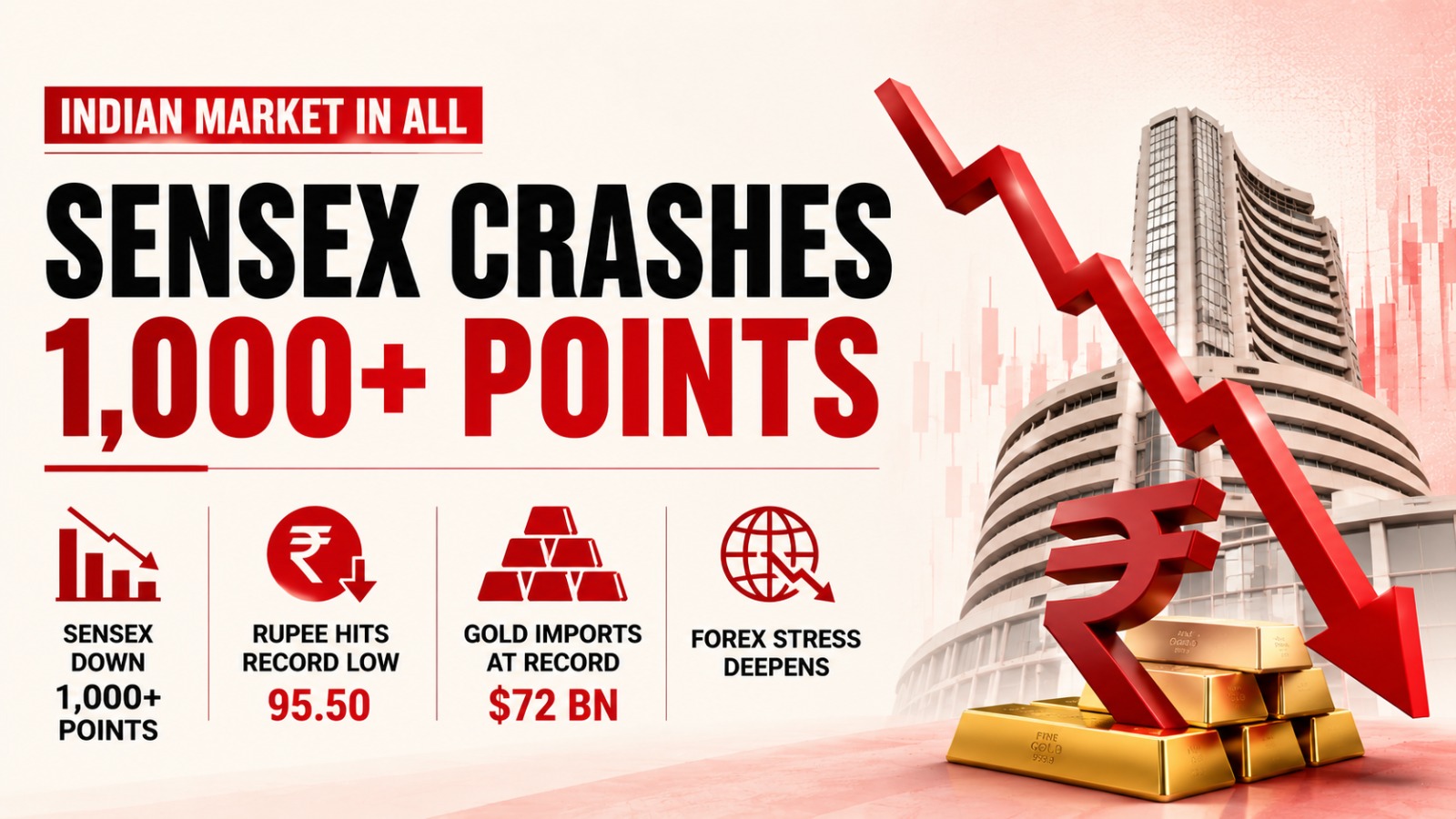
Indian markets entered the week on a nervous note as a sharp equity selloff, rising US bond yields, a stronger dollar and pressure on the rupee brought back an old question for Dalal Street: is India moving into a phase of quiet forex defence?
Indian Market Crash: Sensex Tanks 1,000 Points
The Sensex fell over 1,000 points, while the Nifty slipped below 23,600, with IT and realty stocks leading the decline. The pressure came alongside a hardening in US Treasury yields, with the 10-year yield at 4.423 percent and the 30-year hovering near 5 percent. For foreign investors, higher US yields make dollar bonds more attractive, reducing appetite for emerging-market equities, including India.
The rupee added to the anxiety. It opened at a record low of 95.50 against the US dollar, down 0.2 percent from its previous close. The weakness has sharpened attention on Prime Minister Narendra Modi’s appeal to avoid buying gold for a year and reduce fuel consumption.
The market reading is simple: this is not just a savings message. It is being seen as an early signal of forex austerity.
India’s gold appetite has always carried a currency cost. The country imports roughly 800 to 900 tonnes of gold annually, making it one of the world’s largest gold buyers. Gold imports reportedly touched nearly $72 billion in FY26, up from about $58 billion in FY25. Every additional dollar spent on imported gold adds pressure on the current account and, at the margin, weakens the rupee.
The UAE route is now under sharper focus. Gold inflows under CEPA have reportedly surged, while silver imports have also multiplied. Concerns are rising that a zero-duty window is being used to route precious metals through Dubai, including via “platinum alloy” classifications, creating a major revenue leakage estimated at around ₹63,000 crore annually.
That is why the Prime Minister Narendra Modi’s “don’t buy gold” appeal could have a second layer. It gives the government political space to tighten the UAE-linked duty loophole, restore revenue, and push gold flows back into regulated channels.
For the market, however, the message is double-edged. If traders see the appeal as crisis management, the rupee may come under more speculative pressure after any short-lived relief. Domestic gold prices may also rise if buyers fear supply disruption. Banks have already been largely absent from the market for weeks, creating a strong local premium. Jewellery stocks such as Titan and Kalyan could face selling pressure, especially with wedding-season demand in the background.
The bigger concern is the current account. With crude firming, the dollar strong and the rupee under pressure, India’s external balance is again becoming a market trigger. The current account deficit is seen drifting from around 1 percent to 1.3 percent of GDP, while the gold bill alone is closer to 1.8 percent of GDP. If West Asia tensions worsen and crude remains elevated, the deficit could move toward the 2 percent zone, increasing volatility in the rupee.
For now, the street is reading the Prime Minister’s call as more than moral restraint. It looks like the first public signal of a policy shift: conserve dollars, curb non-essential imports, protect reserves and prepare the ground for action on gold inflows.
The equity selloff shows investors are not treating it lightly.
Also Read: Vaibhav Suryavanshi’s Rise Is Bigger Than a Net-Worth Number