

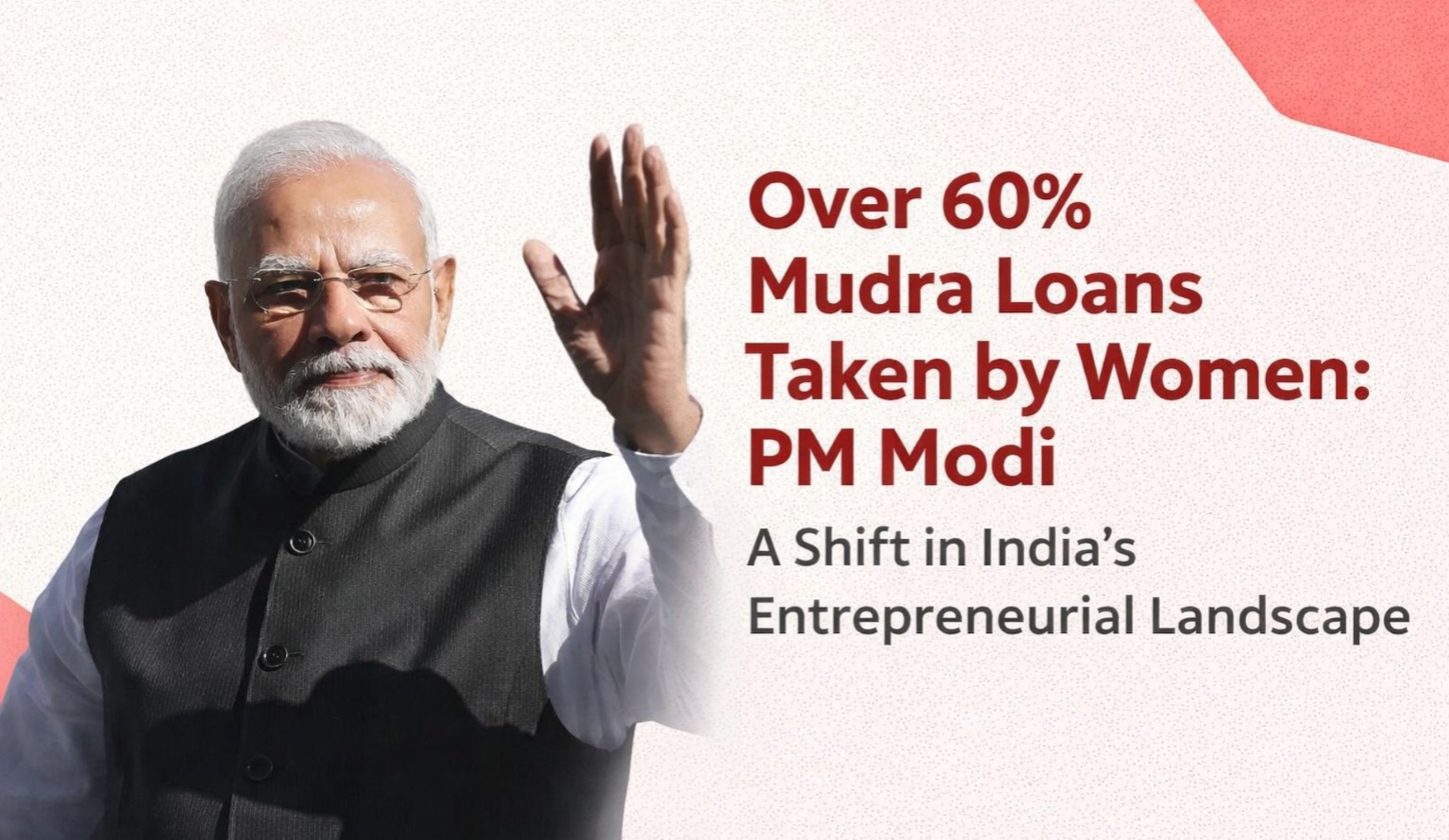
Prime Minister Narendra Modi on Monday said that women account for more than 60 per cent of Mudra loans sanctioned under the Pradhan Mantri Mudra Yojana, using the figure to argue that women-led entrepreneurship is quietly reshaping India’s economic and social landscape.
Speaking at the Nari Shakti Vandan Sammelan at Vigyan Bhawan in the national capital, Modi said Indian women are increasingly stepping beyond traditional roles and building independent identities through business and enterprise.
He said the high share of women beneficiaries under the Mudra scheme reflects a deeper shift underway at the grassroots, where access to small-ticket credit is beginning to translate into economic participation.
At the heart of his remarks was a simple but politically significant message: women are no longer being described only as beneficiaries of welfare, but as active participants in growth.
Modi said women are helping strengthen families while also contributing to the country’s broader economic expansion. He also placed them at the centre of India’s startup momentum, saying they are at the forefront of the country’s “startup revolution” and are breaking barriers in entrepreneurship.
The Mudra scheme has often been projected as a vehicle for widening access to formal credit, particularly for small entrepreneurs, first-time borrowers and those operating outside traditional business networks. In Modi’s framing, the fact that more than three-fifths of these loans have gone to women is not merely a welfare indicator; it is evidence of a structural change in who gets to participate in the economy. That argument formed the central thread of his address.
The Prime Minister also connected financial access with political representation. He said women’s participation in decision-making would be among the strongest guarantees of India’s future, and described the growing public conversation around women’s representation as a sign of democratic maturity and changing social attitudes.
In that context, he referred to the Nari Shakti Vandan initiative as a step that could give “new wings” to women’s aspirations and ease their movement from grassroots leadership to higher political platforms.
To underline that point, Modi said more than 14 lakh women are currently part of local governance institutions and are already helping shape policy at the grassroots level. That observation broadened the speech beyond economics. It suggested that the government sees women’s empowerment not as a single-sector story, but as an intersection of finance, governance and public leadership.
Access to credit, entrepreneurship, political participation and social mobility. Rather than presenting women’s advancement only through the language of welfare or protection, the address framed it as a story of agency, of women starting businesses, entering governance and influencing the country’s direction from below.
That makes the Mudra figure politically useful as well as economically symbolic. A statistic like “more than 60 per cent” works as a headline number, but it also helps the government push a larger argument: that targeted financial inclusion can alter who enters the market, who builds enterprises and who gets visible in the formal economy. Whether viewed as policy messaging or social commentary, the claim was clearly positioned as proof of a silent but significant shift.
Modi’s message was that easier access to credit has enabled women at the grassroots to move from the margins of economic activity toward the centre of it. In his telling, India’s entrepreneurial map is no longer being redrawn only in metros, boardrooms or startup hubs, but also through smaller, localised acts of enterprise led by women.
In a country where economic participation and political representation often move unevenly, that framing carries weight. It places women not at the receiving end of change, but among its drivers.
Also Read: Vaibhav Suryavanshi’s Rise Is Bigger Than a Net-Worth Number
















