Finesse Startup: In India’s startup ecosystem, not every exit comes wrapped in a unicorn-sized valuation or a dramatic bidding war. Some are far more telling. They reveal what young companies often run into after building a product that works: the need for scale, distribution and deeper market reach.
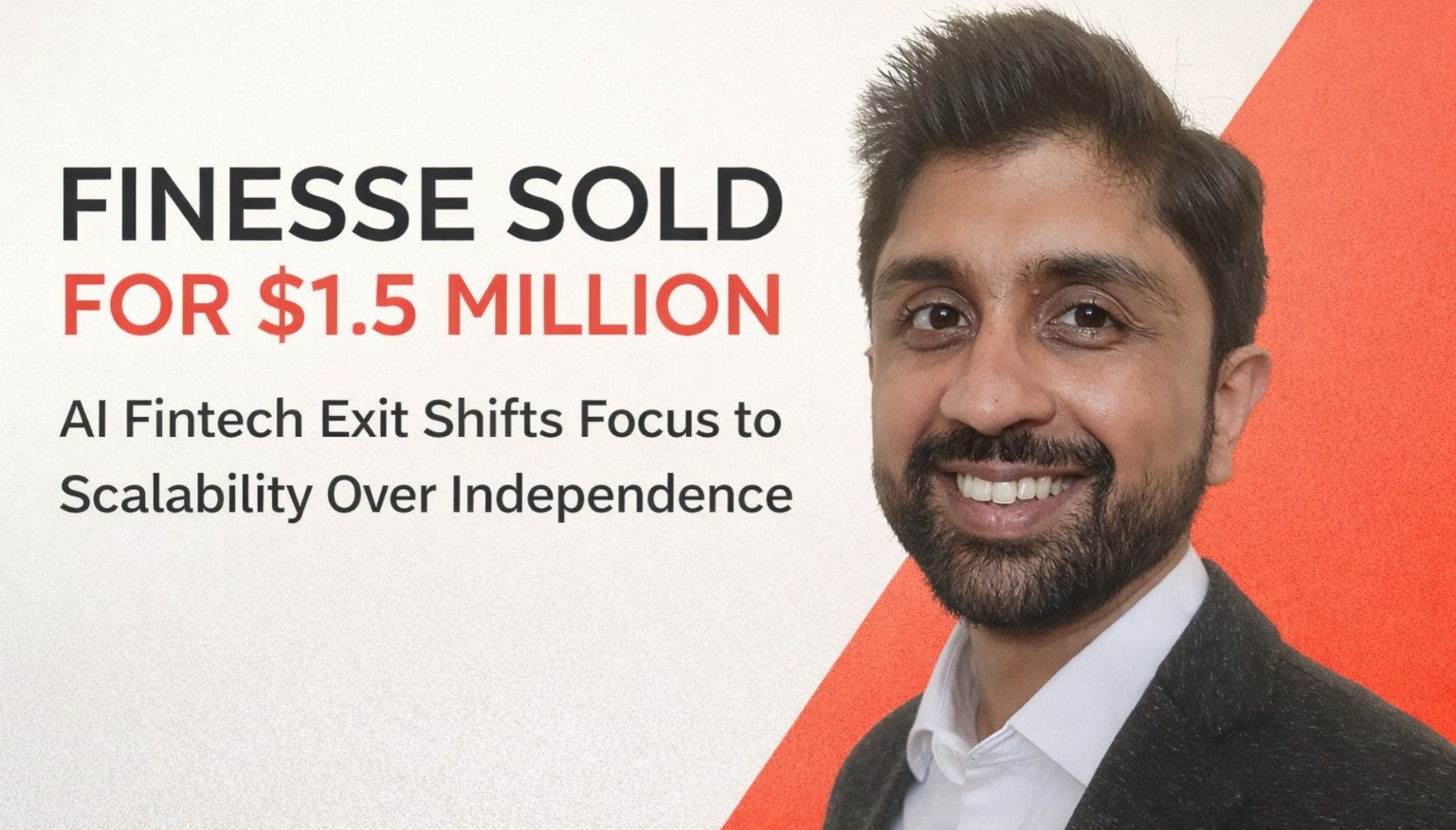
That is the story of Finesse, an AI-led fintech startup that has now been sold for about $1.5 million to a consortium of strategic investors, according to founder and chief executive Rohit Rao. The transaction includes both cash and stock, a structure that Rao said also gives liquidity to early investors.
Founded in 2022, Finesse built its offering around an AI engine designed to deliver hyper-personalised user experiences. The platform, as described in the source material, uses behavioural and transactional data to improve engagement, conversion and long-term customer value.
But for Rao, the sale appears to have been less about stepping away and more about stepping up.
“We sold Finesse because we wanted to achieve a certain amount of scale and that could come by leveraging the distribution muscle of a larger player,” he said. He added that Finesse’s assets under management had reached about $5-6 million on its own, but with the backing of the new owners, that figure could potentially rise to $50-60 million over the next 12 months.
That single remark says a lot about where many specialised fintech startups are today. Building the technology is one battle. Getting it into enough hands, and doing so fast enough, is another. In that sense, the Finesse sale looks less like a quiet exit and more like a strategic handover from product-building mode to distribution-led expansion.
Rao did not disclose the identity of the acquirer. What he did share is that the buyer is a consortium of fintech and financial services executives who are building what he described as a roll-up company in the AI financial services space. The group is expected to emerge from stealth by the end of the year or thereabouts.
The company’s client list, as cited in the source, included Bengaluru-based Bloomtree Advisors and CA firm BCL, among others. While the available information does not disclose revenue, profitability or headcount, it does show that Finesse had already found institutional users for its product before the transaction.
That gives the sale a more grounded tone than many early-stage startup stories. This was not a company selling only a promise. It had a live product, named clients, a stated AUM base and a founder willing to openly admit the central challenge: independence can take a startup only so far when distribution becomes the real moat.
There is also something notable about the price tag. At $1.5 million, this is not the kind of acquisition that reshapes the startup market overnight. But it is the kind that reflects the current environment more honestly.
Investors and acquirers are increasingly rewarding strategic fit, usable technology and growth pathways over hype alone. For founders, that often means the question is no longer just, “Can we build this?” but, “Can we scale this faster by joining forces?”
Finesse’s journey, at least from the facts available, fits that shift neatly.
Its core proposition was clear: use AI to make fintech experiences more personalised and therefore more effective. Its founder’s reasoning for the sale was equally clear: scale required stronger distribution. The buyer’s profile points to a bigger ambition in AI-led financial services. And the structure of the deal, combining cash and stock, suggests an exit that was designed not only to close a chapter, but also to keep stakeholders tied to what may come next.
For a startup founded in 2022, that is a quick arc, but not an unusual one in a market where speed matters and consolidation is becoming part of the playbook. Finesse may have started out as a standalone AI fintech engine, but its next phase will now unfold inside a larger financial services buildout.
And that may be the bigger takeaway here: in fintech, a good product can open the door, but scale still decides how far a company goes.
Also Read: Greenvize Launches Hydrogen Cooktop That Runs on Water