

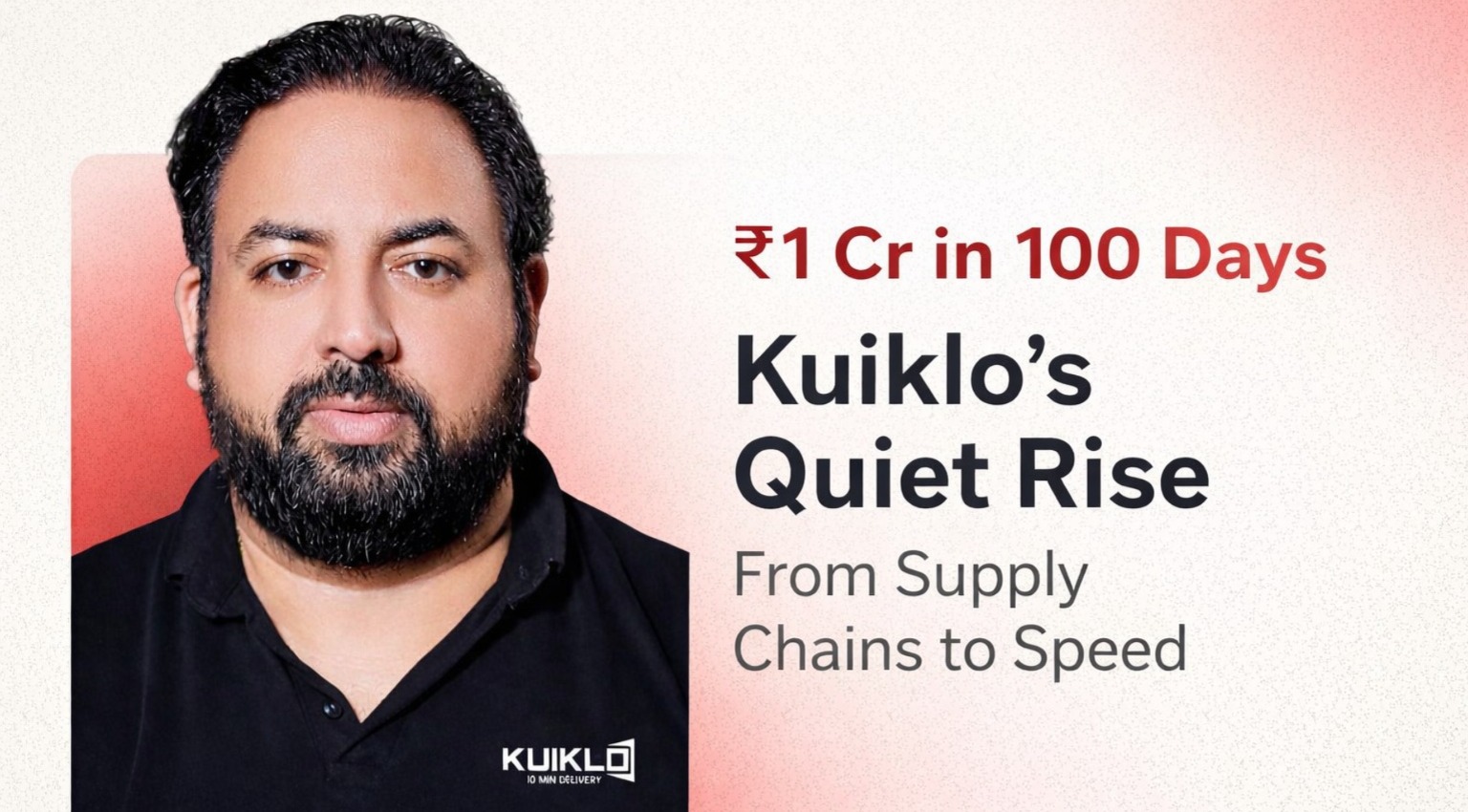
In India’s quick-commerce market, most stories begin with delivery speed. This one begins much earlier, inside factory systems, supply chains, and years of observation. Kolkata-based quick-commerce startup Kuiklo, founded by entrepreneur Shyam Gupta, has reported ₹1 crore in sales within 100 days of launch. The milestone stands out not only because of the number, but because of the route that led to it. Before launching the business, Gupta had spent nearly a decade studying supply chains in China, including an analysis of 2,000 factories, before stepping into one of India’s most crowded consumer categories.
That background gives Kuiklo’s story a different weight.
The Indian quick commerce industry is not untouched by the presence of giants like Blinkit, Zepto, and Instamart that have made urban customers accustomed to getting their grocery and essential needs delivered within just 10 minutes. The concept of regular grocery store shopping for the week ahead has slowly lost its charm to instant purchases using apps.
But despite everything that it offers, it is a sector that thrives under some tough business environment. Fast commerce in India is a sector full of competition because of the investments made, discounting done, rapid growth of dark stores, and constant promotion being done.
That is where Kuiklo’s founding story becomes more interesting than a standard startup-growth headline.
Rather than entering the market on momentum alone, Gupta appears to have come into quick commerce with a long exposure to the mechanics behind movement of goods. In a sector where the customer sees only the final 10-minute promise, the real business is often hidden in inventory logic, fulfilment systems, sourcing discipline and supply-chain coordination. Delivery speed may be the visible product, but operational precision is what holds the model together.
Kuiklo’s early sales performance suggests that preparation may have translated into traction.
Crossing ₹1 crore in sales in the first 100 days does not, by itself, define the future of a startup. But in a category as contested as quick commerce, it does indicate that the company has managed to secure early consumer acceptance in a market where attention is fragmented and loyalty is hard-won. For a Kolkata-based player competing in a space dominated by larger and better-known brands, that early momentum is significant.
There is also a larger signal here for India’s startup landscape.
Startup narratives are often dominated by metro cities, high-profile funding rounds and valuation-led conversation. But businesses do not always emerge from the loudest ecosystems.
Sometimes they come from founders who spend years understanding how industries work before they attempt to build within them. Kuiklo adds to a growing set of stories that show regional entrepreneurship can create meaningful traction even in sectors that appear saturated from the outside.
Kolkata’s presence in this story matters. The city does not usually command the same startup attention as Bengaluru, Mumbai or Delhi, especially in fast-moving consumer-tech segments. A quick-commerce venture gaining early revenue traction from Kolkata challenges that imbalance.
It suggests that execution, local relevance and operational discipline can still create room in markets that look closed off by scale.
What makes this venture worth watching is not just its speed promise, but its founding logic.
Quick commerce has already moved beyond novelty in India. Consumers understand the model. What matters now is which companies can translate convenience into consistency. In that context, a founder shaped by years of supply-chain observation brings a different kind of credibility to the table, one rooted less in trend-following and more in systems thinking.
That may be Kuiklo’s real differentiator.
The story is not simply about a startup entering a booming market. It is about a founder who seems to have understood that in quick commerce, the last mile gets the attention, but the deeper advantage often comes from everything built before that mile begins.
For now, Kuiklo’s first 100 days offer an early snapshot of that possibility: a Kolkata startup, a founder with years of supply-chain exposure, and a revenue milestone that places the company on the map in one of India’s toughest consumer battlegrounds.
Whether that momentum scales into a durable business will depend on how the company navigates competition, customer retention and the unforgiving economics of fast delivery. But its opening chapter has already done enough to stand apart.
Not because it promises speed. Because it appears to have been built on study before speed.
Also Read: Meta Pauses Work With AI Startup Mercor After Data Breach















