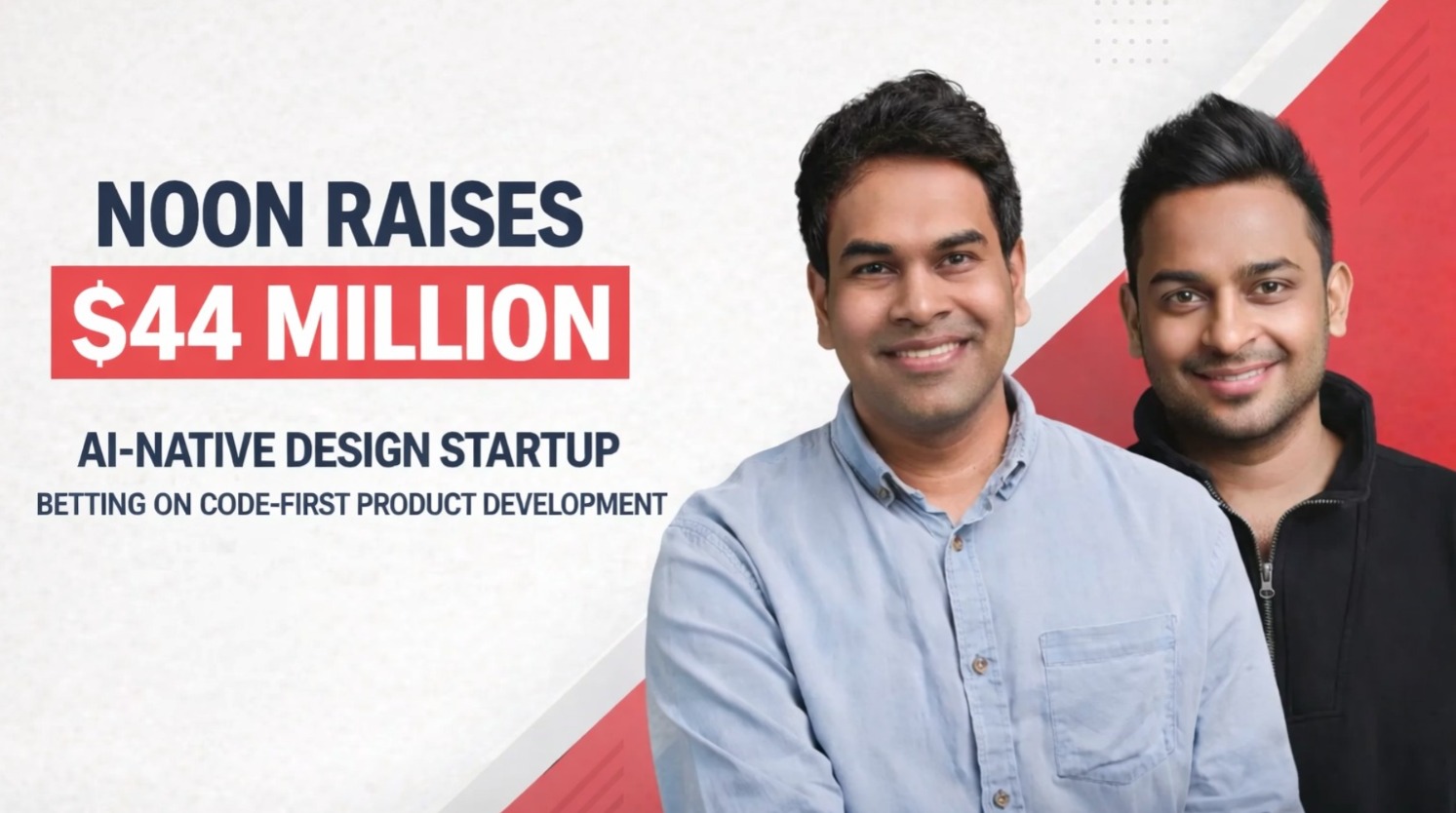
In a funding announcement that reflects how quickly the software world is changing, San Francisco-based startup Noon has raised $44 million from investors including Chemistry, First Round Capital, Scribble Ventures, Elevation Capital and Afore Capital.
The company is emerging from stealth at a time when artificial intelligence is pushing product teams to rethink not just how software is built, but how it is designed in the first place.
Noon is positioning itself in a space that has become increasingly important as AI tools speed up software development. Its pitch is straightforward but ambitious: design should not remain a separate, static exercise that gets handed off to engineers later.
Instead, Noon wants designers to work directly with functional components that behave like actual software. The platform integrates with a company’s codebase and is built to reduce the gap between design and engineering.
That framing matters. For years, product design has largely relied on tools rooted in graphic design logic, beautiful screens, polished mockups and presentation-ready workflows. Noon’s founders are arguing that this model is starting to show its age, especially in an era when products can be built and iterated faster than ever.
Co-founder and co-CEO Aditya Bandi captured that shift bluntly, saying that for decades product design borrowed the tools of graphic design, while Noon believes “the thing you design should be the thing that ships.”
The company says the fresh capital will be used in three clear directions: expanding access to its platform, investing in product development, and scaling its team globally.
That signals a growth phase, not just a proof-of-concept moment. Noon is no longer merely describing a future of code-native design; it is trying to build the team and product footprint needed to compete for it.
The investor list also suggests that Noon’s story is resonating beyond traditional venture firms. Alongside institutional backers, the round included participation from design and product leaders associated with companies such as Stripe, OpenAI, Microsoft AI, Apple, Meta and Shopify.
Noon was founded by Aditya Bandi and Kushagra Sinha, both described as second-time entrepreneurs. The report says they have had prior exits to Yahoo and Whatfix, respectively. The company operates out of the United States, has a presence in Bengaluru, and has assembled talent from firms including Google, Uber, Slack and PhonePe.
Sinha’s remarks in the report add another layer to Noon’s pitch. He warned that AI could make products feel “generic” if design does not evolve alongside development. That argument goes to the heart of a growing debate in the tech industry.
AI can help teams move faster, write more code and automate more routine tasks, but speed alone does not guarantee distinct products. Noon appears to be betting that design will become even more important as AI lowers the cost of building.
What makes Noon’s emergence worth watching is that it is not merely selling another productivity layer to software teams. It is challenging a long-standing workflow.
In many companies, design and engineering still operate like neighboring departments speaking slightly different languages. Noon’s model suggests those boundaries are becoming less useful, especially as AI compresses timelines and raises expectations around rapid iteration.
For investors, that thesis is evidently compelling enough to back with serious capital. For the broader startup ecosystem, the funding round is another sign that AI’s influence is now reshaping not only coding tools, but the design stack around them as well. Noon’s wager is that the next generation of product teams will not want to design software as a picture of what could be built. They will want to design it as something already alive.
Also Read: What Was Harshad Mehta Worth at the Height of His Rise?