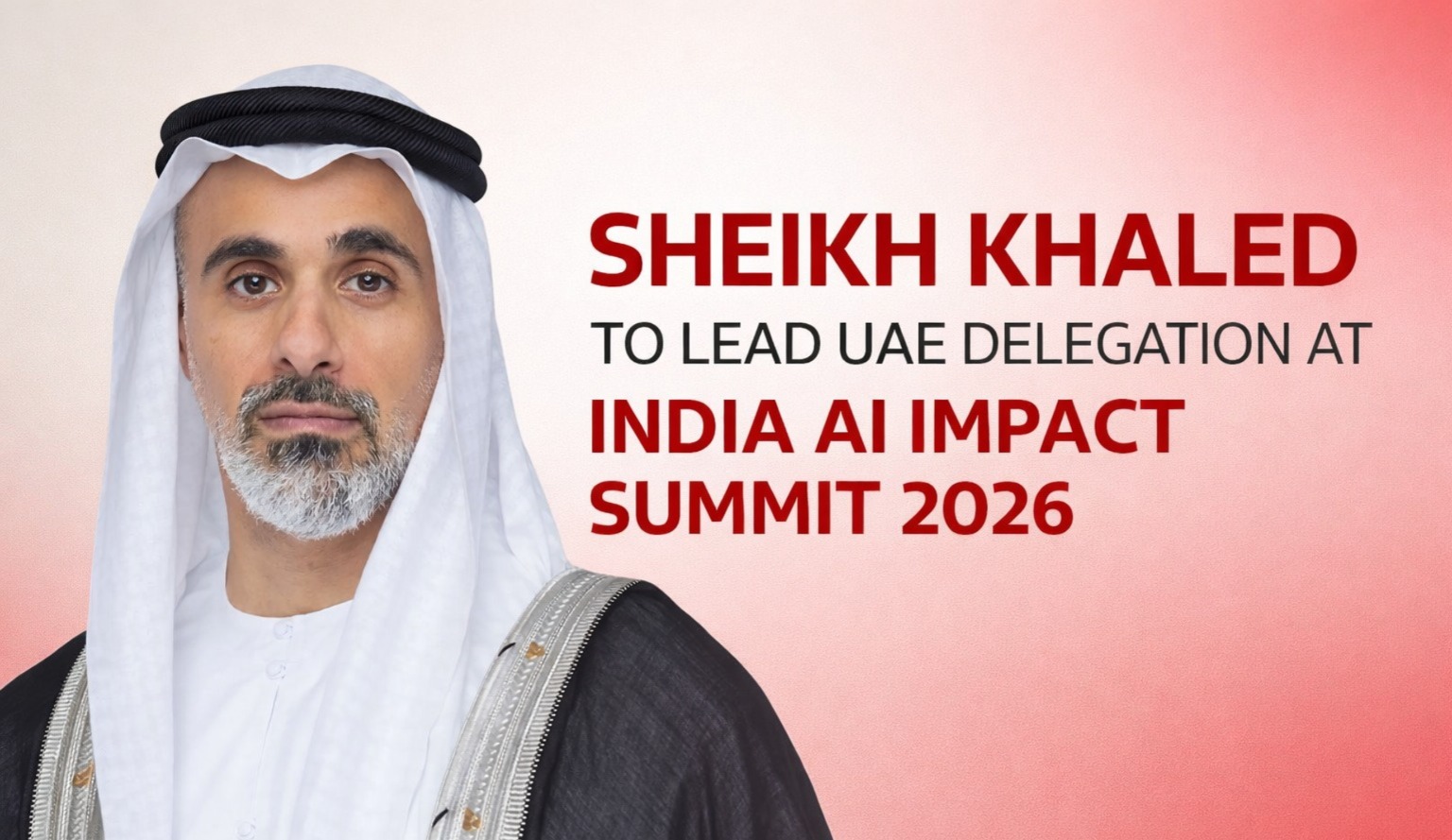
New Delhi: H.H. Sheikh Khaled bin Mohamed bin Zayed Al Nahyan, the Crown Prince of Abu Dhabi, will lead the UAE delegation to the India AI Impact Summit in New Delhi from February 16 to 20, 2026, representing President Sheikh Mohamed bin Zayed Al Nahyan.
The summit is expected to bring together heads of state, government leaders, policymakers and technical experts from more than 100 countries, with the agenda centred on how nations regulate and deploy artificial intelligence at scale, without losing sight of public accountability, cross-border alignment, and sustainable development goals.
What the UAE says it wants from India AI Impact summit?
UAE’s participation is aimed at deepening cooperation in advanced technologies and expanding partnerships that support the use of AI for sustainable development and sector-wide innovation.
That framing matters because global AI conversations are increasingly moving beyond “cool tools” to harder questions: who sets the rules, who audits outcomes, and how public institutions and private companies share responsibility when AI systems impact people’s lives. The India summit’s format appears designed around that pivot, policy, governance, and real-world deployment.
A big focus: AI governance and public-private cooperation
High-level dialogue sessions at the India AI Impact Summit will focus on shaping global frameworks for AI governance. Participants are expected to discuss future priorities for AI and explore ways to strengthen public-private cooperation in developing AI solutions linked to the Sustainable Development Goals (SDGs).
In practical terms, that typically translates into issues governments everywhere are wrestling with: how to regulate fast-moving models, how to make safety and transparency measurable, and how to prevent AI benefits from pooling only in a few sectors or geographies. The summit is also set to include panel discussions and expert-led sessions on technological shifts and practical applications of AI and emerging technologies.
Exhibition alongside the summit: 300+ companies, 30 countries
Running in parallel will be an exhibition featuring more than 300 international companies from 30 countries presenting developments in artificial intelligence.
For industry watchers, this is usually where the summit’s big themes, governance, cooperation, sustainability, get translated into demonstrations: tools, platforms, and deployment models pitched as “ready now” for governments and enterprises.
With Sheikh Khaled leading the delegation, the UAE’s presence at these events indicates that the country is taking these international AI meetings not as business as usual, but as platforms for partnership-building and rule-making discussions that are increasingly entwined with technology and investment.
It is not what happens at the meetings in New Delhi that will be more important for the headlines, but what happens next among countries in terms of how they coordinate on AI governance, how they can get companies into the conversation on compliance, and how they can ensure that the benefits of AI are linked to public outcomes.
Also Read: Journalist Ravi Nair convicted in Adani criminal defamation case