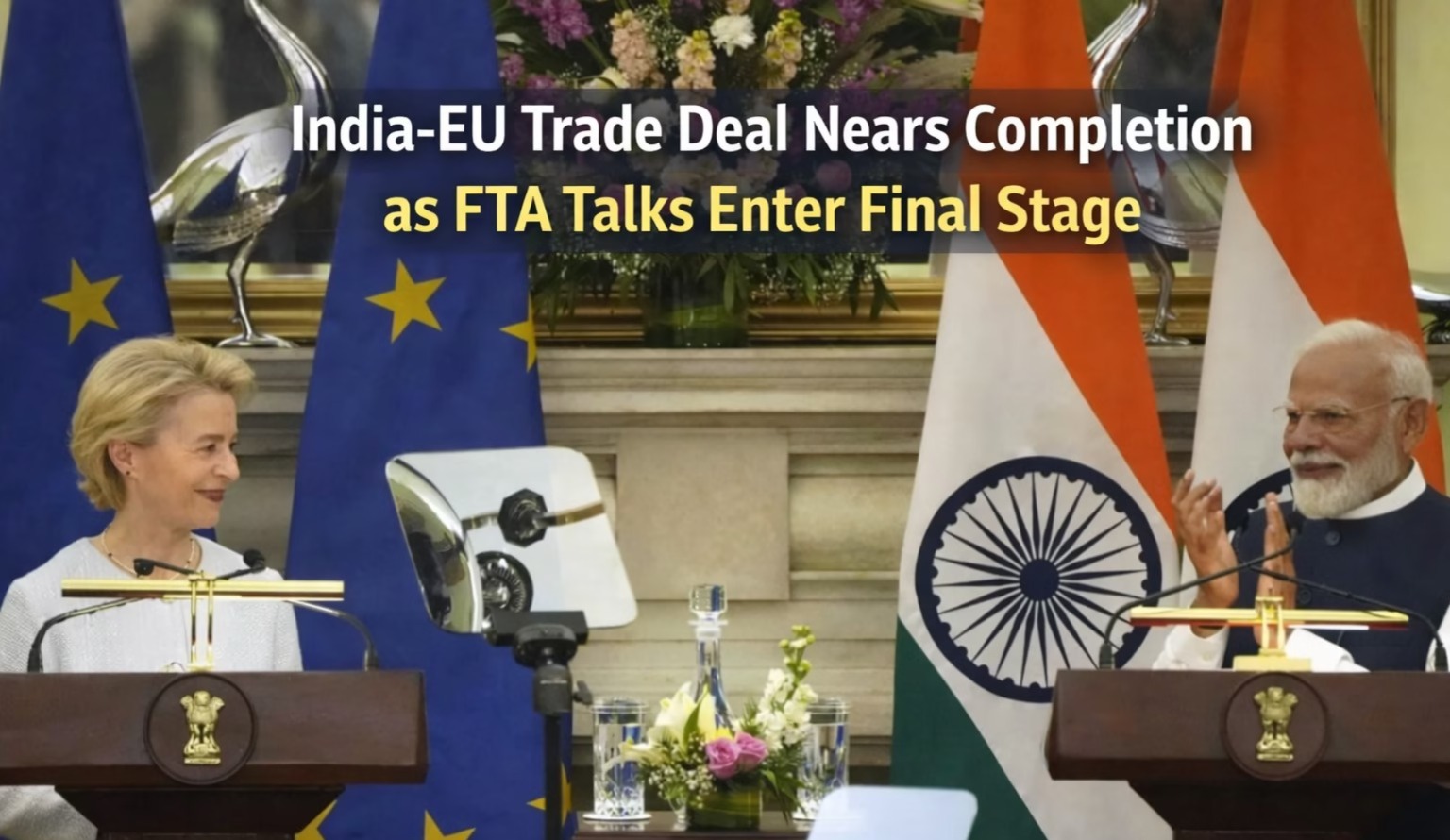
The India-EU trade deal nears completion after negotiators from India and the European Union finalized 20 of the 24 chapters of a long-pending Free Trade Agreement (FTA), significantly narrowing differences and raising expectations of a political breakthrough ahead of the upcoming leaders’ summit later this month.
Officials familiar with the talks said negotiations have moved into the final stretch, with both sides focusing on resolving a small number of politically sensitive chapters. If concluded, the agreement would mark one of the most comprehensive trade pacts negotiated by India and the European Union in recent years.
Long-Delayed Talks Gain Momentum
Negotiations on the India-EU FTA were launched in 2007 but stalled for several years due to disagreements over tariffs, intellectual property rights, data protection, and regulatory standards. Talks were formally revived in 2022 amid shifting global trade patterns and growing emphasis on supply chain resilience.
The fact that the India-EU trade deal nears completion now reflects sustained political engagement and a convergence of strategic interests. According to officials, chapters covering trade in goods and services, customs facilitation, investment cooperation, and technical barriers have already been agreed upon.
The remaining chapters reportedly involve government procurement, dispute settlement, intellectual property, and sustainability-related provisions, areas that have traditionally been contentious.
Economic Stakes for Both Sides
The European Union is India’s largest trading partner, accounting for more than $120 billion in annual bilateral trade in goods and services. A comprehensive trade agreement is expected to reduce tariffs, ease regulatory barriers, and improve market access for businesses on both sides.
For India, the agreement could boost exports of textiles, pharmaceuticals, engineering goods, and IT services to Europe. Indian negotiators have consistently pushed for better access for service professionals and lower duties on labor-intensive products.
For the EU, the deal offers deeper access to India’s rapidly expanding market, particularly for automobiles, machinery, clean-energy equipment, and high-value manufactured goods.
Trade analysts say the fact that the India-EU trade deal nears completion signals growing alignment on economic priorities at a time of global uncertainty.
Political Significance Ahead of Summit
The timing of the progress is politically significant. With a high-level India-EU summit scheduled later this month, both sides are under pressure to demonstrate concrete outcomes. Officials say political guidance at the leadership level could help resolve the remaining issues.
Beyond economics, the agreement is also seen as strengthening a broader strategic partnership. Both India and the EU are seeking to diversify trade ties, reduce dependence on a limited set of markets, and reinforce rules-based trade amid geopolitical tensions.
Final Hurdles Remain
Despite the progress, negotiators caution that the final phase will be challenging. Differences remain over sustainability commitments, carbon-related trade measures, and data governance. India has expressed concerns about climate-linked trade restrictions, while the EU continues to push for higher environmental and labor standards.
Trade experts note that while the India-EU trade deal nears completion, success will depend on how flexibly both sides handle these final issues without undermining domestic interests.
Outlook
India-EU Free Trade Agreement Once the deal goes through, it will be a great step forward in the Indian trade policy and the European Union’s economic interests in one of the biggest growing economies of the world. It is anticipated that the agreement will offer a platform of enhanced trade integration, market entry, and more regulatory collaboration in a vast gamut of industries.
Negotiators on both sides are putting their heads under more pressure to seal the negotiations, as only four chapters are yet to be resolved. The upcoming leaders summit has ensured there is an urgency because the highest level of political support might serve to iron out the remaining differences on delicate matters like sustainability standards, dispute settlement, and government procurement. The last phase of negotiations is not always the simplest, however, warn officials, and no official schedule has been established.
The recent rate of development notwithstanding, the optimism among policymakers and businesses has been high that a breakthrough can be achieved. On the one hand, the agreement would improve the inflows of investments in the country and the supply-chain connections and strengthen the economic ties between India and the European Union in the long term. The most recent news reveals that the much hoped-after trade agreement between the two parties is the nearest it has ever been since the process started.
Also Read: Rekha Gupta Net Worth: Know How Rich the Delhi BJP CM Is