An 18-month-old voice AI startup called Beside is betting that the next great productivity tool for small businesses is not another inbox or chatbot, but a tireless digital receptionist that lives on the phone line and never misses a call.
The company, which only stepped out of stealth earlier this month, has raised a total of $32 million to scale what it describes as an “AI receptionist” for people and small businesses that can’t afford a full-time assistant.
Beside: A phone assistant that behaves like a chief of staff
Beside’s product connects directly to a customer’s existing phone number through an app. Once set up, the AI receptionist answers incoming calls, remembers customer details, books appointments, and handles follow-ups, essentially behaving like a human assistant sitting at the front desk.
Founder and CEO Maxime Germain, who is based in Paris, pitches it in unusually personal terms: hiring Beside, he says, is like bringing on a “Harvard-grad Chief of Staff with a perfect memory.” Over time, the system is designed to learn a business’s customers, own the follow-through on tasks, and “help you win more business,” he told Fortune.
The core idea is simple: capture every call, remember every detail, and make sure no prospective customer falls through the cracks because someone was in a meeting, on a job site, or simply away from their phone.
Inside the $32 million funding stack
Beside’s latest financing is built around a recently closed $20 million Series A round led by EQT Ventures, with participation from Index Ventures and several angel investors, including Slack founder Stewart Butterfield. That follows a $10.5 million seed round led by Index and an additional $1.4 million raised via SAFE notes, taking its total funding to roughly $32 million.
The company, currently operating in the United States, plans to use the fresh capital for product development, hiring, and an eventual expansion into European markets.
EQT Ventures partner Kaushik Subramanian frames the bet in broader terms, arguing that Beside is not just smoothing communication between businesses and customers but “completely rethinking how work gets done.”
From stealth mode to millions of calls a month
Before its public launch, Beside spent 18 months operating in stealth under the internal name M1. During that period, it quietly built a substantial business:
- $4 million in annual recurring revenue (ARR)
- More than 20,000 paying customers
- Half of those users opening the app 14 times a day, six days a week
These are unusually engaged usage patterns for a business tool, suggesting that for many customers, the AI receptionist is not a side utility but has already become part of daily workflow.
Beside’s system is currently handling millions of calls per month, according to the company, underscoring the scale of its telephony infrastructure as well as demand from small businesses willing to let AI answer the phone on their behalf.
A consumer-style bet in a B2B market
Where many AI infrastructure companies are aiming at large enterprises, Beside has made a deliberate choice to go directly to individual professionals and small businesses. Germain argues that this “consumer-like” approach is what sets Beside apart in a crowded voice AI field.
The founding team comes from companies with deep consumer and product DNA, X (formerly Twitter), Snap, and Jour, a mental health app Germain previously sold to digital health insurer Alan in 2021.
Rather than focusing on call centers of big corporations, Beside is zeroing in on the roughly 100 million Americans whose jobs happen primarily over the phone, among them contractors, real estate agents, hairdressers, dispatchers, and owner-driven small businesses that often lose business simply because no one is free to pick up the phone.
The company says its customer base already stretches across sectors: lawyers, doctors, priests, churches, and other service-driven organizations are using the product. What links them, Germain suggests, is not industry but mindset, a focus on high-touch service where the “detail of the conversation” with a customer really matters.
The problem: missed calls, missed revenue
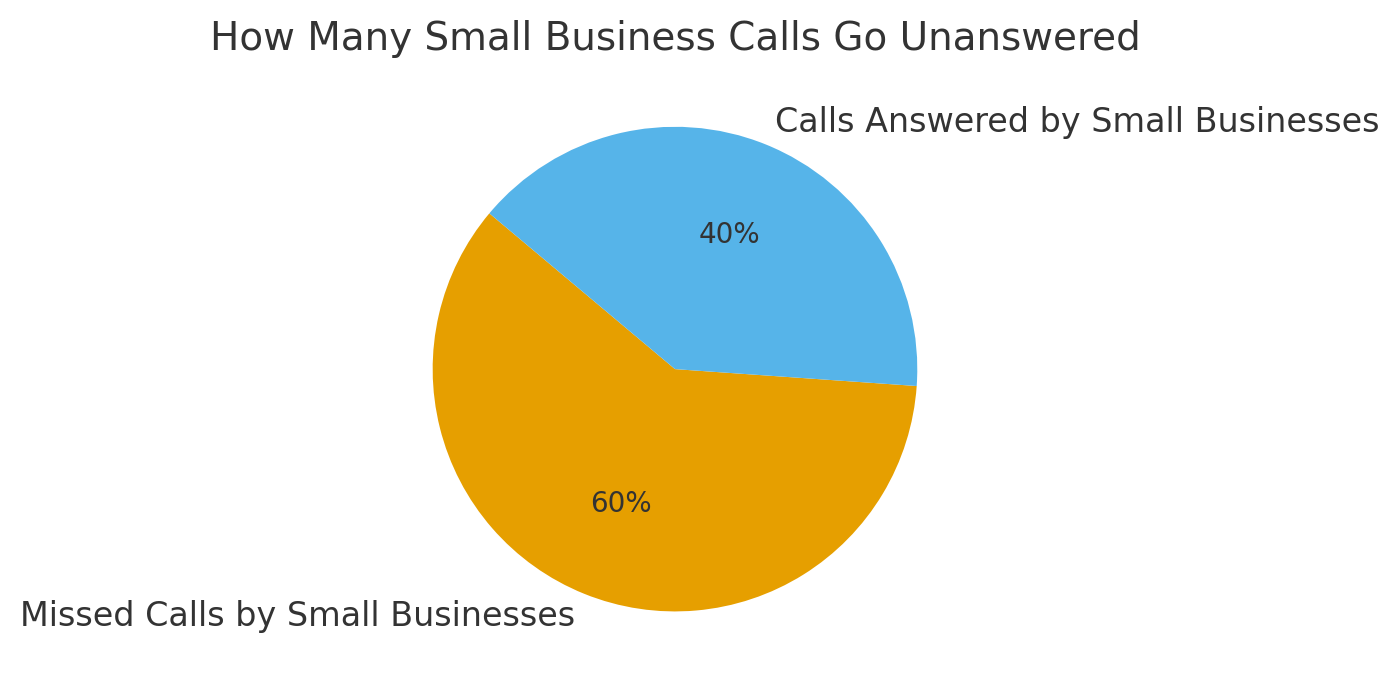
Beside’s pitch leans heavily on a simple behavioral reality: many small businesses just don’t answer the phone often enough.
Research cited in the article notes that in the U.K., most small businesses answer fewer than 40% of their incoming calls, and four out of five callers who hit voicemail never call back.
For a solo contractor or a small clinic, that can add up to significant lost revenue and poor customer experience. Beside’s AI receptionist is positioned as a direct response to this gap, picking up every call, capturing intent, scheduling, and reconnecting with the customer even when the human owner can’t be present.
A booming, crowded voice AI arena
Beside is entering a market that is expanding quickly and already packed with both specialist startups and tech giants. The voice AI market is projected to grow from $3.14 billion in 2024 to $47.5 billion by 2034, reflecting expectations that a large share of customer service interactions will be automated over the next decade.
On the startup side, companies like ElevenLabs and Vapi are building sophisticated voice systems that can handle routine questions and appointment scheduling, while Amazon and Microsoft are integrating voice automation more deeply into their cloud and communications stacks.
Many businesses already use chatbots for written queries on websites and apps. Voice AI, however, is seen as the next step, enabling natural, spoken conversations that could replace large portions of call-center work and frontline phone reception.
In that context, Beside’s decision to focus tightly on small operators, rather than selling tools to large enterprises, marks a strategic gamble that the most painful problems, and the fastest adoption, may be at the very bottom of the business pyramid.
Rebuilding the phone system from scratch
Under the hood, Beside is not simply plugging into existing phone systems. The startup chose the harder route of rebuilding telephony infrastructure from the ground up, rather than layering AI over legacy systems.
Today, the company manages number provisioning, regulatory compliance, call forwarding, and number porting itself, alongside the AI stack that actually speaks to customers.
According to Germain, delivering high-quality AI calls “anywhere, in a truck, on a job site, across a busy city” requires deep technical work, especially to navigate the complex regulatory and carrier ecosystem in the U.S. He calls this a “blueprint” the company hopes to replicate globally as it expands.
In the long term, Beside’s ambition is to become a full mobile carrier with SIM-level integration, folding its AI receptionist directly into the communications layer rather than treating it as an add-on.
For small businesses, the message is blunt: the kind of always-on, context-aware phone support once associated with corporate call centers is being rebuilt for solo operators, clinics, and local service providers.
For the AI ecosystem, Beside is another sign that the next phase of competition may be less about who has the flashiest demos and more about who quietly owns the workflows where work actually happens, whether that’s in a browser tab or on the other end of a ringing phone.
Also Read: London startup SAGES raises £190,000 to turn food waste into sustainable dyes