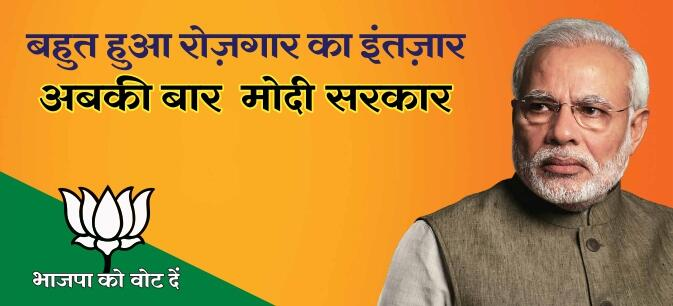
In the history of Indian political advertising, few lines have etched themselves as deeply in public memory as “Abki Baar, Modi Sarkar.” For years, the media and popular belief credited the slogan to legendary adman Piyush Pandey, whose association with several BJP campaigns made the claim believable. But the truth, as it turns out, is different and it comes straight from inside the 2014 BJP campaign war room.
The story of how the line came to life is a study in persistence and teamwork rather than a single stroke of genius.
The Struggle to Find the Right Words
The BJP’s creative team faced a monumental challenge: to distill the spirit of change, leadership, and hope into a few unforgettable words. “Sifting through hundreds of permutations,” Nisheeth Sharan recalls, “we were trying to capture what BJP wanted to say to India, simple, punchy, and rally-ready.”
For nearly two weeks, slogan after slogan failed to clear the committee. Either the lines lacked emotional appeal or felt too verbose to echo across rally grounds. The campaign room, led by Ajay Singh, promoter of SpiceJet and coordinator of the committee, was running out of patience.
That’s when Singh reminded the team of an old campaign line from the Atal Bihari Vajpayee era: “Abki Bari, Atal Bihari.” The brilliance of that slogan lay in its simplicity, conversational, rhythmic, and catchy enough for the masses. It sparked a new direction for the 2014 team.
From “Is Baar BJP Sarkar” to “Abki Baar Modi Sarkar”
Inside the war room sat a small circle of creative minds, Nisheeth Sharan, Banu Nagarajan and Debojo Maharshi. Their first attempt was “Is Baar, BJP Sarkar.” It carried the right rhythm but lacked the personality that had come to define the campaign.
Internal data showed something remarkable, Narendra Modi’s personal popularity was running nearly 20% ahead of the BJP’s brand appeal nationwide. That finding shifted the focus. The team decided to bring Modi’s name into the slogan, tweaking it to “Is Baar, Modi Sarkar.”
It had the right sound, but still felt like a personal pledge rather than a national call.
At this juncture, Prasoon Joshi, the acclaimed lyricist and adman who was contributing in his personal capacity, suggested an alternative: “Desh ki Pukar, Modi Sarkar.”
The committee liked the poetic cadence, but when the line reached Narendra Modi for final approval, he offered a subtle yet decisive critique, the phrase “Desh ki Pukar” (the nation’s call) felt “presumptuous.” The team returned to the drawing board one last time.
That’s when consensus settled on “Abki Baar, Modi Sarkar.” The line resonated instantly. It carried the simplicity of everyday speech, the rhythm of a chant, and the emotional pull of leadership. The approval came swiftly, from Modi himself and from every level of the campaign team.
The Creative Collective Behind a Historic Line
Though the slogan is often attributed in popular memory to the BJP’s communication team as a whole, the Utopia Consulting account offers rare insight into the collaborative process that birthed it.
The credit, as Sharan’s recollection suggests, belongs collectively to the campaign team led by Ajay Singh, with contributions from Nisheeth Sharan, Banu Nagarajan, Debojo Maharshi and Prasoon Joshi.
It was a perfect confluence of political instinct, advertising craft, and timing, a slogan that captured the national mood for change and turned into a cultural refrain.
A Line That Defined an Era
“Abki Baar, Modi Sarkar” went on to dominate billboards, television spots, and loudspeakers across the country. It became not just a slogan but a declaration, echoing in urban streets and rural gatherings alike. The line’s conversational Hindi, its sing-song rhythm, and its alignment with Modi’s persona turned it into one of India’s most powerful political messages.
Even a decade later, it remains shorthand for the 2014 wave that transformed Indian politics, a line born in a cramped campaign room, refined through debate and data, and immortalized by the voice of a nation ready for change.
Also Read: Statiq Accelerates EV Push with $15-18 Million Funding Round