The Archia Story: The Kansas City startup believes the future of artificial intelligence will not be decided by who builds the smartest model, but by who makes AI safe enough for ordinary companies to actually use
The artificial intelligence race has largely been dominated by giant technology companies, billion-dollar funding rounds, and increasingly powerful models competing for attention. But away from Silicon Valley’s noise, a quieter struggle is unfolding inside mid-sized companies across America.
Many of them want AI.
Very few know how to safely deploy it.
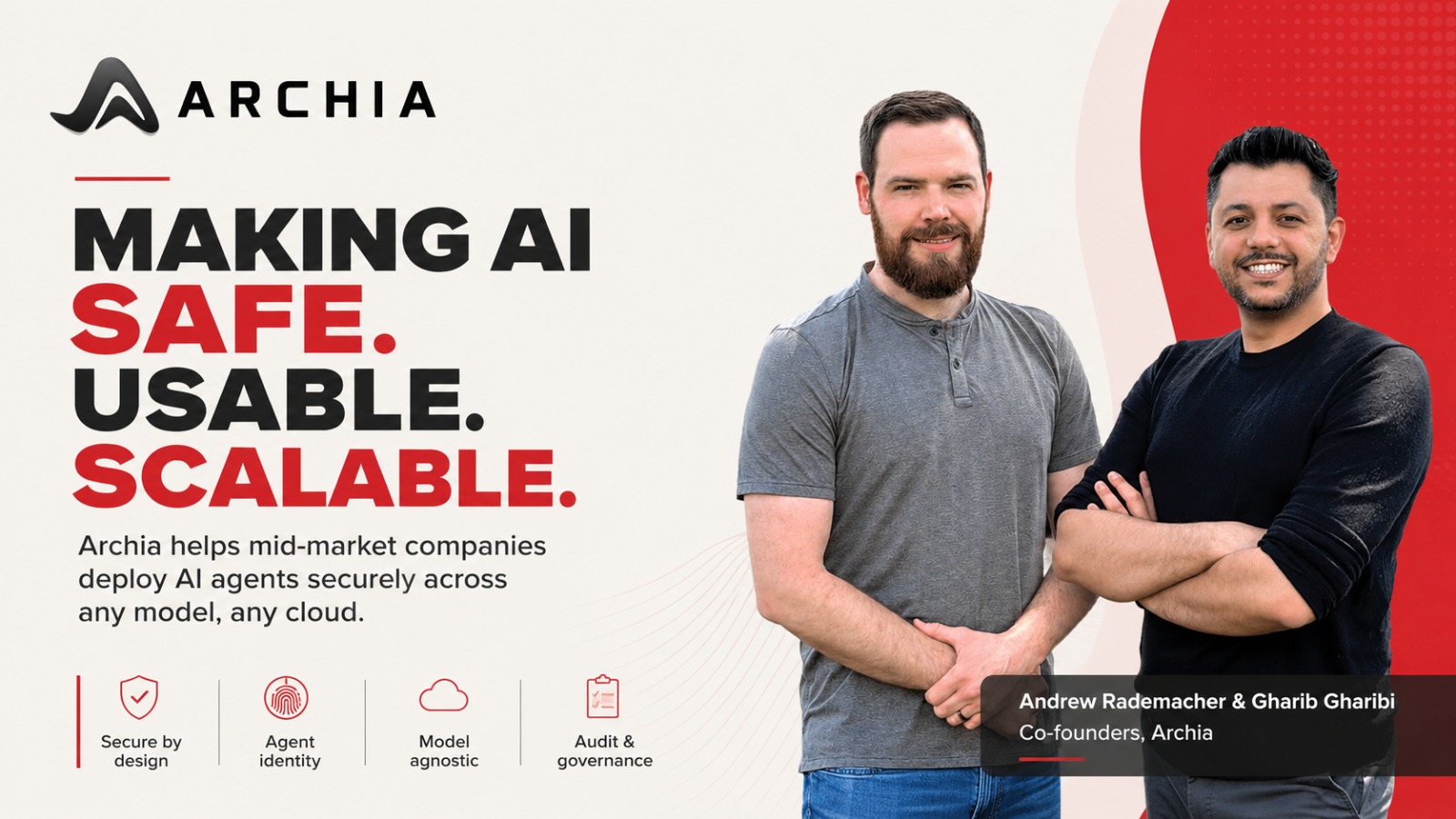
That reality is what led Gharib Gharibi and Andrew Rademacher to launch Archia, an Overland Park-based startup focused on helping businesses adopt AI agents without exposing themselves to operational, security, or governance risks.
At a time when companies are being told that AI will transform productivity, customer service, operations, and decision-making, Archia is betting that the real opportunity lies not in building another flashy chatbot, but in solving the messy, unglamorous infrastructure problem underneath AI adoption itself.
And for the founders, that problem is far bigger than most people realise.
The Companies AI Forgot
The AI economy today is heavily tilted toward two extremes.
On one side are global corporations with massive budgets, dedicated AI teams, and direct partnerships with hyperscalers. On the other are startups rapidly experimenting with AI-first products.
Between them sits the mid-market.
These are manufacturing firms, healthcare operators, financial businesses, and regional enterprises that often generate significant revenue but lack deep AI expertise internally. According to Archia’s founders, these companies are increasingly being left behind because they cannot easily hire AI talent or navigate the technical complexity of deploying AI systems securely.
For many businesses, creating a proof-of-concept AI demo is no longer the hard part. Modern coding tools and APIs have lowered that barrier dramatically.
The real challenge begins after the demo works.
How do companies track what an AI agent is doing?
How do they audit decisions?
How do they ensure privacy protections remain intact?
How do they avoid becoming dependent on a single AI provider?
Those questions become even more critical in regulated sectors where mistakes are expensive and compliance is non-negotiable.
That is where Archia sees its opening.
Archia: Building an “Operating System” for AI Agents
Rather than positioning itself as another AI application company, Archia is building what it describes as an agent runtime system.
In simpler terms, the startup wants to become the infrastructure layer that allows businesses to safely deploy and manage AI agents across multiple models and providers.
Its architecture separates AI agents from the application code around them, giving each agent a distinct identity. The practical result is that companies can trace actions, audit behaviour, and move agents between providers without rebuilding entire systems.
That flexibility matters in a rapidly evolving AI market where businesses fear vendor lock-in almost as much as they fear security failures.
An enterprise that builds heavily around one provider today could face pricing shifts, policy changes, or technological limitations tomorrow. Archia’s model attempts to reduce that dependency by making agents portable across ecosystems including OpenAI, Anthropic, Google, and Gemini-linked environments.
The startup has also prioritised governance and compliance from the beginning. Archia is HIPAA compliant and is currently under observation for SOC 2 Type II standards, a process important for companies operating in healthcare and financial sectors.
For businesses handling sensitive data, trust is becoming just as important as capability.
A Founder Shaped by Regulated AI Systems
Archia’s direction is deeply connected to Gharib Gharibi’s own professional experience.
Before launching the startup, he spent six years at Kansas City-based TripleBlind, where he worked on deploying AI systems in heavily regulated environments including hospitals and large banking institutions.
That experience exposed a recurring issue.
The technology itself was advancing quickly, but organisations struggled to move AI systems into production because deployment required extensive testing, governance structures, and safeguards around sensitive data.
When TripleBlind was later acquired, Gharibi saw an opportunity to focus entirely on solving that bottleneck.
Instead of building AI models, Archia would focus on making AI usable in the real world.
It is a less glamorous positioning in a market obsessed with model performance benchmarks and viral consumer products. But it may also prove more durable.
Because as AI adoption matures, companies are likely to care less about novelty and more about reliability.
Early Momentum Without the Silicon Valley Noise
Archia officially launched in July 2025 and released its business-to-business product by January 2026. Since then, the company has onboarded customers across healthcare, manufacturing, and sports technology.
The startup has also received backing from regional innovation initiatives including Digital Sandbox funding and support from the inaugural Digital Health KC Accelerate initiative.
One of the more revealing signals of traction came from customer usage itself.
According to the company, token processing volume increased sevenfold within three months, reflecting how quickly customers expanded their use of AI agents after deployment.
Archia is now looking to expand its customer base further and hire sales leadership as demand grows.
But unlike many AI startups chasing global visibility from day one, Archia’s strategy appears rooted in something more local and relationship-driven.
The founders believe many mid-market businesses still value proximity and trust. They want to know who is building the technology, where the company is based, and whether someone can physically walk into their office when problems arise.
In an industry often defined by abstraction and scale, that may become an underrated advantage.
The Bigger AI Story May Not Be About Models
For the past two years, the AI conversation has revolved around which company can build the most advanced system.
But another race is quietly taking shape beneath that layer.
Who will make AI operationally safe enough for ordinary businesses to depend on every day?
Who will manage governance?
Who will handle interoperability?
Who will ensure compliance standards evolve alongside deployment?
Who will help companies use AI without surrendering control?
Archia is attempting to answer those questions before the rest of the market fully recognises how important they are.
Because in the long run, the AI winners may not only be the companies building intelligence. They may also be the companies building trust.
Also Read: Vaibhav Suryavanshi’s Rise Is Bigger Than a Net-Worth Number