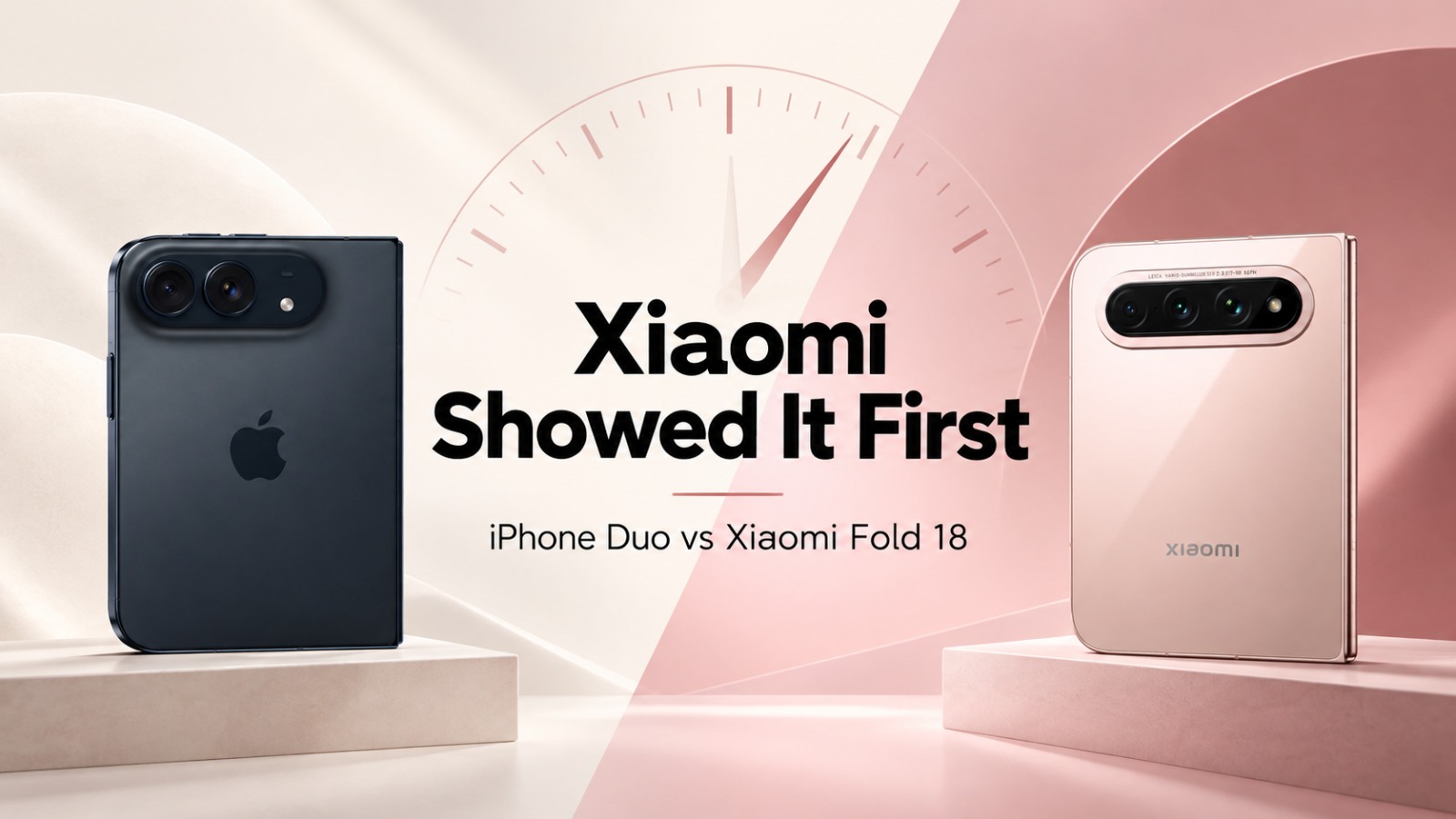
Xiaomi 18 Fold vs Apple Duo: Xiaomi showed its Xiaomi 18 Fold at a product event in China on September 7, 2026. Apple announced the iPhone Duo on September 9. When Xiaomi’s phone went on stage, Apple’s foldable had not been shown, yet its wide, rounded, passport-style body drew immediate comparisons to it. A line-by-line comparison shows the two are near-identical in format, screen size and thickness, and clearly different in cameras, battery, materials and hinge. Public reporting points to a leak chain, a rival with a long habit of following Apple, and a market where Apple is arriving late to a category that Samsung and Chinese brands have built.
Where the two phones line up?
Both are wide, book-style foldables that open into a larger inner screen. Gulf News described both as passport-style designs with comparable outer and inner screen sizes. Specifications below come from published comparisons rather than the manufacturers’ own pages.
| Feature | Xiaomi 18 Fold | iPhone Duo | How close |
|---|---|---|---|
| Format | Wide, passport-style book fold | Wide, passport-style book fold | Same |
| Inner display | 7.58 inches, AMOLED, 2364 x 1672 | 7.6 inches, OLED, 2670 x 1878 | Within 0.02 inch |
| Cover display | 5.38 inches, 1712 x 1168 | About 5.4 inches, 2034 x 1398 | Within about 0.02 inch |
| Refresh rate | 1-120Hz LTPO | 120Hz LTPO | Same ceiling |
| Unfolded thickness | 5.02mm | 5.2mm | Within 0.18mm |
| Folded thickness | 10.68mm | 11.3mm | Close |
| Memory and storage | Up to 16GB, 256GB base | 12GB, 256GB base | Base tiers overlap |
| Unlock | Side fingerprint sensor | Touch ID | Same approach |
| Selfie cameras | 16MP on both screens | Front and inner cameras | Same layout |
| Weight | 219g | 254g | Different |
| Battery | 6,000mAh | 5,400mAh | Different |
| Rear cameras | 200MP main, 50MP telephoto, 50MP ultrawide | 48MP main, 48MP ultrawide | Different |
| Frame | 7000-series aluminum alloy | Grade 5 titanium | Different |
| Hinge | Three-link “Dragon Bone” | Titanium, 100+ components | Different |
| Starting price | 10,999 yuan (about $1,640) | $1,999 | Different |
The ratios also line up. The published inner-screen resolutions work out to roughly 1.41:1 for Xiaomi and 1.42:1 for Apple, which is this article’s own arithmetic rather than a figure either company states. PC Guide’s comparison called the two inner screens “nearly identical,” and Techloy called the unfolded thicknesses near-identical. Gizmochina separately noted that both use 120Hz LTPO panels with HDR and Dolby Vision, and both support Wi-Fi 7.
Where they split?
The telephoto lens is the biggest functional difference. Xiaomi lists a 50MP periscope telephoto with 3.5x optical zoom and a 200MP Leica main sensor, per PetaPixel. The Duo has two 48MP rear cameras and no telephoto, MacRumors reported.
Xiaomi’s phone is lighter at 219g against 254g and carries a bigger battery, with 67W wired and 50W wireless charging. Apple uses a titanium frame and a different hinge, and sells in far more markets.
Two very different rollouts
The phones do not compete in most of the world. Xiaomi’s 18 Fold is confirmed for China only. ChannelNews reported that Xiaomi had announced no availability or pricing for Australia or other international markets, and MacRumors noted that previous Xiaomi foldables stayed in China. Converted prices were about $1,640, or A$2,260 to A$3,290 across configurations.
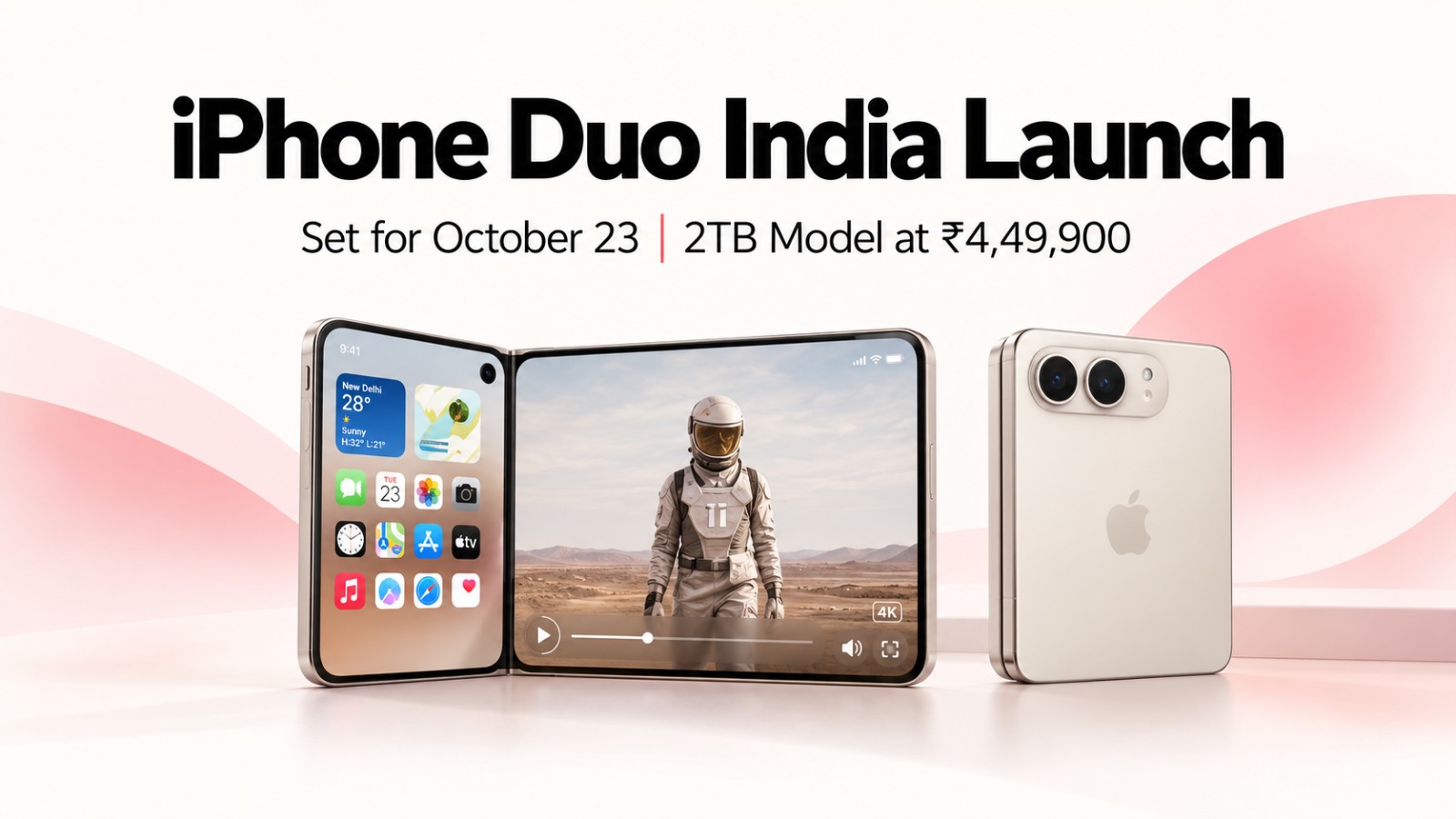
Apple’s plan is global. MacRumors reported that the Duo opens for pre-order on Friday, October 16 at 5 a.m. Pacific Time and reaches stores on October 23 in the U.S. and more than 70 other countries, including Australia, Canada, China, France, Germany, India, Japan, Singapore and the U.K. Another 28 countries and regions follow on October 30. U.S. prices run from $1,999 for 256GB to $3,199 for 2TB.
China is therefore the one big market where the two phones meet head to head. A CNBC report, relayed by Silicon Report, said Apple’s China debut is planned for October 23 and still depends on approval for eSIM from mainland authorities. The same summary listed Honor, Oppo, Vivo and Huawei as established foldable makers in the market Apple is entering.
The market Apple is entering
Apple arrives as a late entrant. Counterpoint Research, in a forecast published September 8 and summarized by Apple World Today, projected Apple would hold about 25% of global foldable shipments by the end of 2026, placing it second. Tarun Pathak, a director at Counterpoint, said Apple’s entry “will surely increase competition at the premium end.” Counterpoint’s July outlook, authored by Associate Director Liz Lee, projected 21% year-on-year growth for the category in 2026 with Samsung retaining the lead.
That helps explain the timing. Xiaomi, Huawei and other brands had a window in which Apple’s foldable was widely expected but not yet available, and a competing phone launched in that window gets compared to Apple’s before buyers have seen it.
The leak chain did much of the work
Apple’s products are hard to keep secret once they reach production. AppleInsider noted in February that new iPhones typically leak in full as they enter mass production, with chassis dummies and parts surfacing during the late validation stages. It pointed out that the iPhone Air had already leaked molds, schematics and dummy models by March 2025, while the foldable had produced none by late February.
That changed by late spring. On May 28, TrendForce reported case listings from accessory maker iFunSmart showing a slim body, dual rear cameras with no telephoto lens, and side-mounted Touch ID. Those details matched the final phone. On June 1, Notebookcheck published a hands-on video of a foldable dummy unit from a Chinese factory, first shared on X by a leaker. Notebookcheck cautioned that it was a low-quality unit and “clearly far from the final product.”
By August, accessories for the unreleased phone were already on sale. When reporters posed as customers, most vendors would not name their data source and said only that the factory guarantees the data and builds molds accordingly, BigGo Finance reported.
The public leaks were not precise, though. The case listings described a 5.5-inch cover screen and a 7.8-inch inner screen, and a unit about 4.5mm thick. The final Duo reportedly has a 7.6-inch inner screen and is 5.2mm thick. Xiaomi’s 7.58 and 5.38 inches landed closer to the final Duo than those public numbers did. That does not show Xiaomi had inside information, since the two companies may simply be working within similar panel and hinge constraints. It does mean the public leaks alone do not fully explain the match.
A habit Xiaomi has not hidden
Xiaomi’s founder, Lei Jun, said in 2022 that the company would “benchmark against Apple” and described high-end smartphone competition as “a war of life and death,” 9to5Mac reported. Xiaomi’s 2018 flagship resembled the iPhone X and that the Mi Pad 5 Pro drew iPad Pro comparisons.
Smartprix columnist Yogesh Brar wrote on August 31 that Xiaomi has long adopted Apple’s design language because familiarity sells, and that Lei Jun has said Steve Jobs was a major inspiration. Brar argued the 18 Fold lacks an identity of its own. TechRadar said the Xiaomi 18 Pro’s similarity in size and weight to the iPhone 18 Pro looked deliberate.
Also Read: iPhone Duo India Launch Set for October 23, 2TB Model to Cost ₹4,49,900