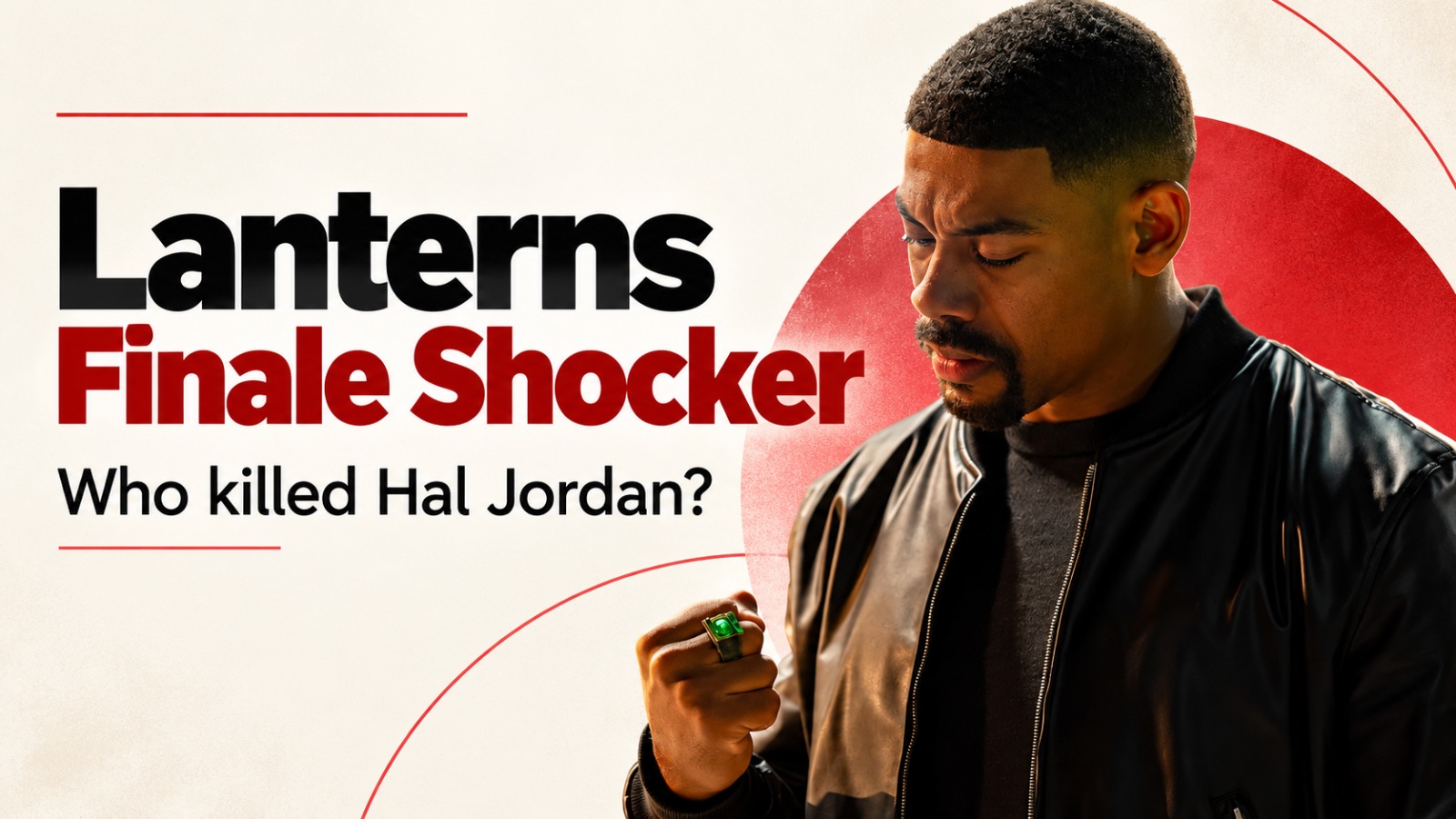
Lanterns Finale has resolved the murder mystery at the centre of its first season with a deliberately personal answer: Sheriff Kerry Kane, played by Kelly Macdonald, killed Hal Jordan after a confrontation over her son Noah Macon and his concealed Manhunter identity.
The revelation closes the case that has driven John Stewart’s investigation since Hal’s death, while the finale simultaneously completes John’s transformation into a Green Lantern operating on his own terms.
Rather than ending on a conventional superhero showdown, the episode places its biggest consequences inside three relationships: Hal and Kerry, Kerry and Noah, and Hal and John.
Kerry’s role in Hal’s death emerges after John confronts her about Noah. Hal had previously discovered that Noah knew he was a Manhunter and was preparing for a possible confrontation with the Guardians.
Hal tried to convince Kerry to leave Rushville with Noah before things spiralled further out of control. Faced with the possibility of losing the life she had built, Kerry panicked and shot Hal. The moment is portrayed as a split-second decision, not a planned killing, and her regret is immediate.
What began as a murder mystery ultimately becomes less concerned with identifying a hidden mastermind than with explaining why someone who loved Hal could still be responsible for his death.
Co-creator Damon Lindelof said the writers wrestled with precisely that contradiction, asking whether Kerry could genuinely love Hal and still kill him. The creative team, he said, increasingly saw the story as a “why-done-it” rather than a conventional whodunit.
The producers also made clear that Hal’s death was not designed as a temporary fake-out: Lindelof said the team decided early that reversing it would undermine the emotional progression of the season.
Noah Macon’s Manhunter identity changes the stakes
The finale’s other major reveal confirms that Noah Macon, portrayed by Shea Pritchard, is a Manhunter.
Noah had secretly used leftover Manhunter technology to save Hal after an arson attack left him badly burned. He later freed Sinestro from imprisonment and enlisted him to create a ring-charging lantern, giving Noah a potential weapon against the Guardians.
The circumstances of Noah’s existence also deepen Kerry’s story. The finale explains that Zoe’s alien technology, originally used after Kerry sought help regenerating a severed finger, instead resulted in Kerry becoming pregnant with Noah. Kerry subsequently tried to raise him as a human being capable of resisting the impulses associated with his Manhunter nature.
Mashable’s account of the finale similarly identifies Noah as the person who broke Sinestro out of prison and notes that the revelation complicates earlier assumptions that Zoe was the last surviving Manhunter.
Yet Lanterns stops short of turning Noah into a straightforward villain. After taking John’s ring and lantern, he ultimately relinquishes them and asks John to kill him rather than risk becoming what he fears he is capable of becoming.
John refuses.
That choice links Noah’s conflict directly to John’s own season-long struggle with identity, conditioning and authority. John sees someone attempting to resist the role assigned to him, a conflict the series has repeatedly explored through John’s relationship with his family, the military and the Green Lantern Corps.
John Stewart becomes a Green Lantern on his own terms
The finale’s lasting change to the wider Lanterns story is not simply Hal’s killer being exposed. It is John deciding what kind of Green Lantern he wants to be.
After resolving Hal’s case, John tells Guy Gardner that he will take responsibility for Earth rather than operate as a conventional subordinate of the Guardians. He retains the unsanctioned lantern forged by Sinestro, whose power source contains an element associated with fear.
That decision culminates in John altering the traditional Green Lantern oath to reflect his acceptance of fear instead of attempting to eliminate it.
The change was not conceived as a rejection of Green Lantern mythology, according to the show’s creators. Showrunner Chris Mundy said the writers were initially nervous about rewriting such an established piece of the character’s mythology before writer Justin Britt-Gibson suggested viewing the decision as “remixing” rather than rewriting it.
Co-creator Tom King offered a story-based explanation: John is no longer functioning as a standard Green Lantern with a conventional Corps-issued power source. His lantern incorporates yellow, fear-linked energy, making his status deliberately different from that of other Lanterns.
The new oath therefore serves as more than a cosmetic change. It completes a season in which John has repeatedly been asked whether courage means the absence of fear or the ability to act while experiencing it.
Hal’s holographic consciousness gives that idea its final emotional push, telling John, “Don’t be afraid to be afraid,” before disappearing when John fully synchronises with the ring and his new lantern.
A finale built around consequence rather than spectacle
The relative lack of a giant final battle was intentional.
Showrunner Chris Mundy said there was never a more action-heavy version of the finale, arguing that the episode would succeed if the creative team landed the emotional conclusion between Hal and John. Lindelof similarly described the earlier “Battle of Rushville” as the season’s equivalent of the large-scale third-act spectacle commonly associated with superhero stories.
However, such a structure allows for several loose ends for Lanterns that don’t undermine the main climax of the ending. Sinestro continues to be a part of the cosmic universe within the storyline, Noah continues to be alive and able to become both an ally and an antagonist, and John is now using the powers of the Green Lanterns in his unique way.
For Hal Jordan, however, the first season reaches a firmer conclusion.
The man whose death launched the mystery does not return through a last-minute reversal. Instead, his final impact is carried forward through John, who ends the season not by replacing Hal, but by rejecting the idea that becoming Green Lantern requires becoming the same kind of Lantern Hal was.
Also Read: Meet Flashoot: The Startup Bringing Quick Commerce to Content Creation With Reels in 10 Minutes