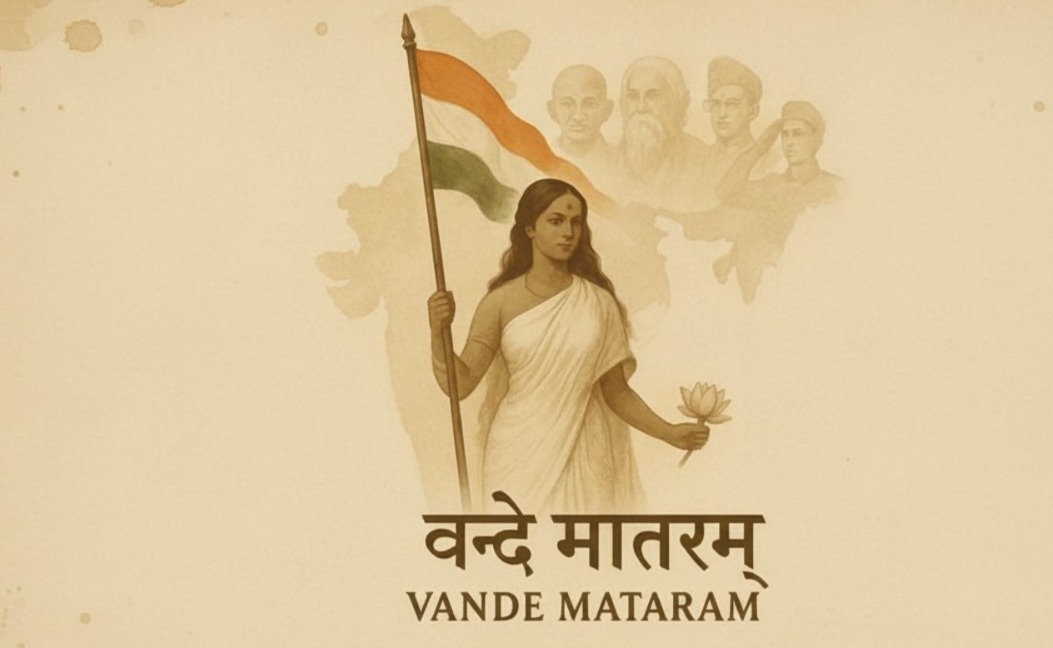
At the heart of a fresh political slugfest over Vande Mataram lies an old, simple question:
did Congress and particularly Jawaharlal Nehru, “cut” or “change” the national song?
In a detailed post, senior journalist and political commentator Umang Misra has challenged this narrative, calling it “अर्धसत्य का पाप”, the sin of half-truths. His argument: once the full history of Vande Mataram and its link with the संन्यासी विद्रोह (Sannyasi Rebellion) and आनंदमठ is understood, the controversy more or less collapses.
This report pieces together that chain of events, strictly on the basis of documented history and the information cited by Misra, to examine whether Congress actually “changed” Vande Mataram – or whether the story is more nuanced.
The song before the slogan: 1875 and the original Vande Mataram
Journalist Umang Misra notes that Bankim Chandra Chattopadhyay first wrote Vande Mataram around 1875.
- At that time, he wrote two stanzas.
- These two stanzas were an ode to the motherland, मातृभूमि की वंदना and are the lines that later came to be widely accepted as India’s राष्ट्रीय गीत (national song).
Crucially, the 1875 version did not depict भारत माता specifically as देवी दुर्गा. It was a poetic salutation to the motherland, not yet embedded in a fictional narrative.
1882: आनंदमठ, संन्यासी विद्रोह and the “extra” four stanzas
In 1882, Bankim Chandra published his famous novel आनंदमठ (Anandamath). The story is set against the backdrop of the Sannyasi Rebellion that erupted in parts of Bengal after 1760.
In this novel:
- Bankim incorporated the already written two stanzas of Vande Mataram.
- To fit the emotional and religious world of the sanyasi protagonists, he added four more stanzas.
- In these additional verses, भारत माता is imagined in the form of देवी दुर्गा – a natural creative choice in a story whose heroes are संन्यासी, for whom देवी-उपासना is central.
Misra’s central point here is important:
The “extra” four stanzas were literary additions to make the hymn match the tone and setting of आनंदमठ and the sanyasi characters.
They were not part of the 1875 standalone composition that was later accepted as the national song.
In other words, there are effectively two contexts to Vande Mataram:
- The civic-national context (1875) two stanzas, saluting the motherland.
- The literary-devotional context (1882) six stanzas within a novel, with भारत माता as a Durga-like figure, aligned with sanyasi bhakti.
Confusing these two contexts, Misra argues, is the starting point of much present-day controversy.
The real question was never “changing” the song, but “how much to adopt”
Fast-forward to the freedom movement and the run-up to Independence.
By the early 20th century, Vande Mataram had already become a powerful political slogan and a rallying cry in protests. But when the time came to formally adopt national symbols, leaders faced a practical and sensitive question:
How much of Vande Mataram should be given official status as the राष्ट्रीय गीत?
According to Misra:
- The complete six-stanza version existed, two original stanzas plus the four novel-specific ones.
- But those extra four had a distinct religio-symbolic framing (भारत माता as देवी दुर्गा), which the Muslim League and Muhammad Ali Jinnah were already using to push communal politics and claim that the song was “exclusionary”.
This is where Rabindranath Tagore’s role becomes crucial.
Tagore’s advice: keep the original two stanzas
Misra points out that Gurudev Rabindranath Tagore was regarded by his contemporaries as the foremost authority on literature, music and the cultural nuances of national symbols.
On his advice:
- Only the first two stanzas the ones written in 1875, were treated as suitable for adoption as the राष्ट्रीय गीत.
- The four additional stanzas, written to deepen the atmosphere of आनंदमठ and its sanyasi characters, were not included in the official national song.
The key argument from Misra and from many historians over the years – is that:
No one “changed” or “edited” Vande Mataram.
The leadership simply chose which part of an already layered composition would be given official constitutional status.
In plain terms, selection is being spun today as alteration.
Was it Nehru alone? The committee that took the call
In current political rhetoric, Jawaharlal Nehru is often singled out and accused of “cutting” Vande Mataram for appeasement. Misra directly contests this by reconstructing the institutional process.
According to him:
- A sub-committee was formed to recommend how Vande Mataram should be treated.
- Misra states that this sub-committee was chaired by Netaji Subhas Chandra Bose, with Jawaharlal Nehru, Sardar Vallabhbhai Patel, Maulana Azad, Dr Rajendra Prasad, C. Rajagopalachari, Acharya Narendra Dev and Jamnalal Bajaj as members.
- On the basis of Tagore’s advice, this body recommended that only the first two stanzas be given the status of national song.
- Misra further notes that the Congress Working Committee accepted this recommendation.
- Later, the Constituent Assembly, the body that framed the Constitution, also accepted the same formulation: Vande Mataram as the national song, with only the first two stanzas carrying official recognition.
By that logic, Misra asks a pointed question of those who attack only Nehru:
अगर आप नेहरू को दोषी मानते हैं, तो क्या आप
– सुभाष चंद्र बोस,
– सरदार पटेल,
– डॉ. राजेन्द्र प्रसाद,
– बाबा साहेब अंबेडकर और
– कांग्रेस वर्किंग कमेटी व संविधान सभा
को भी “गुनहगार” कहने की हिम्मत रखेंगे?
His contention is that a collective, cross-ideological leadership took the call, not one individual acting unilaterally.
(Where historical specifics are contested today, what is not in dispute is this: the Constituent Assembly ultimately resolved that only the first two stanzas of Vande Mataram would be recognised as the national song. No official record suggests that the text of those two stanzas was altered.)
“अर्धसत्य का प्रोपगंडा”: the politics of half-truths
Misra’s post goes beyond procedural history and makes a moral argument about the politics of memory.
He notes that:
- The freedom movement and the symbolism of Vande Mataram were shaped largely under the leadership of the Indian National Congress.
- Leaders like Nehru spent over a decade in jail, and laid many foundations of modern India’s institutions and infrastructure.
- To now run दुष्प्रचार अभियान (disinformation campaigns) against them using “half-truths” about Vande Mataram, he argues, is deeply unfortunate.
“साहस सत्य की साधना से आता है,” he writes in essence,
“अर्धसत्य के प्रोपगंडा से नैतिक साहस नहीं आता।”
In other words, moral courage comes from facing the whole truth, not sliced versions tailored for present-day political battles.
History vs present politics: what are we really debating?
Towards the end of his post, Misra turns the lens back on today’s politics – both Congress and BJP.
He suggests:
- आज की कांग्रेस should be judged on its current merit and demerit.
- आज की भाजपा should be assessed on the basis of its present governance and actions.
- Turning every debate into a hunt for “heroes” and “villains” in history, he argues, often serves to distract citizens from present-day accountability.
“सारा प्रपंच उन लोगों के लिए रचा जाता है जिन्होंने इतिहास नहीं पढ़ा है,” he warns,
the spectacle is crafted for those who haven’t read history closely.
The underlying message: arguing endlessly over whether one leader “cut” a stanza 75+ years ago does little to address today’s pressing issues.
So, did Congress “change” Vande Mataram?
If we strip away the slogans and return to the documented sequence described above, a few clear points emerge:
- Bankim Chandra’s 1875 composition of Vande Mataram consisted of two stanzas praising the motherland.
- Four additional stanzas were later added in 1882 within the novel आनंदमठ, depicting भारत माता in the form of देवी दुर्गा, aligned with the sanyasi storyline.
- When India’s leaders debated national symbols, the question was not about rewriting the song, but about which portions to give official status.
- On the advice attributed to Rabindranath Tagore, and through decisions involving multiple national leaders and the Constituent Assembly, only the first two stanzas were adopted as the राष्ट्रीय गीत.
- There is no evidence in this account that Congress “changed the words” of those two stanzas; the controversy is about selection, not surgery.
In that sense, the viral claim that “Congress/ Nehru changed Vande Mataram” rests, as Misra alleges, on a half-truth: it cites the existence of the longer hymn but omits the historical context of why only the original 1875 portion was constitutionally adopted.
Misra closes his post with a simple, emphatic affirmation:
“वंदे मातरम, भारत माता की जय.”
The debate, he seems to suggest, should honour both, the song, and the full truth of how it became a national symbol.
Also Read: IndiGo Crisis: Experts Reveal How the Airline Planned the Meltdown