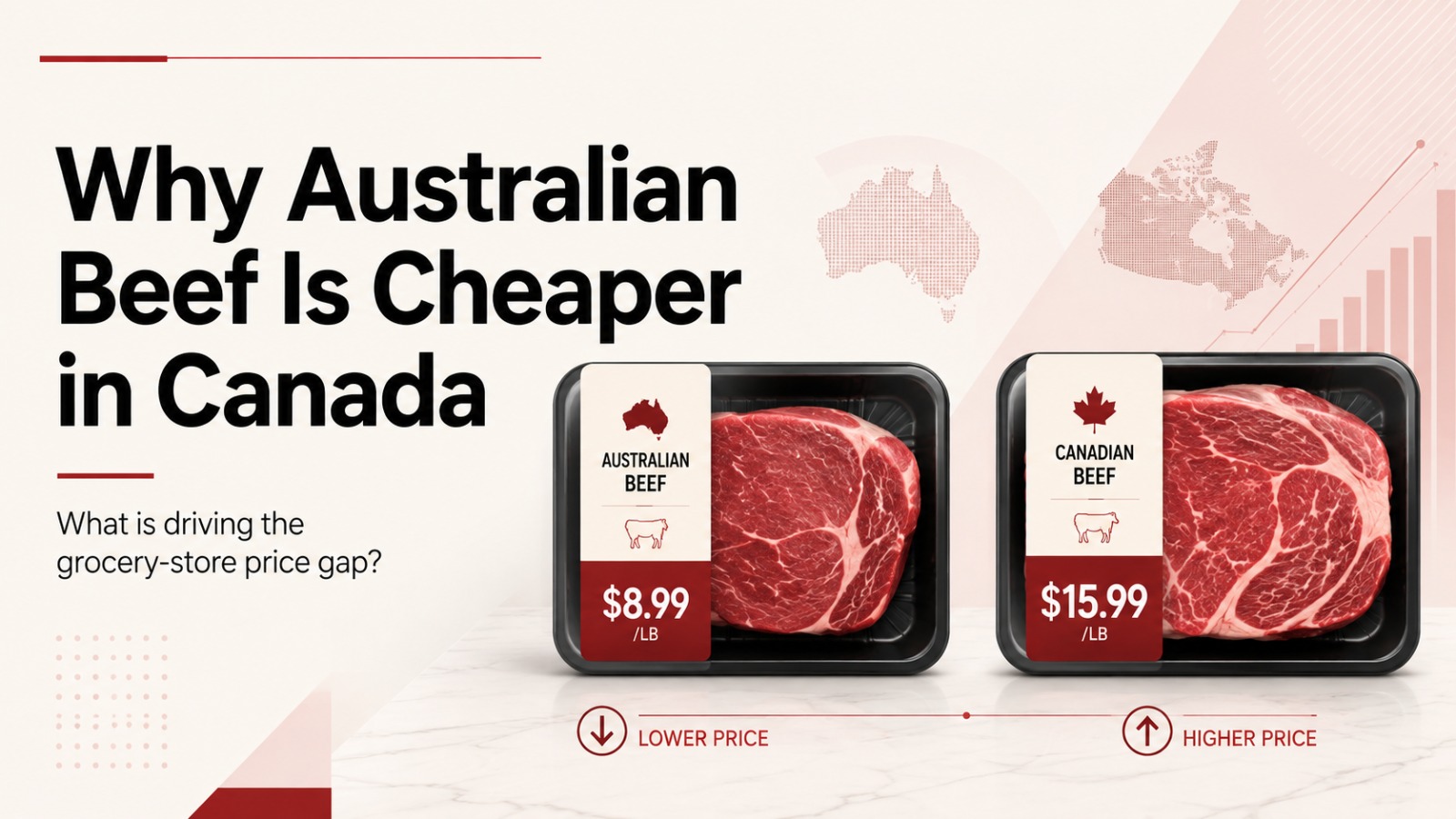
Australian beef is becoming more visible in Canadian grocery aisles as tight domestic cattle supplies, differences in production costs and retailer pricing strategies create unusually wide gaps between imported and Canadian cuts.
A price tag in a Canadian grocery store tells much of the story.
As of Aug. 13, Canadian rib steak at a Loblaws store was priced at $70.52 per kilogram, just two cents short of twice the price of the comparable Australian rib steak on display.
The contrast has pushed Australian beef into the spotlight at a time when Canadian consumers are confronting high meat prices and cattle producers are navigating tight supplies at home.
Australian beef is not new to Canada. What has changed is how noticeable the price difference has become, particularly for steak cuts.
Tyler Fulton, president of the Canadian Cattle Association, said Australian beef has been available in the country for years, but shoppers are now seeing the choice more clearly in stores.
That visibility is giving consumers a decision that can be difficult to ignore: pay substantially more for Canadian beef or choose an imported product that, in some cases, is selling for far less.
In Alberta, recent store comparisons showed differences of more than $40 per kilogram between similar domestic and imported cuts. One southern Alberta shopper, Brad Pace, said the gap was large enough that he and his wife would choose Australian beef when it was available for less than half the Canadian price.
Why Australian beef can cost less?
There is no single explanation for the gap.
Fulton points to differences in how cattle are raised. Australian beef production is largely grass-based, commonly followed by a shorter period of grain feeding. The result, he said, tends to be leaner beef with less marbling than Canadian-produced beef.
That distinction matters because the products are not necessarily competing on identical characteristics. Fulton said Canadian consumers generally show a preference for the marbling associated with domestic beef.
Retail strategy may also be influencing what shoppers see on the shelf. Fulton identified the use of imported beef as a possible “loss leader”, where retailers price certain products aggressively to attract customers.
Another factor is trade access. Australia gained greater access to the Canadian beef market after the Comprehensive and Progressive Agreement for Trans-Pacific Partnership, or CPTPP, came into effect in 2018. Canadian producers receive similar preferential access to markets including Japan and Vietnam.
The economics of producing beef in the two countries also differ.
Sylvain Charlebois, director of the Agri-Food Analytics Lab at Dalhousie University, said Canada’s colder climate raises feeding and housing costs for cattle producers. At the same time, relatively inexpensive shipping from Australia and New Zealand can make imported beef economically competitive even after travelling a far greater distance.
For Canadian shoppers, geography alone therefore does not determine which product will carry the lower price.
A Canadian supply squeeze meets growing Australian production
The price gap is also being shaped by what is happening on each side of the Pacific.
Loblaw said North American cattle supplies have tightened in recent years while Australian beef production has increased, contributing to differences in market pricing.
The company has said it sources from Canadian as well as international suppliers and that retail prices are influenced by market conditions, supplier costs and available supply. It has also said imported Australian beef is being offered as part of an effort to give customers choice and value while maintaining support for Canadian producers.
Brenda Rosadiuk, finance chair of Alberta Beef Producers, described the Canadian market as one of tight supplies combined with strong global demand, a combination contributing to higher grocery-store prices.
There are signs that cattle numbers may be starting to recover.
Rosadiuk said Statistics Canada’s January cattle inventory figures showed early indications of growth, while favourable auction prices and good weather could encourage producers to expand their herds. Fulton offered another measure of that shift, saying Canada’s beef cow herd grew 2.5 per cent last year.
Still, rebuilding cattle numbers does not translate immediately into cheaper meat.
Changes made on farms take time to reach supermarket shelves, meaning today’s herd expansion cannot instantly relieve the supply pressure consumers are seeing at the meat counter.
Imported beef is filling a gap, not simply replacing Canadian beef
Despite concerns that cheaper imports could undercut domestic producers, the Canadian Cattle Association is not treating Australian beef as an immediate threat to the industry.
Fulton described imports as serving an “acute purpose” by filling a short-term supply void. He also expressed confidence in Australian production standards while maintaining that the imported product differs from Canadian beef in quality characteristics.
That distinction has produced a divided response among shoppers.
Some are choosing primarily on price. Others continue to favour local beef even when it costs considerably more.
Alberta resident Daniel Cockburn said he would still lean toward Alberta beef because he considers it higher quality, despite the elevated prices.
In Regina, Karen Novak described how dramatically beef prices have changed her eating habits. She said she could not justify spending that much on a steak and had not eaten beef other than ground beef since around 2024, apart from a beef Wellington made roughly two Christmases earlier.
Other consumers are finding their own middle ground. Jordan Fieseler said he buys beef in bulk from local producers, while Larry Evans said he would consider Australian beef in the future if Canadian prices continued to climb.
Those reactions show why the current debate is not simply about domestic versus imported food. For many households, the question increasingly comes down to what remains affordable.
The pressure is spreading beyond the beef counter
High beef prices may also be affecting the wider meat category.
Charlebois said chicken prices had risen 20 per cent since March, while pork was up 20 per cent since June, arguing that pressure in the beef market is influencing consumers’ choices across the meat counter.
He also pointed to sharp movement in ground beef, saying some parts of Canada experienced increases of as much as 18 per cent in July alone.
That is significant because ground beef remains one of the lowest-priced forms of beef available to consumers and accounts for a substantial share of beef purchases.
For households already adjusting what they buy, cheaper imported beef can therefore serve as more than an alternative steak. It introduces additional competition into a market where domestic supply remains constrained.
Whether that competition eventually helps moderate Canadian retail prices is less certain. Charlebois has said continued competition could be beneficial for consumers over the longer term, while acknowledging that prices remain difficult to predict.
For Canadian producers, there is also a longer-term counterpoint. Fulton said the industry is better positioned for domestic growth after nearly two decades marked by low or negative profitability, and he expects herd expansion to continue if the economic incentives remain in place.
For now, however, the supermarket shelf captures the imbalance more clearly than any industry statistic.
When one rib steak is priced at $70.52 per kilogram and the imported alternative beside it costs little more than half as much, shoppers do not need an explanation of global cattle economics before noticing the difference.
They see it on the label.
Also Read: Trump Threatens to Bomb Oman if It Gets in the Way of Iran Deal