US Chicken Recall: A nationwide food recall involving chicken is drawing attention in the United States, but the reason behind it is different from many familiar food safety warnings.
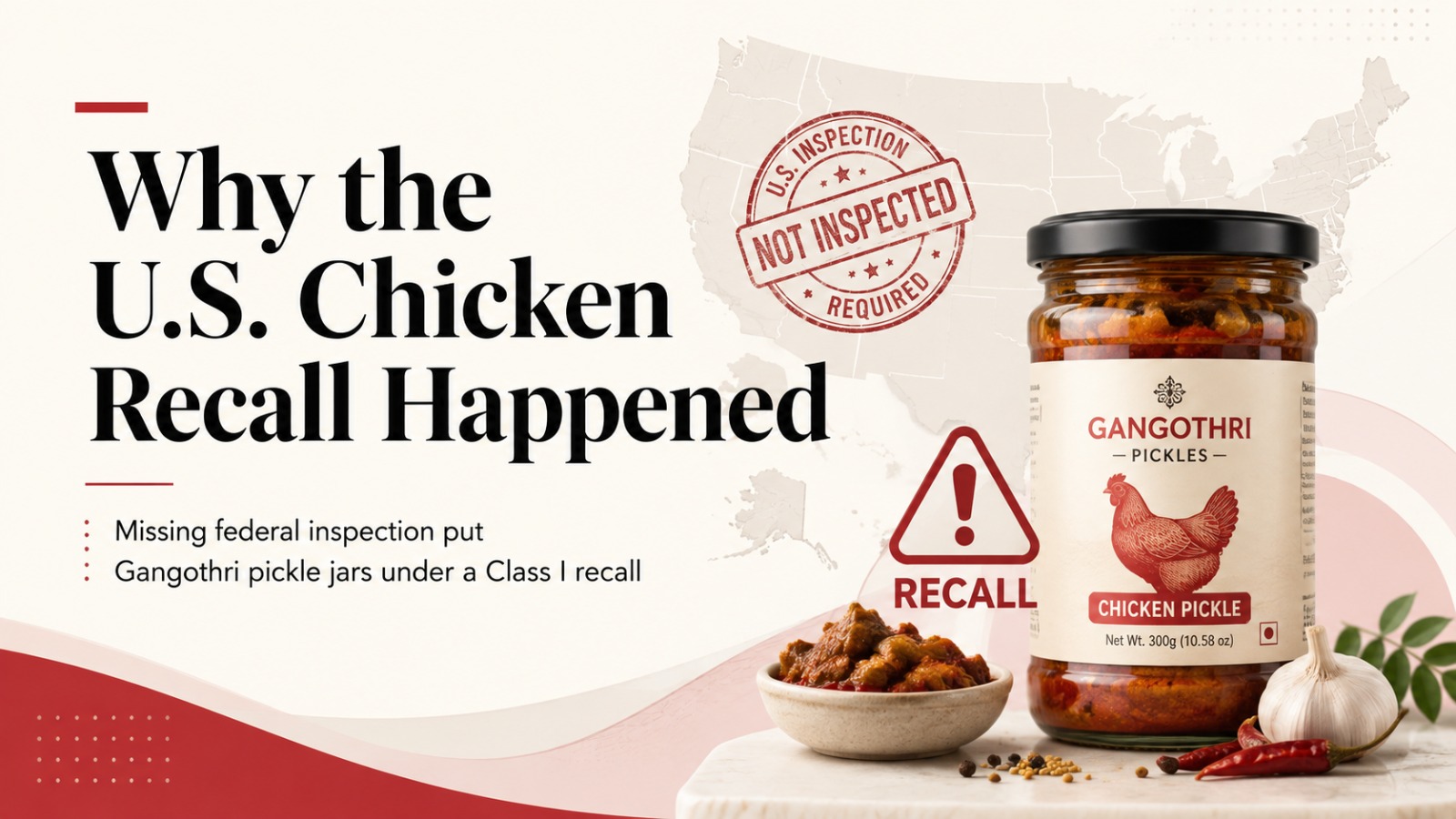
There has been no identified Salmonella, E. coli or Listeria contamination tied to the products. Instead, federal regulators say the ready-to-eat chicken and goat pickles entered the market without undergoing the required federal inspection.
Indus Foods LLC, which does business as Gangothri Foods, recalled approximately 1,626 pounds of ready-to-eat pickled chicken and goat products after the U.S. Department of Agriculture’s Food Safety and Inspection Service, or FSIS, found they had been produced without the benefit of federal inspection. The Austin, Texas-based company’s affected products were distributed nationwide.
That distinction is central to understanding this recall. It is not a broad recall of chicken sold across American supermarkets. It concerns four specific Gangothri Foods pickle products packaged in 8-ounce glass jars.
Why were the chicken products recalled?
The problem was discovered during FSIS surveillance activities.
Federal inspectors determined that the ready-to-eat meat and poultry products had been produced without federal inspection. Meat and poultry products covered by USDA rules are required to go through that inspection system before entering commerce.
The affected jars also do not carry the USDA mark of inspection normally found on federally inspected meat and poultry products.
This means the recall is fundamentally about a missing food safety checkpoint.
Inspection is the process through which federally regulated meat and poultry production is reviewed before products are allowed into the commercial food supply. In this case, FSIS said the chicken and goat pickle products were distributed without that required oversight.
That is why consumers should not interpret the absence of a named pathogen as proof that the jars are safe to eat.
Regulators have not identified a specific contamination event connected with the recalled products, but FSIS considered the lack of required inspection serious enough to place the recall in its highest risk category.
Which Gangothri Foods products are affected?
The recall covers four ready-to-eat products, all sold in 8-ounce glass jars:
- Gangothri Goat Pickle
- Gangothri Gongura Goat Pickle
- Gangothri Chicken Pickle
- Gangothri Gongura Chicken Pickle
The same four products are identified across the available recall coverage.
Consumers checking their kitchens should focus on those specific Gangothri Foods products rather than assuming that other packaged chicken products are part of the recall.
Why the two-year shelf life matters
One detail makes this recall particularly important for people who may have bought the products months ago.
The recalled jars were produced between January 28, 2025, and May 6, 2026, and the products have a two-year shelf life.
That long shelf life means a jar purchased well before the recall announcement could still be sitting unopened in a pantry, restaurant storeroom or other food storage area.
It also helps explain why regulators are telling consumers and businesses to check what they already have, rather than treating the recall only as a problem involving products currently on store shelves.
USA TODAY also reported that the products were produced during that same period, carried a two-year shelf life and were sold nationwide.
Where were the recalled products sold?
The distribution was not limited to one city, supermarket chain or state.
FSIS said the products were shipped nationwide to restaurants, retailers and distributors, while some were also sold directly to consumers through online channels.
That broad distribution is one reason the recall has national relevance.
A specific state-by-state list was not available in the material reviewed, and a retail distribution list identifying individual stores had not yet been published at the time of the reporting.
For consumers, that makes the product name, jar size and lack of a USDA inspection mark especially important when determining whether an item at home may be affected.
Why was this classified as a Class I recall?
FSIS placed the Gangothri Foods recall in Class I, the agency’s most serious recall category.
A Class I designation is used when there is a reasonable probability that use of a product could result in serious adverse health consequences or death.
In this case, the designation can easily be misunderstood.
The highest-risk classification does not mean federal officials announced that a particular pathogen had been discovered in these jars. The available information specifically states that regulators had not identified a particular pathogen or contamination event associated with the products.
The concern is that the products bypassed the federal inspection process required for meat and poultry.
That makes this recall different from one triggered after laboratory testing finds bacteria, an undeclared allergen is discovered, or foreign material is detected in food.
Here, the missing inspection itself is the central food safety failure.
Have any illnesses been reported?
At the time covered by the recall information, no confirmed illnesses had been reported in connection with the Gangothri Foods products.
That is an important distinction, particularly because a Class I classification can sound as though an outbreak has already occurred.
There is no confirmed outbreak identified in the available information.
The recall is preventive action following the discovery that the products had entered distribution without required federal inspection.
What should consumers do?
Anyone who has one of the recalled Gangothri Foods jars should not eat it.
FSIS advises consumers to either throw the affected product away or return it to the place where it was purchased. Restaurants, retailers and distributors have also been advised not to sell or serve the recalled items.
People who believe they became ill after eating one of the products have been advised to contact a healthcare provider.
Consumers can also look for a practical warning sign on the packaging: the affected products do not carry the USDA mark of inspection identified by FSIS.
What makes this US chicken recall different?
Food recalls in the United States often become headlines because of bacterial contamination, allergens or foreign objects. Recent recalls have involved issues ranging from Salmonella and E. coli to Listeria and glass contamination.
The Gangothri Foods case is different.
The recalled food was already cooked and packaged as a ready-to-eat pickle product. The issue uncovered by federal officials was not a publicly identified pathogen. It was the fact that regulated meat and poultry products were produced and distributed without the required inspection.
That makes the missing USDA inspection mark more than a packaging detail. In this recall, it points directly to the reason federal authorities acted.
And because the jars can remain usable for two years, the recall is not only about removing products from stores. It is also about finding products that may already have been sitting in American homes and food businesses for months.
Also Read: Take-Two Seeks Microsoft and Discord Records in Hunt for GTA 6 Leaker