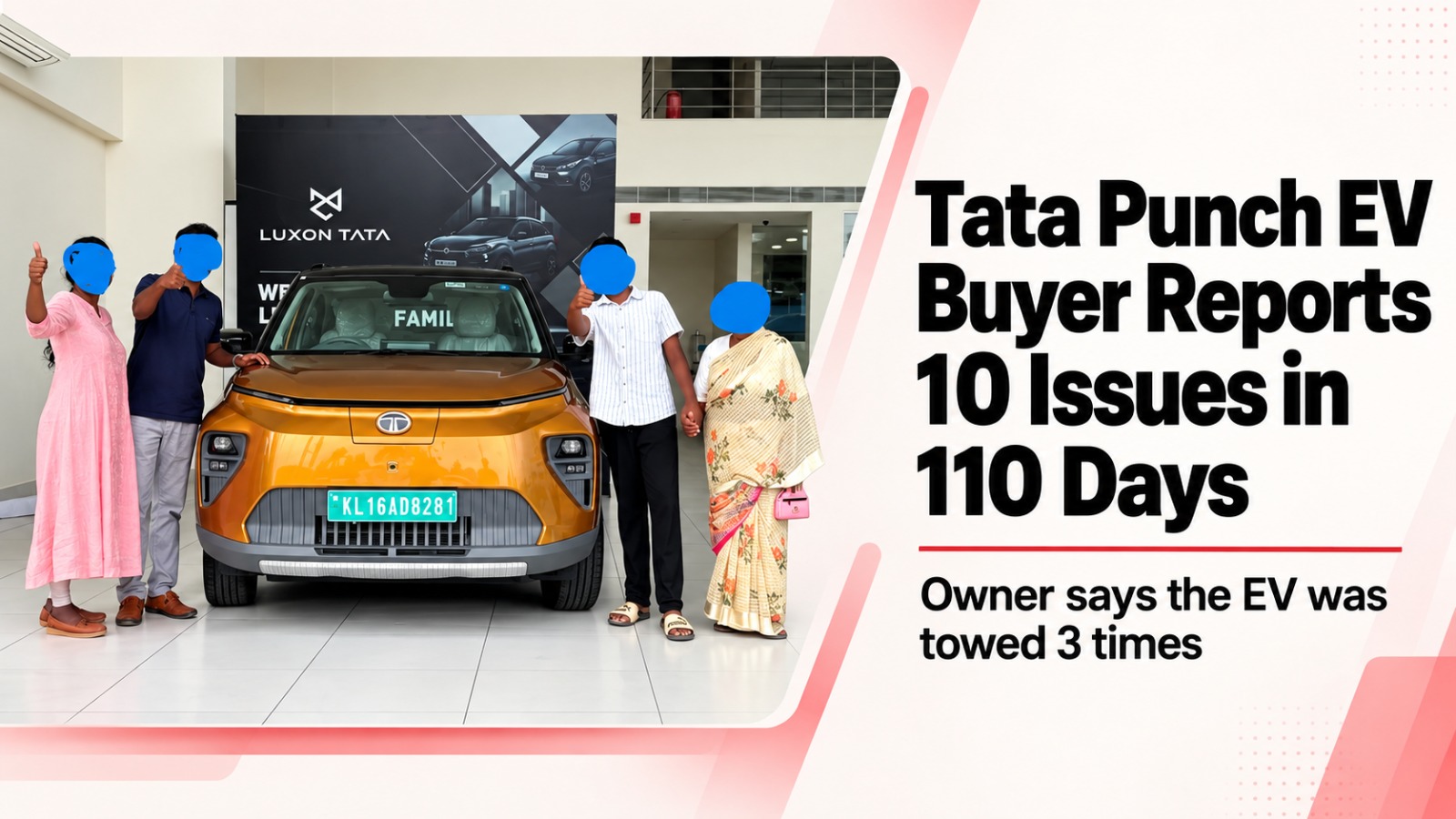
A Tata Punch EV owner in Kerala has shared a detailed account of repeated warning messages, breakdowns and workshop visits during the first few months of owning his 2026 Punch EV, including three instances in which the vehicle had to be towed.
The experience was posted on Team-BHP by forum member rejaneeshsr, who took delivery of a Tata Punch EV Empowered Plus S 40 on April 23, 2026. The owner says long-term reliability was particularly important to him because he typically keeps his cars for around 15 years or longer.
What began as a positive ownership experience, however, changed quickly. According to his account, the Punch EV displayed its first HV Critical Alert on the second day of ownership and entered limp mode. The same warning returned a few days later.
The third occurrence was considerably more disruptive.
While travelling with his family around 250 km from home, the owner says the HV Critical Alert appeared again. The car initially entered limp mode before eventually refusing to shift into either Drive or Reverse. Tata roadside assistance was called and the vehicle was towed to a service centre, where it stayed for almost two days.
According to the diagnosis communicated to the owner, the problems found on that visit included battery cell voltage imbalance and what was described as “fungal growth” inside one of the couplers due to water ingress. The repair was carried out at Hyson Motors in Thrissur.
More warning lights followed
The owner says his car was subsequently called in for replacement of the rear brake assembly. He viewed that intervention positively, saying he would rather see preventive action taken when a possible safety issue is identified.
At around 3,000 km, another problem appeared. An airbag warning symbol began showing up intermittently. According to the account, the service centre inspected the vehicle and advised that a more detailed diagnosis could be carried out when the car was next left with them.
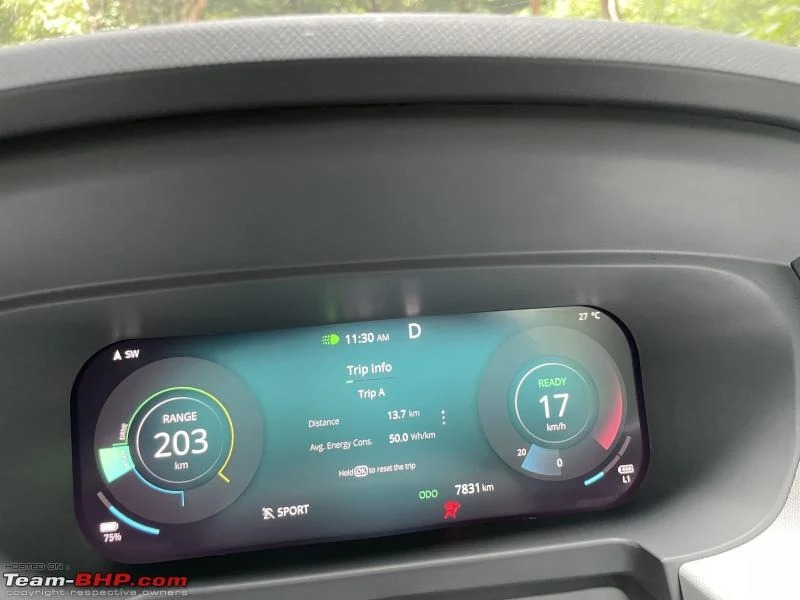
Then, at roughly 6,000 km, the Punch EV reportedly broke down again.
The owner had driven around 10 km and parked at a relative’s home when the vehicle refused to engage Drive or Reverse and displayed an EV Critical Alert. Attempts to reset the car, including disconnecting the low-voltage battery, did not resolve the issue.
The car was towed again, this time to Luxon Tata at Kazhakkoottam. The owner says the workshop diagnosed the problem as a BMS-related software glitch and flashed or updated the software.
But the issue returned the following day.
According to the owner, the Punch EV was taken back to the same workshop, where a TACO technician inspected the vehicle. It remained at the service centre for almost a week while further checks were carried out, including an extended test drive. He believes the VCU software was also updated during that visit.
Car reportedly broke down again while at the service centre
After approximately another 1,000 km of driving, the owner brought the vehicle in for its second service and specifically mentioned the continuing airbag warning.
The EV then reportedly displayed another EV Critical Alert at the service centre itself, shortly after the service had been completed.
This time, according to the account, a TACO technician identified what was described as “improper insulation in one of the HV wiring harnesses”, resulting in a voltage drop. A replacement harness was ordered, taking almost a week to arrive, after which the workshop informed the owner that the fault had been rectified.
Even then, the airbag warning did not disappear permanently.
After another roughly 200 km, the warning returned. The diagnostic code recorded was “HV Battery Disconnect Deployment Control Circuit – Resistance Above Threshold.”
The owner says the service centre considered this separate from the earlier critical-alert problem and told him the cause could lie either in the airbag module or in wiring connecting the airbag system with the high-voltage battery. Further inspection would require removal of the main HV battery, something the owner said he had not yet been able to leave the car at the workshop long enough to undertake.
Windshield crack becomes the latest concern
The latest issue described in the post involves the car’s windscreen.
After the Punch EV had been charged overnight in covered parking, the owner noticed a crack beginning from the lower-left section of the front windshield. He said he was not aware of any external impact, although he also acknowledged that he could not say with complete certainty exactly when the crack developed.
The matter is particularly frustrating for him because the car has Garware Arctic Cool Shield 70 sunfilm, which he says cost about ₹10,000 and would be lost if the windshield has to be replaced.
He also says he knows of two other Punch EV owners who reported similar windshield cracks. That is an owner-reported observation rather than evidence establishing a wider defect.
According to his account, the service centre initially suggested an external impact before later saying it would try to process the windshield replacement as a warranty claim. The possibility that the sunfilm contributed to the crack was also raised by the workshop, according to the owner.
Owner groups have reported other Punch EV concerns
Beyond his own vehicle, the Team-BHP member says he participates in Kerala and all-India Punch EV 2.0 WhatsApp groups with more than 450 owners collectively. He listed several issues that he says have surfaced in discussions there, including repeated HV Critical Alerts, auxiliary-battery charging problems, coolant-system warning lights, infotainment freezing, rattles, air-conditioning concerns and water ingress.
Those reports come from owner-group discussions and should not be treated as independently established problems across the wider Punch EV fleet.
One issue discussed by the group concerns some TACO battery-equipped vehicles. The owner claims those cars are running BMS software intended for the older 35 kWh Punch EV, resulting in a displayed full-charge range of around 290 km. He adds that owners have not noticed a corresponding reduction in actual real-world range.
According to his post, a group of around 100 owners approached Tata, after which technicians inspected the issue, and updated software was being tested on a small number of vehicles. These details remain based on the owner’s account and group discussions.
Around 10 significant issues in roughly 110 days
The numbers in the owner’s summary make the scale of his experience clearer.
He says that in approximately 110 days of ownership, his Punch EV experienced around 10 significant issues, was towed three times, and spent roughly 20 days at service centres. He also made multiple visits to workshops while trying to get the various problems investigated and repaired.
Despite all of this, his assessment of the Punch EV itself is not entirely negative.
He praises its ride comfort, smooth and quiet power delivery, efficiency, equipment levels, ergonomics, seats and overall driving experience. In his view, the larger concern lies with quality control and reliability rather than the fundamental product concept.
He also describes his interactions with Tata service centres in Kerala as reasonably good and cooperative, specifically mentioning Hyson Motors in Thrissur and Luxon Tata facilities at Kollam, Kazhakkoottam and Korani.
For a buyer who expected to keep the car for well over a decade, that contrast perhaps sums up the ownership story: a vehicle he says he genuinely enjoys driving, but one whose repeated warnings and workshop visits have made him hesitant to trust it on longer journeys.