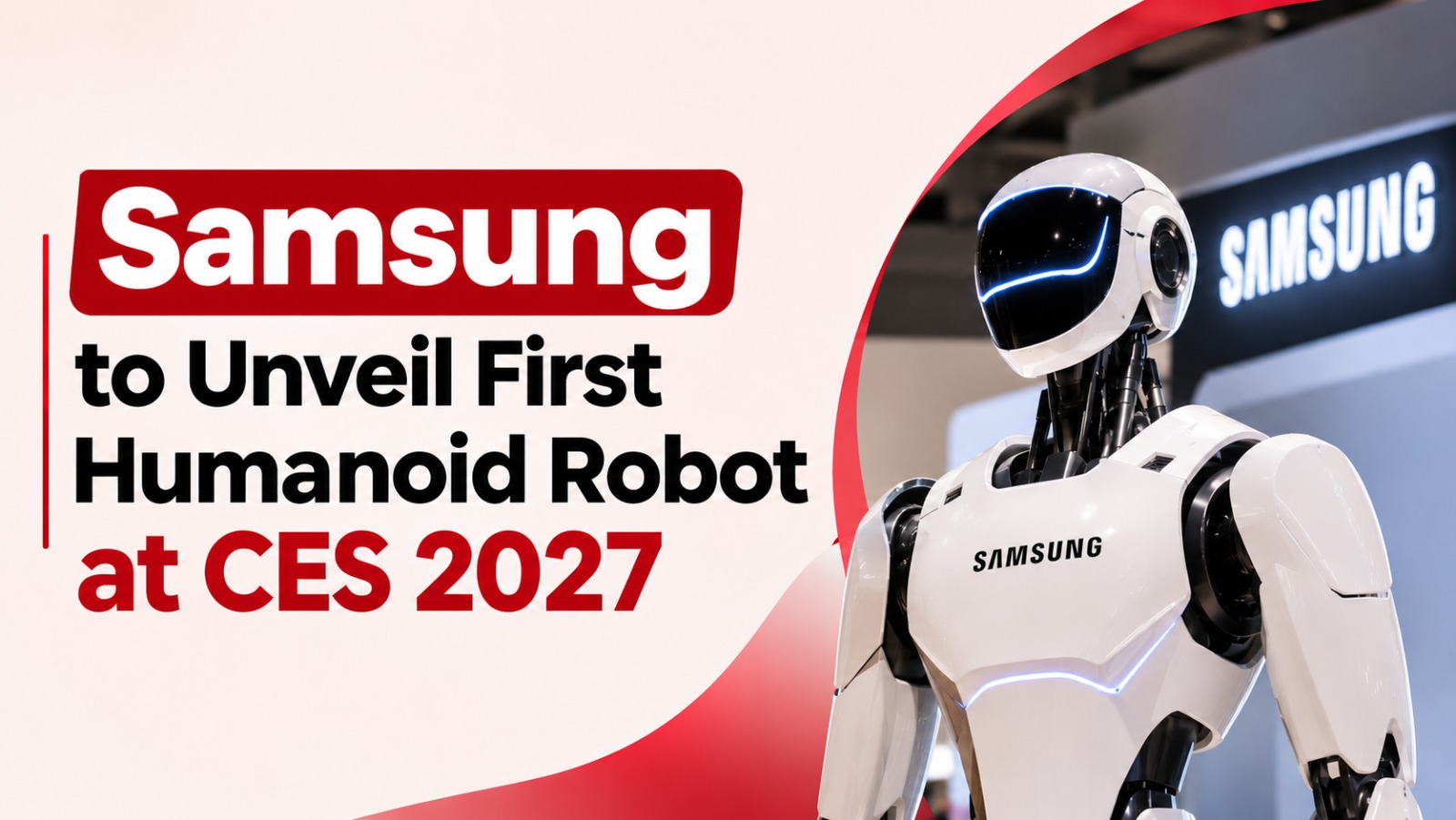
Samsung Electronics is preparing to enter the humanoid robotics market, with plans to publicly unveil its first humanoid robot prototype at the Consumer Electronics Show (CES) in Las Vegas in January 2027. The move marks a new step in the South Korean technology giant’s efforts to expand beyond smartphones, semiconductors and consumer electronics into advanced robotics.
The company recently presented the prototype to its board of directors, showcasing its ability to control full-body movements and handle physical objects using its arms and hands, Reuters reported, citing a person familiar with the matter. The demonstration took place on Thursday at Samsung’s robotics research centre in Seoul and was attended by co-CEO TM Roh.
Samsung has not officially confirmed the planned public unveiling. The company declined to comment on the development.
Samsung Focuses on Robot Hand Manipulation
A major area of development for Samsung is hand manipulation, one of the most technically demanding aspects of humanoid robotics. Robots need to grasp, turn and reposition objects accurately to perform practical tasks, particularly in industrial environments.
The ability to handle objects consistently is essential if humanoid robots are to become commercially viable on factory production lines.
Kris Hauser, head of the robotics lab at Samsung’s Robotics eXperience (RX) unit, highlighted the challenge in September, explaining that even a 99% success rate would not be sufficient for factory deployment. Manufacturers would need reliability closer to 99.99% before trusting robots with production-line operations.
Samsung’s robotics ambitions extend beyond industrial applications. Hauser has also discussed the company’s longer-term interest in developing consumer robots that could perform household chores and assist older people.
New Robotics Division Leads Development
Samsung established its Robotics eXperience (RX) unit in July to strengthen its position in the robotics industry. The division reports directly to co-CEO TM Roh and is responsible for robotics research and development, long-term strategy and commercialisation.
The company has also been expanding its robotics research capabilities across international markets, with operations in the United States, China and Japan.
In March, Samsung outlined its ambition to transform its factories into AI-driven manufacturing facilities by 2030. The plan includes introducing humanoid robots into manufacturing processes as part of a broader push towards automation.
The company has also identified Gumi, a city in southeastern South Korea that houses its smartphone manufacturing facilities, as the location for a planned humanoid robot production line.
Samsung Strengthens Its Position Through Robotics Investments
The planned robot unveiling builds on Samsung’s existing investments in the sector. In 2024, the company became the largest shareholder in South Korean robotics firm Rainbow Robotics, strengthening its access to robotics technology and expertise.
Samsung has also indicated that it would consider further investments and acquisitions to accelerate the development and commercialisation of robotics technologies.
Its entry into the humanoid robot market places it alongside established and emerging players, including Tesla, China’s Unitree and Hyundai Motor’s Boston Dynamics.
With its planned CES 2027 debut, Samsung is preparing to showcase how its robotics research could translate into practical machines. The company’s emphasis on object handling and manufacturing applications suggests that industrial reliability will remain a central priority as it works towards commercial deployment.
Also Read: Samsung Galaxy S27 Ultra Leak Hints at Major Camera Redesign, 200MP Sensor