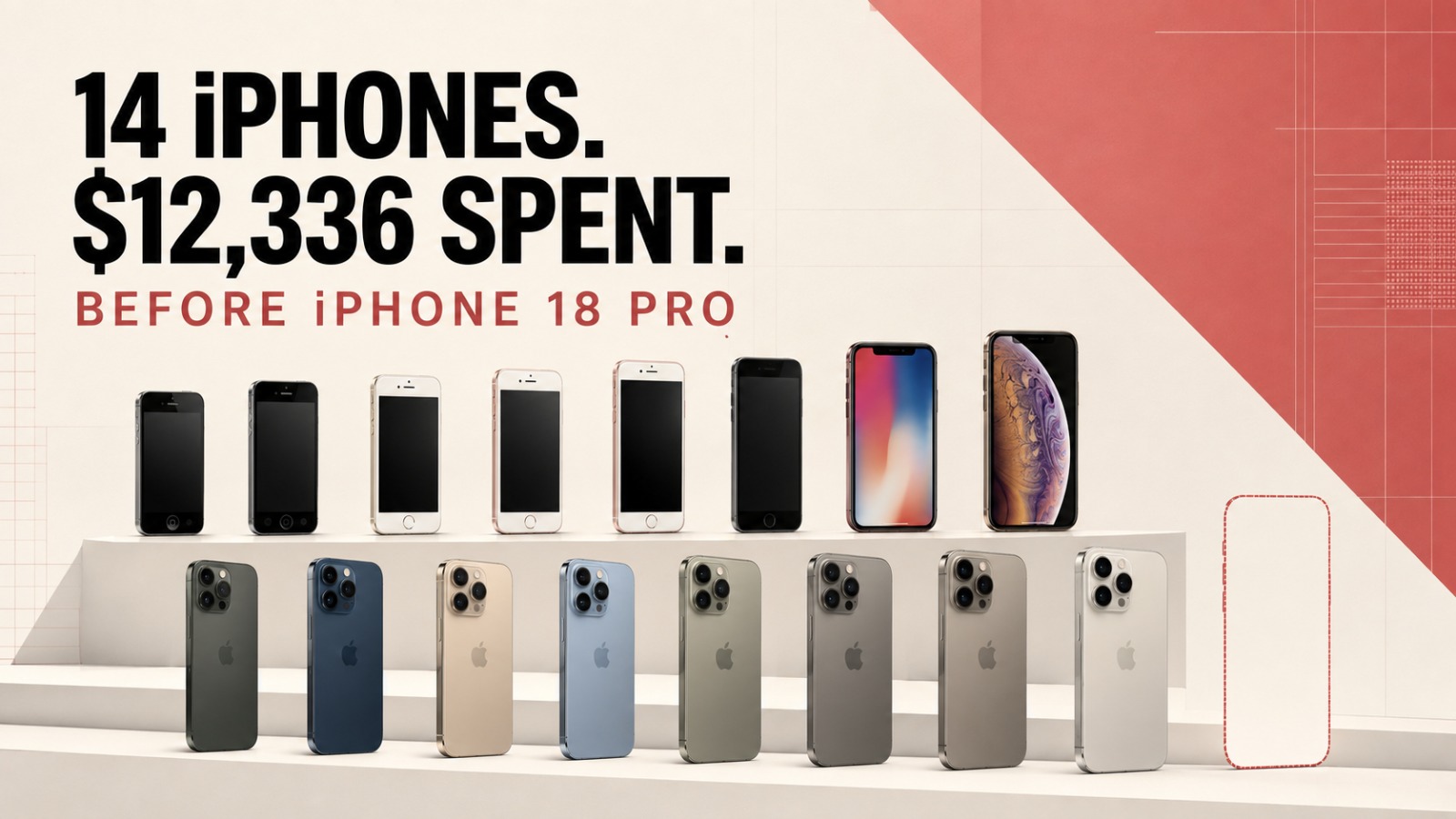
A person who bought one new premium, standard-size iPhone every year, beginning with the iPhone 5 in 2012 and continuing through the iPhone 17 Pro in 2025, would have spent $12,336 on the phones alone before the launch of Apple iphone 18 pro.
$12,336 + the official starting price of the iPhone 18 Pro
The number may feel surprisingly modest to someone picturing more than a decade of premium Apple launches. It may feel enormous to anyone who keeps a phone for four or five years. Either way, it offers a revealing look at what annual upgrading can cost when every purchase is counted at its original US retail price.
How the $12,336 total was calculated?
The calculation follows one clear upgrade path. It uses the least expensive storage option for the premium, standard-size flagship released in each annual cycle. It begins with the iPhone 5, continues through the iPhone 5s, iPhone 6, iPhone 6s and iPhone 7, then follows the higher-end line through the iPhone X and iPhone XS. From 2019 onward, it tracks the Pro model rather than the regular iPhone or the larger Pro Max.
For 2017, the iPhone X is counted instead of the iPhone 8 because this exercise follows Apple’s new premium flagship path. It does not count both phones from the same launch year.
| Year | Model | Entry storage | US launch price |
|---|---|---|---|
| 2012 | iPhone 5 | 16GB | $649 |
| 2013 | iPhone 5s | 16GB | $649 |
| 2014 | iPhone 6 | 16GB | $649 |
| 2015 | iPhone 6s | 16GB | $649 |
| 2016 | iPhone 7 | 32GB | $649 |
| 2017 | iPhone X | 64GB | $999 |
| 2018 | iPhone XS | 64GB | $999 |
| 2019 | iPhone 11 Pro | 64GB | $999 |
| 2020 | iPhone 12 Pro | 128GB | $999 |
| 2021 | iPhone 13 Pro | 128GB | $999 |
| 2022 | iPhone 14 Pro | 128GB | $999 |
| 2023 | iPhone 15 Pro | 128GB | $999 |
| 2024 | iPhone 16 Pro | 128GB | $999 |
| 2025 | iPhone 17 Pro | 256GB | $1,099 |
| Verified total through iPhone 17 Pro | $12,336 |
These are nominal prices, not inflation-adjusted figures. The calculation also leaves out sales tax, carrier service, AppleCare, cases, chargers, repairs, financing costs and other accessories. Trade-in credits and resale proceeds are excluded as well.
Five years at $649, followed by a long $999 plateau
The first part of the journey was remarkably steady. The entry versions of the iPhone 5, 5s, 6, 6s and 7 each carried a full US retail price of $649. Together, those five phones account for $3,245 of the total.
The sharp break arrived with the iPhone X in 2017. Its starting price was $999, or $350 more than the iPhone 7 used in this calculation. The same $999 starting point then held across the iPhone XS and the standard-size Pro line from the iPhone 11 Pro through the iPhone 16 Pro.
Those eight $999 purchases add up to $7,992.
The iPhone 17 Pro took the verified running total to $12,336 with its $1,099 starting price. It also doubled entry storage from the 128GB offered on the iPhone 16 Pro to 256GB.
Across the full timeline, entry storage increased from 16GB on the iPhone 5 to 256GB on the iPhone 17 Pro. That is a 16-fold increase. The nominal starting price rose by $450, or about 69 percent, over the same span.
What the total says about an annual upgrade habit
Spread across 14 phones, the buyer paid an average of about $881 per device before tax. That average hides two distinct eras: five consecutive $649 purchases, followed by a premium run dominated by the $999 price point.
It is important not to confuse the $12,336 figure with the buyer’s true lifetime cost of owning an iPhone. Someone who sold or traded in each outgoing handset could have reduced the amount paid from their own pocket. Someone who chose larger storage capacities, bought Plus or Max models, paid sales tax or added coverage and accessories would have spent more.
The figure is instead a consistent benchmark. It answers one narrow question: what would the phones themselves have cost at their US starting prices if a buyer upgraded once a year along Apple’s premium, standard-size path?
This 14-phone journey shows how Apple turns a single product purchase into a long-term customer relationship. The appeal is not limited to a new camera, faster processor or updated design each year. Features such as iCloud, AirDrop, iMessage and continuity across the iPhone, Mac, iPad, Apple Watch and AirPods make switching away less convenient as a customer adds more Apple products and services.
Apple reinforces that connection through familiar yearly launches, consistent product naming, trade-in offers and clear upgrades to performance, storage and photography. A buyer who began with the iPhone 5 and has spent $12,336 through the iPhone 17 Pro is therefore more than a repeat customer. The buyer represents the strength of an ecosystem designed to keep each new purchase connected to the last, while making the next upgrade feel like a natural continuation rather than a completely new buying decision.
Also Read: iPhone 18 Pro Faces a Tougher US Market: Shocking Survey Shows 41% Rethinking Upgrades