

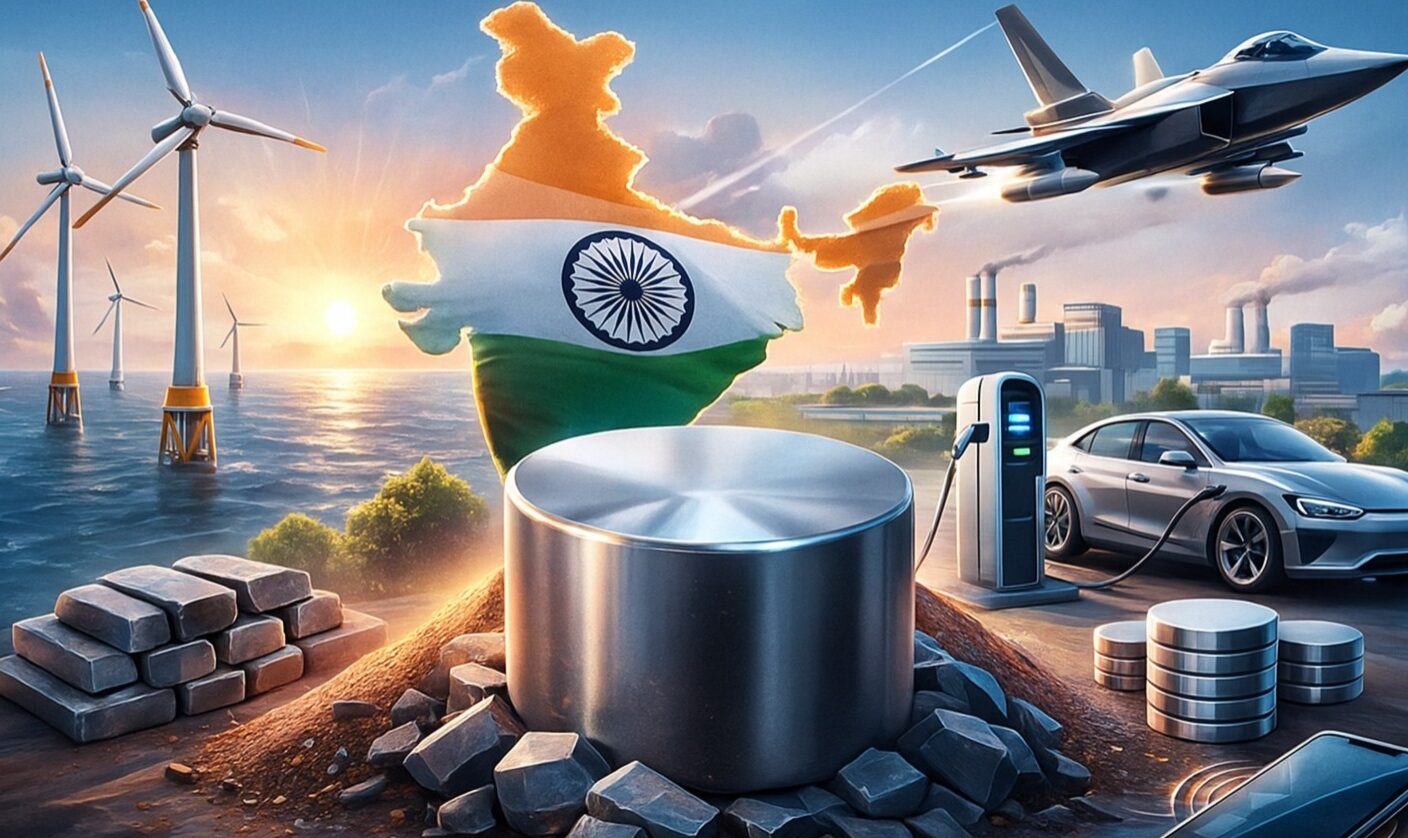
A quiet but powerful shift has taken place in New Delhi. With the Union Cabinet approving India’s first Production-Linked Incentive (PLI) scheme dedicated to sintered Rare Earth Permanent Magnets worth ₹7,280 crore, the country has opened the door to a new industrial future. The announcement did not come with dramatic build-up, yet its potential impact on global manufacturing is substantial.
These magnets, which are made of materials like neodymium-iron-boron and samarium-cobalt, are among the most powerful magnets that current technology knows. Without them, electric vehicles would not be able to operate efficiently, the huge force required for offshore wind turbines to turn would not be possible, the accuracy of fighter jets and missile systems would not be preserved, the vibration engines in smartphones would not work and, in fact, magnets are also the enablers of indispensable medical equipment. Their power density is significantly greater than that of conventional ferrite magnets, which is why they are the driving force behind compact yet powerful devices.
A Global Race Powered by Soaring Demand
Currently, rare earth permanent magnets are undergoing a skyrocketing demand one of the fastest in modern industry history. Just in 2024, the electric vehicle market used more than 37 kilotons of NdFeB magnets, which is a notable increase compared to the year before. The worldwide trends in clean mobility, renewable energy, defence technology, and high-end electronics are behind this rapid expansion.
Despite this global appetite, the world is heavily dependent on a single country for supply: China. It has maintained firm control over rare-earth mining, processing, and magnet manufacturing for decades. With command over the entire supply chain, China has previously tightened exports using quotas, licensing requirements, and unexpected restrictions. Such actions have caused steep price spikes and disrupted industries around the globe.
India’s Long-Neglected Potential Takes the Stage
India’s decision is quite significant when you consider its intrinsic advantages as well. The nation is home to the third-largest rare-earth reserves globally. The coastal areas of Odisha, Andhra Pradesh, Tamil Nadu, and Kerala are endowed with monazite-rich sands, which are the most common naturally occurring materials of rare-earth elements. However, the country has been sitting on this treasure for over seventy-five years. The country was contributing less than one percent to the total global production of rare-earth oxide and was almost non-existent in the production of finished magnets.
The newly approved scheme marks a fundamental change in mindset. India is now focused on building a complete domestic supply chain that begins with processing its own minerals and ends with producing high-grade sintered magnets for advanced applications.
Also Read: Skyroot Aerospace Unveils 75-ft Vikram Rocket Monument in Hyderabad
A Structured Plan Designed to Scale Fast
The PLI scheme is tightly designed with clear goals. Out of the total ₹7,280 crore outlay, ₹6,450 crore will be used as sales-linked incentives spread over five years, while ₹750 crore is reserved for capital support. The government aims to establish five major integrated facilities that can together manufacture up to 6,000 tonnes of NdFeB and SmCo magnets annually. This scale is intended to meet the needs of industries such as electric vehicles, renewable energy, defence, and advanced electronics.
To avoid concentration of capacity, each plant will be limited to 1,200 tonnes per year. The selection of companies will take place through a global bidding process. Participants must also share critical technologies, including the closely guarded sintering and advanced coating processes required for high-performance magnets. Commercial production is expected to begin within two to three years, and the goal is to achieve full indigenisation of top-grade magnet types within four years.
How Multiple Sectors Stand to Gain
Once production begins, its ripple effects will touch several industries.
Automobiles and Clean Energy:
Locally produced magnets will lower the cost of motors used in electric vehicles and reduce reliance on imported components. Wind energy firms will also gain steady access to essential magnet supplies, ensuring smoother project execution.
Defence and National Security:
Advanced magnets are fundamental for engines, actuators, guidance systems, and propulsion units. Indigenous production helps eliminate strategic vulnerabilities and strengthens India’s defence preparedness.
New Technology Horizons:
Industries such as high-efficiency rail systems, maglev concepts, advanced cooling devices, and next-generation electronics will finally have room to expand. Research hubs in Bengaluru, Hyderabad, and Chennai are already exploring how to support future innovation in this field.
Challenges That Require Skill and Precision
Despite the opportunities, several challenges remain. Processing monazite demands strict safety measures due to its mild radioactivity. Producing sintered magnets requires exceptional precision and advanced machinery. Global competitors have decades of expertise and may not easily relinquish their dominance.
However, India has repeatedly proven its ability to scale quickly. Its success in smartphones, solar manufacturing, and drones shows how rapid execution can reshape entire industries. With the same determination, the rare-earth-rich sands along India’s coast may soon become the foundation for innovations used across the world.
From Natural Reserves to Global Competitiveness
An initiative centered around magnets is not just an industrial announcement for India. It signifies India’s increasing assurance of constructing strategic, sophisticated, and high-value sectors. With the help of plentiful natural resources, the nation is converting itself into a technologically advanced country and is thus ready for a future that is more self-reliant, strong, and able to compete on a global scale.
Also Read: India’s Q2 GDP Growth Hits 8.2 Percent as Economy Maintains Strong Momentum
















