

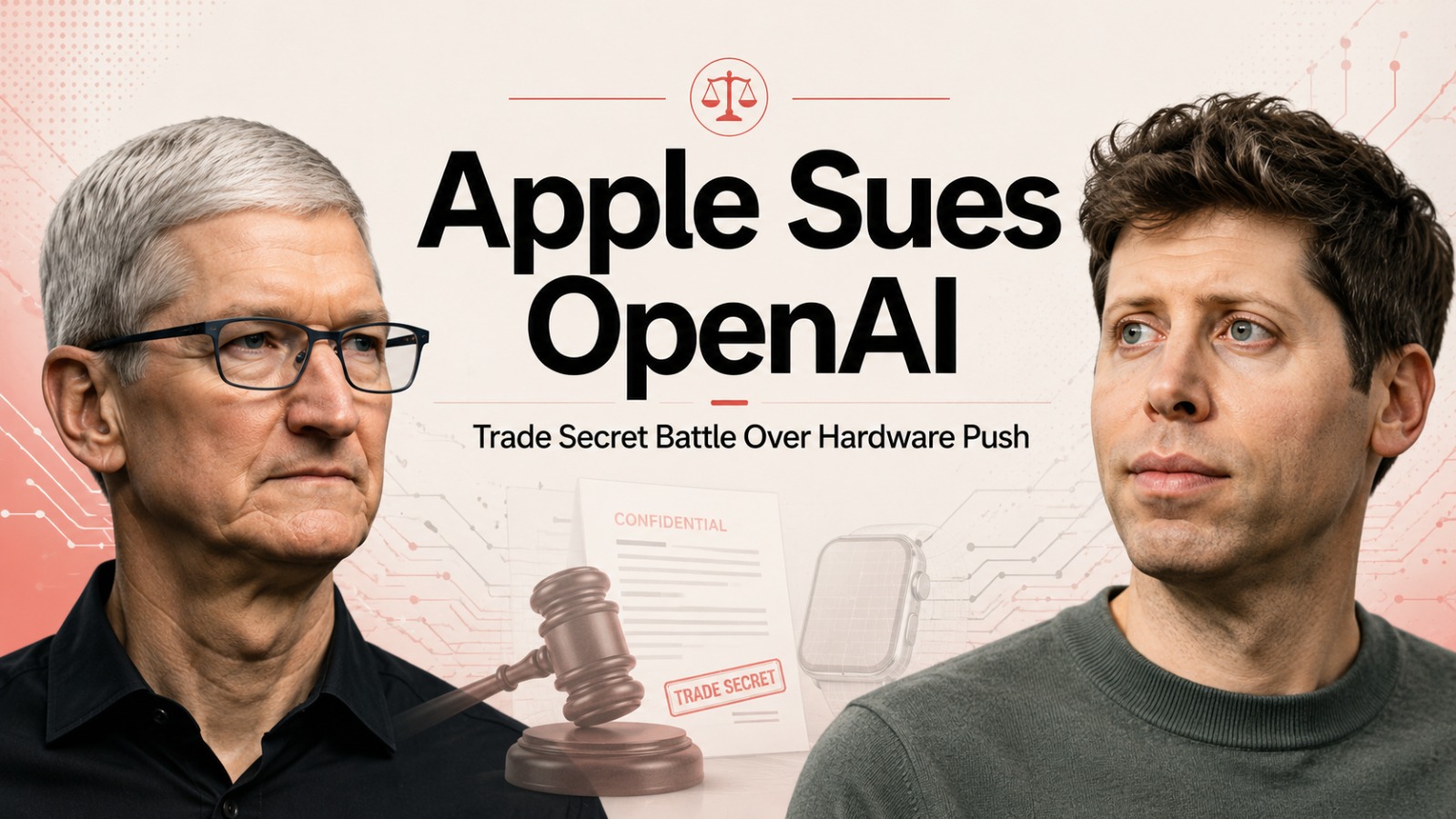
Apple has filed a lawsuit against OpenAI and two former employees, accusing them of improperly using confidential company information to support OpenAI’s expansion into consumer hardware.
The case was filed in the US District Court for the Northern District of California. Apple alleges that OpenAI recruited employees with access to sensitive projects and benefited from proprietary information covering unreleased hardware, engineering processes, manufacturing practices, supplier relationships and product development plans.
OpenAI has rejected the allegations and said its hardware programme is being built through its own research, engineering and innovation.
Apple alleges coordinated effort to obtain confidential information
At the centre of the dispute is Apple’s claim that the movement of employees from its organisation to OpenAI went beyond ordinary recruitment.
The complaint alleges that former Apple employees retained or transferred confidential material after leaving the company. Apple argues that OpenAI gained access to information that could help it shorten development timelines and strengthen its position in the emerging market for artificial intelligence devices.
The company has accused OpenAI and the former employees of trade secret misappropriation, unauthorised retention of proprietary data and misuse of confidential engineering and manufacturing information.
Apple is seeking financial damages, the return of its confidential material and court orders preventing any further use of the information in question.
The allegations have not yet been proven in court.
Two former Apple employees named in case
The lawsuit names two former Apple employees who later joined OpenAI’s hardware organisation.
Apple claims that one former engineer kept confidential company materials after leaving. Another former executive is accused of encouraging the exchange of proprietary information during recruitment discussions.
The company maintains that sensitive internal documents and hardware-related material remained accessible after the employees’ departure. It argues that the conduct violated confidentiality obligations and legal protections covering trade secrets.
The identities of the employees were not detailed in the information provided.
OpenAI’s hardware ambitions come under scrutiny
The legal action places OpenAI’s growing interest in consumer hardware at the centre of the case.
Apple has linked its concerns to OpenAI’s recruitment of experienced engineers, the acquisition of AI hardware startup io Products and the involvement of former Apple design and hardware executives in the development of new devices.
The lawsuit suggests that confidential knowledge from Apple may have been used to support those efforts. OpenAI denies that claim.
The dispute is significant because it comes as artificial intelligence companies move beyond software and into physical products. Companies are exploring wearables, personal AI assistants, edge computing, custom chips and devices designed around AI-first interactions.
As that competition intensifies, engineering talent and internal product knowledge have become increasingly valuable.
OpenAI says its work is independently developed
OpenAI has said it has no interest in using a competitor’s trade secrets.
The company maintains that its hardware work is based on its own research and technical development. It is reviewing the lawsuit and plans to contest the allegations through the legal process.
The response sets up a direct conflict between Apple’s claim that confidential information helped accelerate OpenAI’s hardware plans and OpenAI’s position that its programme has been developed independently.
Case could test hiring practices in the AI industry
The lawsuit may raise wider questions about how technology companies recruit employees from competitors while protecting confidential information.
Employee movement is common across the technology industry, particularly in specialised areas such as hardware engineering, chip development, industrial design and artificial intelligence. The legal dividing line often depends on whether employees take general experience and skills to a new role or carry protected company information with them.
The court is expected to examine whether Apple’s trade secrets were accessed, retained or transferred, as well as whether OpenAI used any such information in its hardware programme.
The role of the former employees, the nature of the material involved and any potential impact on OpenAI’s development work are also likely to be closely examined.
A partnership gives way to a legal confrontation
The case marks a sharp turn in the relationship between Apple and OpenAI. The companies have previously worked together on AI integrations, but their interests appear to be moving closer as both pursue products shaped by artificial intelligence.
That shift has added a competitive layer to a relationship that was previously associated more closely with collaboration.
The litigation could take months or years to resolve. For now, Apple’s claims remain allegations, while OpenAI has made clear that it intends to defend itself.
The eventual outcome could influence how technology companies manage employee departures, recruitment from competitors and access to confidential information as the race to build consumer AI hardware gathers pace.
Also Read: Indian Railways cuts advance ticket booking window to 60 days















