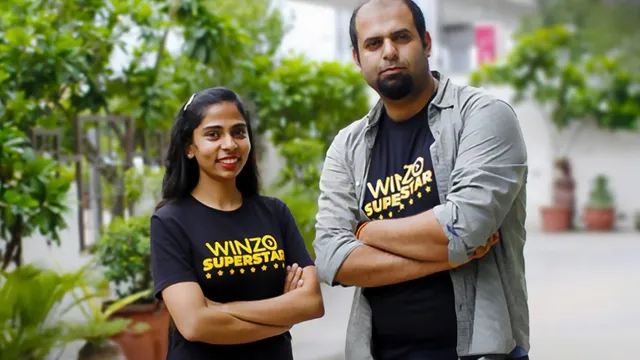
The Enforcement Directorate (ED) has arrested online real-money gaming platform WinZO’s co-founders, Saumya Singh Rathore and Paavan Nanda, in a money laundering case under the Prevention of Money Laundering Act (PMLA). The agency has also frozen assets worth about ₹505 crore linked to the company after searches at multiple premises.
Taken into custody after questioning in Bengaluru
According to officials, Rathore and Nanda were summoned to the ED’s Bengaluru zonal office on 26 November. They were taken into custody after a round of questioning and later produced before a local court, which remanded them to one-day ED custody.
The duo is expected to be brought back before the court again for detailed arguments as the agency seeks to build its case around alleged irregularities in WinZO’s real-money gaming operations.
Raids on WinZO in Delhi and Gurugram, assets worth ₹505 crore frozen
The arrests come days after the ED carried out searches at four locations linked to WinZO in Delhi and Gurugram earlier this month. Following those searches, the agency moved to freeze assets worth around ₹505 crore held in the form of bank balances, bonds, fixed deposits and mutual funds.
These assets were frozen under Section 17(1A) of the PMLA, a provision that allows the agency to provisionally attach or freeze property it believes is involved in money laundering.
ED allegations: algorithms instead of humans, blocked withdrawals
In a statement issued on 24 November, the ED said its probe had found that WinZO was engaged in “criminal activities and unscrupulous practices”. The agency alleged that:
- Players were made to compete against algorithms or software, rather than real human opponents,
- Users were not informed that they were playing against software, and
- The alleged conduct took place in real-money games, where users stake actual funds.
The investigation further claimed that WinZO restricted or prevented withdrawals of money that users held in their gaming wallets. According to the ED, around ₹43 crore remains with the company and has not been refunded to players, even though there has been a ban on real-money games since 22 August.
At the same time, the agency noted that the new online gaming law is yet to come into effect. Draft rules notified on 2 October propose a 180-day window for gaming companies to return funds owed to users once the law becomes operational.
Overseas operations and US account under scrutiny
The ED has also turned its focus to WinZO’s overseas footprint. Its probe has alleged that:
- WinZO operated real-money games for users in Brazil, the United States and Germany from India,
- The same gaming platform was used for both Indian and overseas markets, and
- These operations were being controlled from India.
As part of this overseas angle, the agency has pointed to about USD 55 million (approximately ₹489.9 crore) allegedly parked in a bank account in the United States in the name of WinZO US Inc. The ED has described this entity as a “shell company”, stating that its day-to-day activities, operations and bank account management are all handled from India.
Company response: “fully cooperating”, says fairness is core
WinZO has said it is cooperating with the investigation. In its statement on 24 November, the company said it has been “cooperating fully with the investigating agency” and “will continue to support the process”.
The company added that fairness and transparency are central to how it designs and operates its platform, and that its focus is on protecting users and ensuring a secure, trustworthy experience. WinZO also asserted that it remains fully compliant with applicable laws.
Wider action against real-money gaming firms
WinZO is not the only gaming firm under the ED’s scanner in this probe. Alongside the action against the company and its founders, the agency has also frozen eight bank accounts holding about ₹18.75 crore linked to Gameskraft and Nirdesa Networks (Pocket52).
Earlier this year, Gameskraft suspended operations of its poker platform Pocket52, describing the move as part of a broader reassessment of its long-term strategy.
With the arrests of Saumya Singh Rathore and Paavan Nanda, the WinZO case has moved into a sharper enforcement phase. The next hearing before the local court, and the ED’s subsequent filings, will determine how the allegations around algorithms, user funds and overseas operations are tested in court under the PMLA framework.
For now, the case has placed both WinZO and the broader real-money gaming ecosystem under an intense legal and regulatory spotlight, at a time when the sector is awaiting the formal rollout of India’s new online gaming regime.
Also Read: Harmonic Raises $120M to Advance Its Quest for Mathematical Superintelligence