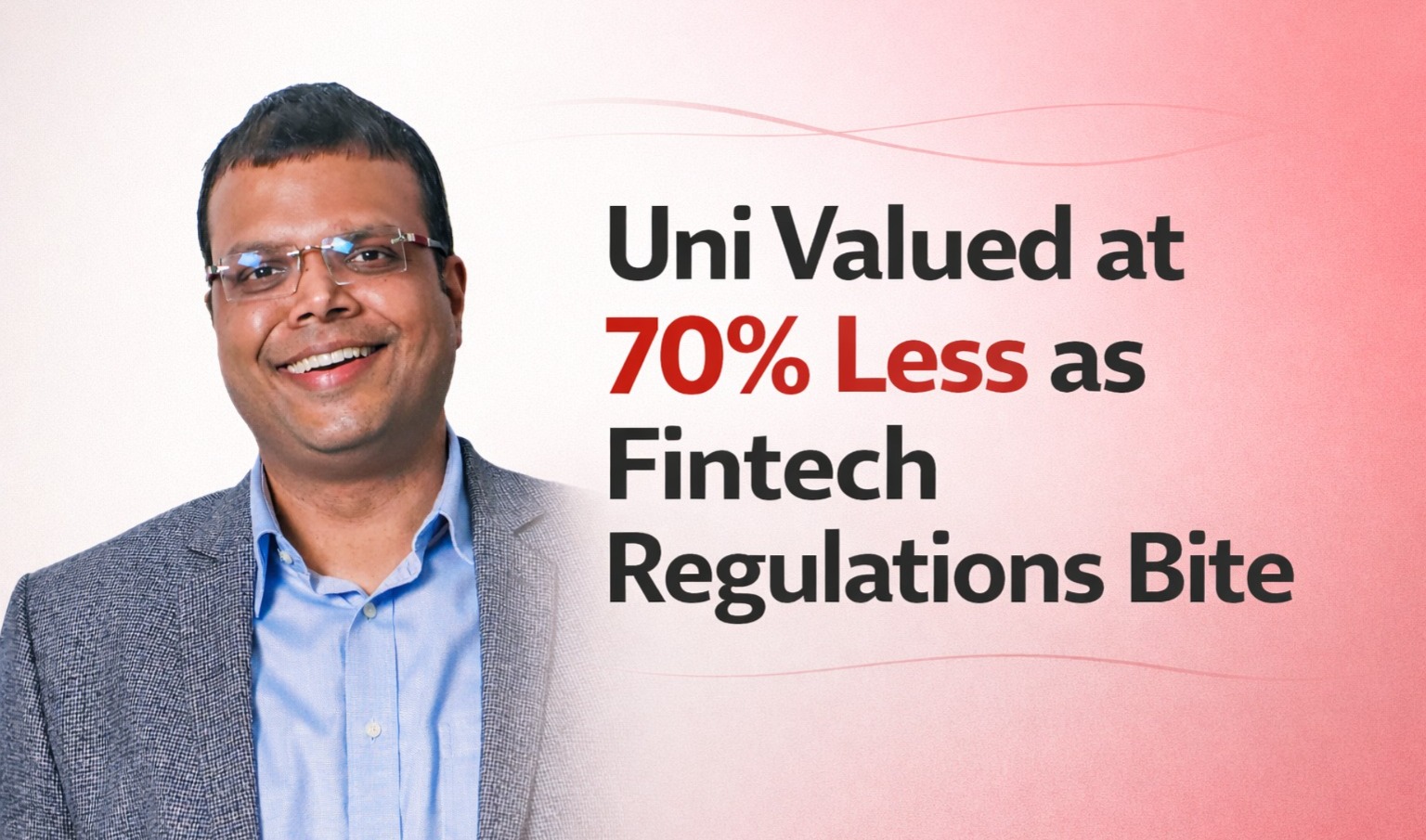
Credit card startup Uni is seeking fresh capital at a steep markdown, a sign of how sharply India’s fintech landscape has changed under tighter regulation and slower lending growth.
The Bengaluru-based company, backed by investors such as General Catalyst, Accel and Lightspeed, is in talks to raise about $18 million in a new round that could value the business at roughly $95 million post-investment.
That would mark a drop of more than 70% from its previous valuation of around $350 million. At the heart of the reset is a broader shift in the fintech credit market. Uni, which once built its proposition around quick credit and buy-now-pay-later offerings, has pulled back from personal loans and moved its focus to credit card distribution. The company is now offering co-branded cards with Bob Card and Yes Bank, with rewards and cashback features that can be converted into gold.
That pivot did not happen in isolation. It reflects the pressure that regulatory action has placed on several consumer fintech models over the past few years.
The Reserve Bank of India’s 2022 move against credit lines loaded onto prepaid cards and wallets disrupted players such as Uni and Slice. Later, tighter scrutiny of data-sharing arrangements between banks and fintech partners in co-branded credit cards further altered how such companies could operate. In 2024, stricter rules for peer-to-peer lending added another layer of pressure, especially for firms that had exposure to that segment.
For Uni, those policy changes appear to have directly affected the business it had tried to build. The company had worked with non-banking lenders and peer-to-peer platforms such as Liquiloans and Lendbox to offer consumer loans. It also acquired P2P lending startup OmlP2P in April 2023, but that business did not scale after central bank interventions in the sector. As reported, new loan disbursals have stopped and the company is currently servicing existing borrowers while functioning as a loan platform.
Even so, Uni is not absent from the market. Chief executive Nitin Gupta told The Economic Times that the company is issuing more than 40,000 credit cards a month. That is still a modest share in a market where Indian banks issue around 850,000 cards every month, but it shows the startup continues to operate in the cards segment despite the disruption to its earlier lending model.
The fundraising effort, if completed on the reported terms, would underline a hard truth that has become increasingly visible across Indian fintech: scale and brand recall are no longer enough to preserve valuations when the underlying business model faces regulatory friction. Investors are now pricing companies more conservatively, especially when revenue growth has slowed and compliance-driven business adjustments have become unavoidable.
Uni’s recent financials reinforce that reality. The company closed FY25 with revenue of Rs 95 crore and a net loss of Rs 151 crore. That was broadly flat compared with FY24, when it posted revenue of Rs 100 crore and a net loss of Rs 167 crore The numbers suggest that while losses have narrowed slightly, the company is still some distance from a materially stronger financial position.
Founded in 2020 by Nitin Gupta, along with Laxmikant Vyas and Prateek Jindal, Uni entered the market with an ambition to make short-term credit faster and more consumer-friendly. Gupta had earlier led the financial services business at Ola. Over time, however, the business environment around digital lending changed faster than many startups expected. One cofounder, Prateek Jindal, exited in 2024 to start wealthtech startup Powerupmoney.
The latest developments around Uni also capture a wider trend in Indian fintech: the market is no longer rewarding promise alone. It is rewarding durability, regulatory alignment and business models that can survive policy tightening. For startups that grew during the easy-money cycle of 2021, the current moment is forcing a difficult but necessary reset.
In Uni’s case, the question is no longer just how much money it can raise. It is whether a company built for a more permissive fintech era can reinvent itself for one defined by caution, compliance and constrained growth.
Also Read: Edorica Luxury Skincare: India’s Rising Clean Beauty Brand