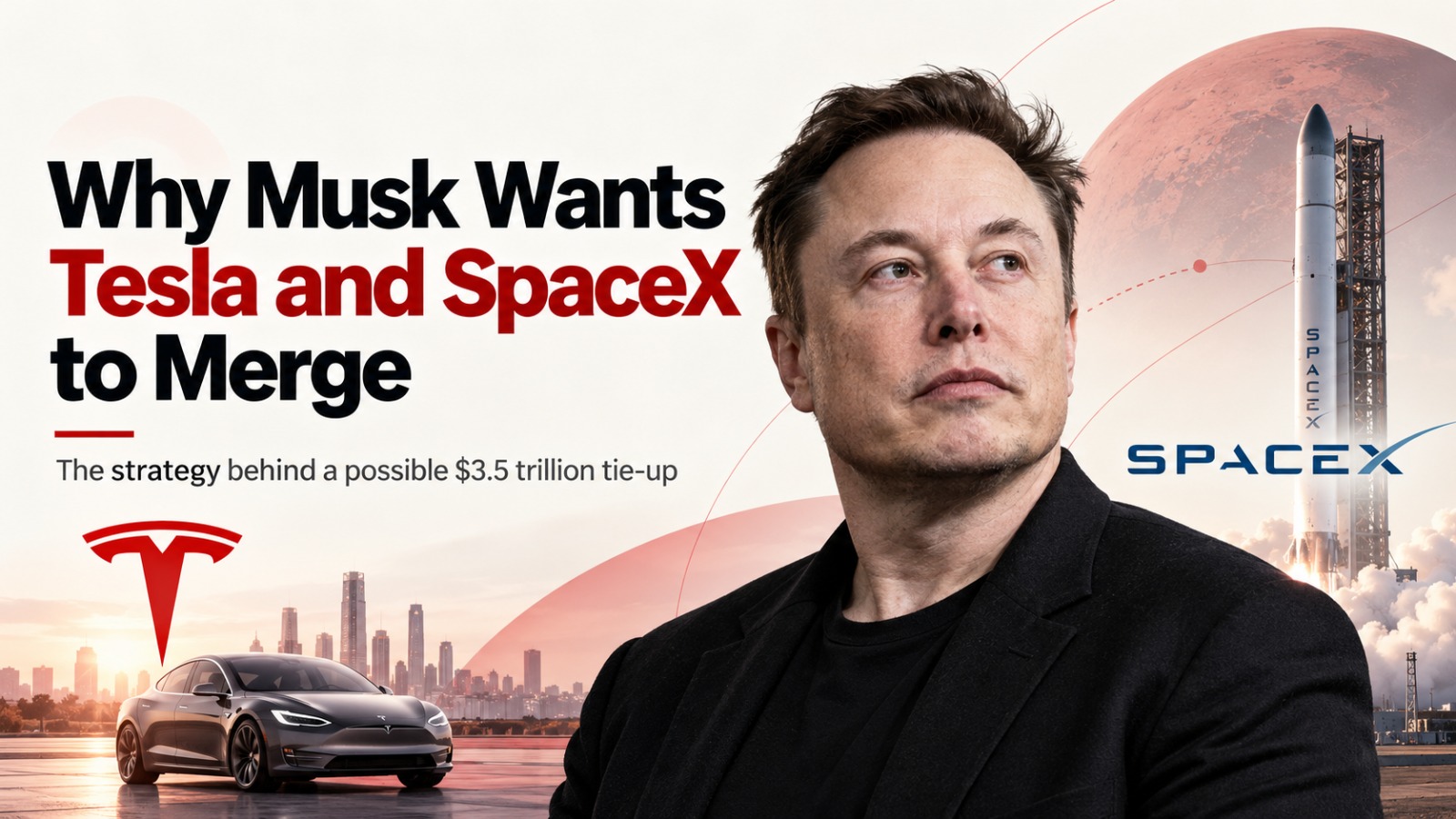
Elon Musk wants to bring Tesla and SpaceX closer together, and he now believes merging the two companies could make sense.
On Tuesday, October 20, Musk publicly supported the idea of combining the electric vehicle manufacturer and the space exploration company into a business potentially worth around $3.5 trillion.
At first glance, the proposal seems unusual. Tesla makes electric cars, develops autonomous driving technology and builds energy-storage systems. SpaceX launches rockets, operates Starlink satellite internet services and is working on future space infrastructure.
So what would either company gain by merging with the other?
The explanation lies in Musk’s expanding ambitions in artificial intelligence, robotics and computing. Both Tesla and SpaceX increasingly need similar technologies, from powerful semiconductors to advanced manufacturing systems.
A merger could allow them to share resources and coordinate major projects more easily. However, it could also expose investors to new risks and invite greater regulatory scrutiny.
Here is what the potential Tesla-SpaceX merger could mean.
1. Why Does Elon Musk Want to Merge Tesla and SpaceX?
The central argument for a merger is that Tesla and SpaceX are no longer operating in completely separate technological fields.
Tesla is moving beyond electric vehicles into autonomous driving, AI-powered robots and energy technology. SpaceX, meanwhile, is expanding beyond rocket launches into satellite communications and potentially space-based computing infrastructure.
Both companies require advanced chips, large amounts of computing power and sophisticated manufacturing capabilities.
Elon Musk believes combining them could accelerate work on these technologies.
A merger could also remove some of the organisational barriers that currently exist between the companies. Projects involving both businesses require decisions from separate management teams, boards and shareholders.
Under one corporate structure, capital, engineering expertise and infrastructure could potentially be allocated more freely.
There is also the issue of Musk’s influence. He owns nearly one-fifth of Tesla and holds voting control at SpaceX. Bringing the two businesses together could consolidate his influence over their strategic decisions.
2. What Is Terafab, and Why Is It Important to the Merger?
Terafab may be one of the clearest examples of why Musk sees value in combining Tesla and SpaceX.
It is a semiconductor and AI-computing project intended to produce advanced chips for technologies being developed across both companies.
Tesla needs powerful chips for its autonomous vehicles and Optimus humanoid robots. SpaceX needs computing capabilities for its AI ambitions and proposed data-centre infrastructure.
Rather than treating those requirements as entirely separate, Terafab is intended to support both.
Musk has indicated that he hopes the project can begin volume production by late 2028.
A merger could potentially simplify decisions about funding, production capacity and the allocation of chips between projects.
3. How Could Starlink Help Tesla’s Robotaxis and Humanoid Robots?
Another potential advantage involves SpaceX’s Starlink satellite network.
Starlink provides satellite-based communications, while Tesla is developing autonomous vehicles, robotaxis and Optimus humanoid robots.
In the future, Starlink could provide communications connectivity for those Tesla technologies.
This is a possible area of cooperation rather than confirmation that Tesla’s robotaxis or robots will rely on Starlink.
Tesla’s energy-storage products could help SpaceX meet growing power requirements, particularly if its proposed data-centre projects move forward.
Tesla’s expertise in factory automation could also support SpaceX’s efforts to manufacture Starship rockets on a larger scale.
The companies could benefit from closer coordination without formally merging, although a combined structure might make such cooperation easier to manage.
4. Why Are Data Centres in Space Part of the Discussion?
One of the more unusual aspects of Musk’s vision is the possibility of developing computing infrastructure in orbit.
SpaceX is exploring an orbital data-centre concept linked to its Starmind constellation.
Such infrastructure would fit into Musk’s broader ambitions for AI computing, satellite communications and transporting large amounts of equipment into space.
A Tesla-SpaceX combination could bring together technologies relevant to these projects, including energy storage, semiconductor development, advanced manufacturing and space transportation.
A merger would not remove the difficulty or expense of building and operating such infrastructure.
5. What Would Tesla and SpaceX Investors Gain From a Merger?
A combined Tesla-SpaceX business could be valued at approximately $3.5 trillion, potentially placing it among the world’s most valuable companies.
But the benefits would differ depending on which company an investor currently owns.
For Tesla shareholders, a merger could provide exposure to SpaceX’s rocket-launch services, Starlink satellite broadband network and future space ventures.
For SpaceX investors, it could offer a stake in Tesla’s electric vehicle business, energy storage, autonomous driving technology and humanoid robotics projects.
Supporters could argue that a combined business would be better positioned to invest in expensive technologies that serve more than one division.
For example, spending on advanced chips could potentially benefit both autonomous vehicles and AI computing infrastructure.
The downside is that shareholders would also inherit risks from businesses they did not originally invest in.
An investor interested in Tesla’s automotive and energy operations would become exposed to the costs and uncertainties of space infrastructure. Similarly, SpaceX investors would face the challenges associated with autonomous vehicles and robotics.
The important question is whether the advantages of sharing technology and capital would outweigh those additional risks.
6. Why Could Tesla’s China Operations Become a Problem?
A merger could face substantial scrutiny because of the companies’ different relationships with the United States and China.
SpaceX is a major contractor for NASA, the US military and American intelligence agencies.
Tesla, meanwhile, has significant business interests in China. Its Shanghai factory is an important part of the company’s vehicle production and sales operations.
Combining a major US government space and defence contractor with a carmaker deeply involved in Chinese manufacturing could raise national-security concerns.
US authorities might examine the implications of bringing the businesses under common ownership, while the transaction could also attract attention from Beijing.
7. What Are the Biggest Risks of Combining Tesla and SpaceX?
One major concern is whether merging two highly complex companies would make them easier or harder to manage.
Tesla and SpaceX are pursuing several expensive projects that still face considerable technical challenges.
These include Starship, robotaxis, humanoid robots, AI computing infrastructure and potential orbital data centres.
Each requires substantial investment, specialised engineering and, in some cases, regulatory approvals.
Combining the businesses would not automatically make their projects commercially successful.
There are also questions about corporate governance.
Investors would need to understand how voting power would be distributed, how capital would be allocated and how possible conflicts of interest would be handled.
A larger company might be able to share resources more efficiently, but it would also need to balance competing demands from its automotive, energy, aerospace, communications and AI operations.
8. Has Elon Musk Confirmed a Tesla-SpaceX Merger?
No. Musk has publicly supported the idea of merging Tesla and SpaceX, but that is different from announcing an agreed transaction.
His comments indicate that he sees strategic value in combining the businesses.
Any potential combination would have to address shareholder interests, corporate governance and regulatory concerns.
The estimated $3.5 trillion figure describes the possible scale of a combined business, not a confirmed transaction price.
9. What Happens Next, and Why Does This Matter?
The possibility of a Tesla-SpaceX merger reflects a broader shift in Musk’s business strategy.
Tesla’s future ambitions increasingly involve AI, robotics and advanced computing, while SpaceX is pursuing opportunities beyond launch services and satellite internet.
Their interests are beginning to meet in projects such as Terafab, along with potential cooperation in connectivity, energy and manufacturing.
Whether that overlap justifies combining two companies remains an open question.
Also Read: Anthropic’s $80.7 Billion Loss: $72 Billion Accounting Twist Before IPO