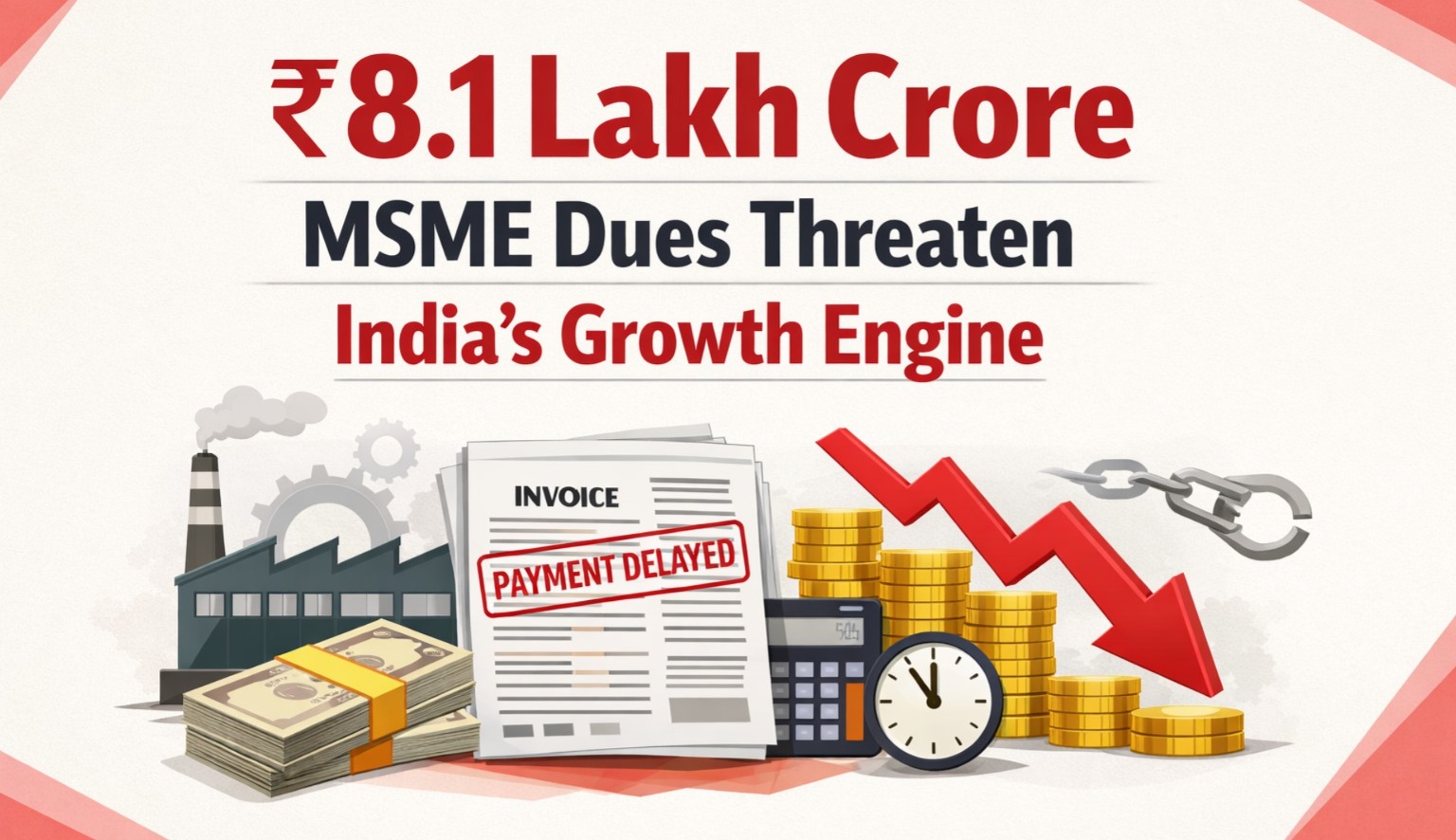
Delayed MSEM payments totaling about Rs. 8.1 lakh crore have become a major working capital constraint, as the latest Economic Survey shows, and an aspect of an ongoing stressor of the Indian business environment despite the strong macroeconomic variables.
The survey observes that since MSMEs usually have financial buffers that are low in nature, they are particularly susceptible to cash flow shocks. On-time receivables will be very important in covering the normal daily expenses like wages, procuring raw material, and repayment of loans. Delay: It notices weakening everyday functions and financial sustainability throughout the sector due to prolonged delays.
Affect Liquidity and Supply Chain.
The government procurement sector, manufacturing sector, infrastructure sector, and services sector all have their backlog of outstanding dues. Analysts confirm that delayed payments essentially force MSMEs to finance bigger purchasers, and this moves the liquidity strain along the supply chain.
These practices increase borrowing expenses of small firms and degrade balance sheets and their ability to invest in growth or productivity. In the long term, it can disrupt supply chains and slow down production cycles as well as impact employment, especially in labor-intensive industries where MSMEs are a major player.
Laws are in place, but these are not enforced equally.
The legal system of India puts the time-bound payments to MSMEs with the interest penalties in case of delays. The survey, however, notes that there is inconsistency in enforcement. Most small businesses fear taking a legal course of action against large buyers in the fear that they might lose future business opportunities.
The mechanisms of dispute resolution, existing though they may be, are often faced with delays that are limiting their efficiency. This therefore means that the unpaid dues keep accumulating regardless of statutory protection, portending a disparity between policy design and actual practice.
Policy Concentrate Before the Budget Talks.
As the Union Budget draws near, the issue of delayed payments to the MSMEs will receive increased policy focus. Economists believe that increasing the discipline in payments would free up a significant amount of liquidity to the industry without the need to spend more money in the process.
The stricter adherence to payment schedules and schedules, stronger sanctions against habitual defaulters, and the broader introduction of digital invoice-tracking and funding programs are the proposals that are discussed. The connection between prompt payments and the right to be considered eligible to bid on government contracts or credit incentives has also been proposed as the means to better the compliance.
The survey evaluation highlights that although the growth prospects in India are still strong, various structural challenges like slow payments to the MSMEs will be critical in maintaining an inclusive and widespread economic growth.
Read also: Salman Khan Commits Rs 10,000 Crore to Landmark Film Studio and Township in Telangana