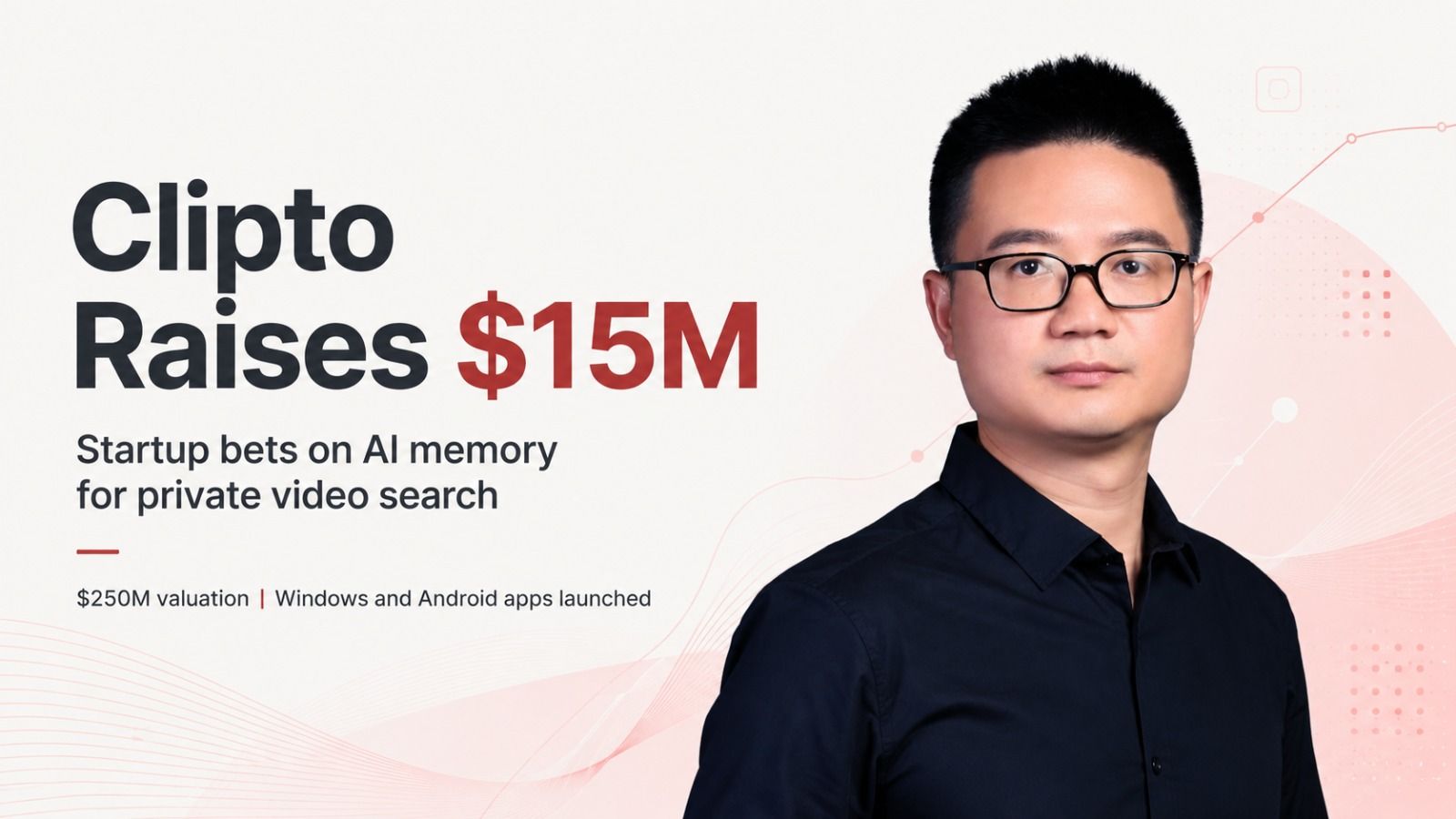
Clipto has secured $15 million in funding at a $250 million post-money valuation, giving the company fresh capital to expand its approach to turning large collections of video and audio into searchable, AI-readable libraries.
The round includes backing from HSG, formerly Sequoia China, GL Ventures, EnvisionX Capital, Palm Drive Capital, Hans Tung, Lu Zhang and 522 Ventures. Alongside the funding announcement, Clipto has launched native applications for Windows and Android and introduced a Model Context Protocol, or MCP, designed to let AI agents search users’ private media libraries.
The combination gives the funding story a broader product angle. Clipto is not simply adding another transcription or video-search tool. Its pitch is that years of footage stored across personal devices can become a searchable layer of information that both people and AI systems can use, while allowing users to keep their media local.
Clipto AI: Turning old video libraries into searchable information
Clipto’s focus is a problem familiar to anyone who has accumulated large amounts of footage: finding one useful moment can be far harder than recording it in the first place.
The company says conventional workflows often involve manually scrubbing through timelines, deciphering filenames or tagging clips by hand. Cloud-based AI tools can make search easier, but Clipto argues that sending large media files online introduces privacy, bandwidth and workflow concerns.
Its alternative is built around on-device AI.
Clipto says its technology can index video and audio without sending the underlying files to the cloud. The platform combines video understanding, transcription, summaries, structured video notes and semantic search, allowing users to search their media using natural-language queries.
The company also supports integrations with video-editing applications including Adobe Premiere. Users can choose to carry out searches on-device, while the newly introduced MCP functionality enables AI agents to query video libraries for search and analysis.
That local-search model is central to Clipto’s positioning. Rather than treating every video as an isolated file, the company wants a user’s existing archive to function more like a private body of searchable knowledge.
A search that can reach the exact moment
One detail illustrates what Clipto is trying to change.
UK restaurant photographer Alex Grubb said the challenge in his workflow was not producing footage but finding a particular moment later. According to Grubb, Clipto automatically tags his material, allowing him to enter a keyword and move directly to a relevant shot, including the precise timecode. He said searches that previously took hours could be completed in seconds.
That use case gets to the practical side of the company’s larger “memory layer” argument. A vast archive has limited value if neither its owner nor an AI assistant can quickly locate what is inside it.
Clipto says its platform is already used by more than 30 million people worldwide, including professionals working at Google, Apple, Amazon, Meta, Microsoft and McKinsey. The company does not state that those organisations themselves are customers, only that professionals from those organisations are among its users.
Clipto wants AI to remember, not only generate
Founder and CEO Henry Kang is positioning the company around a gap he sees in the current generation of AI products.
“AI needs a memory layer, not just a reasoning layer,” Kang said, arguing that generative tools have become better at creating content but still struggle to make sense of the large volumes of personal media people have accumulated over time.
He said the latest funding will support infrastructure that allows users and AI agents to search, understand and work with private media while retaining control over their data.
The company’s immediate focus is video, where unstructured archives can quickly grow too large for manual organisation. But Clipto’s stated ambition goes further, towards helping AI understand information accumulated across years of work.
That strategy also explains the significance of MCP support. If AI agents are going to work with personal information rather than simply respond to individual prompts, they need a way to retrieve relevant material. Clipto is attempting to make private video and audio libraries part of that retrieval layer without requiring users to move their entire archive into the cloud.
Windows and Android broaden the platform
The latest launches extend Clipto beyond its existing availability on web, Mac and iOS. Windows and Android support gives the platform a wider device footprint at the same time as it opens its indexed libraries to compatible AI agents through MCP.
Founded in 2023, Clipto describes its business as privacy-first AI memory infrastructure for personal media. Its platform is aimed at creators, professionals and enterprises managing large collections of video, audio and other unstructured material.
With the $15 million round, the company now has fresh funding to pursue that idea at a time when its product is moving beyond human search alone. The larger bet is that the next useful step for AI may not be generating another piece of content, but finding the exact piece of information a user already owns.
Also Read: Sugar Cosmetics Raises Rs 144.5 Cr as Valuation Drops to Rs 755 Cr