

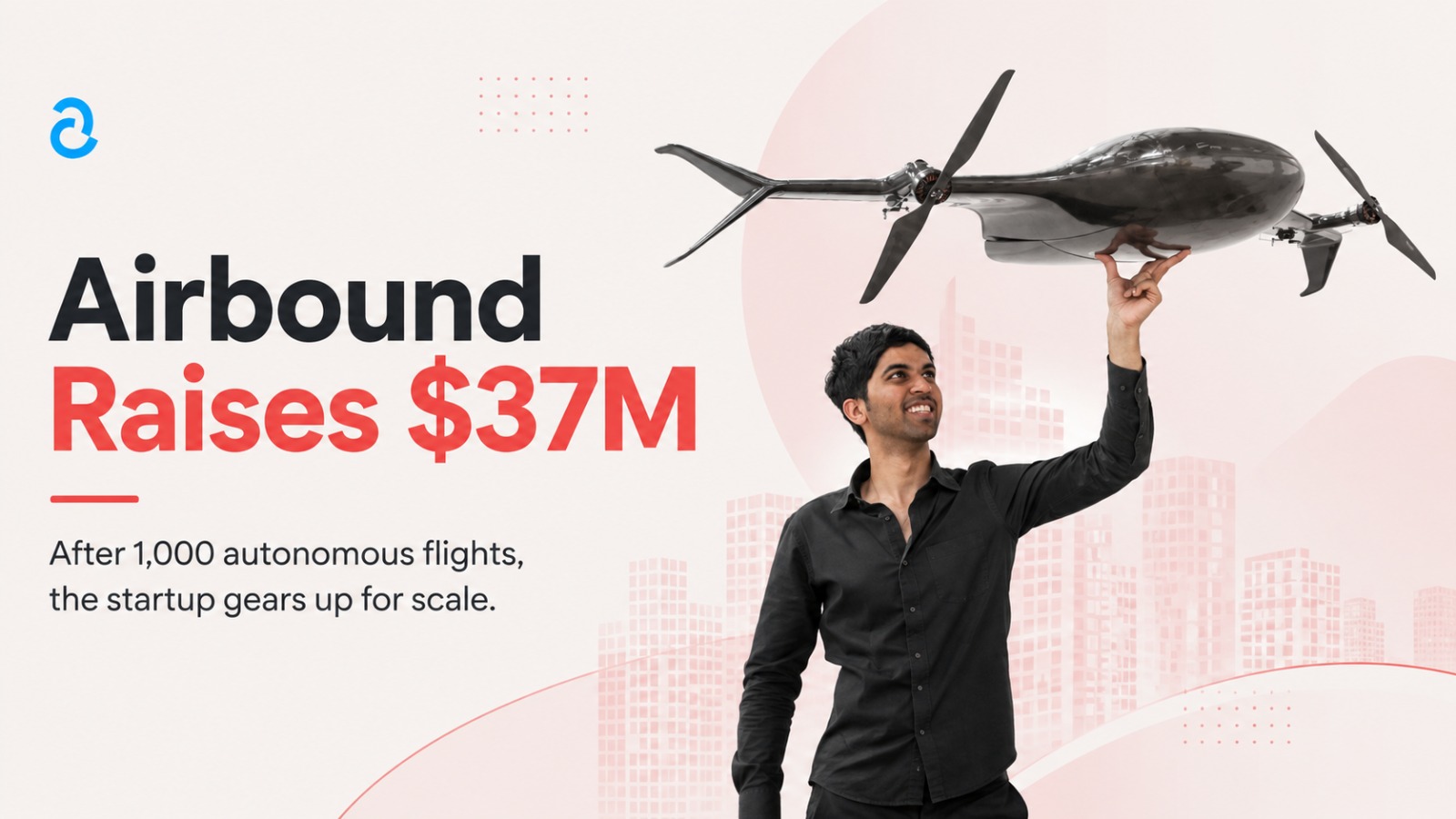
Aerospace startup Airbound has raised $37 million in a Series A funding round as it looks to move its lightweight autonomous aircraft technology toward larger commercial deployments.
Greenoaks led the round, while DoorDash, Lachy Groom, Lightspeed and Humba Ventures participated. The latest investment takes Airbound’s total funding to nearly $50 million since the company launched in 2023.
Airbound plans to direct the new capital toward engineering and commercial-scale manufacturing, two areas that will be central to its effort to take autonomous aircraft beyond smaller deployments.
The company, founded by Naman Pushp, is developing lightweight autonomous aircraft for moving people and goods. Its central argument is that reducing the amount of aircraft weight needed to carry a payload could bring down the economics of air transportation.
Airbound says its aircraft is designed to carry either a single passenger or around 100 kg of cargo. The company is working on an aircraft architecture that requires significantly less vehicle weight to move that payload, an approach it believes could make autonomous aerial transportation commercially viable.
More than 1,000 autonomous flights already completed
The fundraise comes with Airbound having already put its technology through more than 1,000 autonomous flights.
Those flights have included the movement of diagnostic samples between healthcare facilities. Airbound says the programme has cut delivery times that previously took hours to just minutes.
That operational milestone offers an important backdrop to the new funding. Airbound is not limiting its plans to aircraft development alone. It is also preparing for a substantially larger deployment in Andhra Pradesh.
The company has signed a commercial deployment agreement with the Andhra Pradesh government to create an autonomous drone delivery network connecting three cities.
Airbound plans to scale that network to 10,000 flights a day, with the system intended to support retail and healthcare deliveries, among other use cases outlined by the company. Airbound sees the Andhra Pradesh deployment as a model that could eventually support the expansion of aerial delivery networks elsewhere in India.
Passenger travel remains part of the longer-term plan
Cargo and delivery operations form the more immediate part of Airbound’s rollout, but the company’s ambitions extend to passenger transportation.
Airbound eventually wants to use its aircraft for intercity travel. One of the scenarios it has outlined is a journey of about 300 km completed in roughly 20 minutes.
That remains a longer-term ambition rather than a current commercial service. The company is betting that advances across aircraft design, autonomous systems and materials science can lower the cost of air transportation enough to widen the practical use of autonomous aircraft.
For now, the $37 million Series A gives Airbound fresh capital to work on the engineering and manufacturing required for that expansion. At the same time, its planned Andhra Pradesh network will test whether a model built around thousands of autonomous flights each day can move from a technical proposition into a commercially deployed transportation system.
Also Read: Neno nears 200 customers months after Q1 launch, raises €6.6m Seed to build Ambient AI back office















