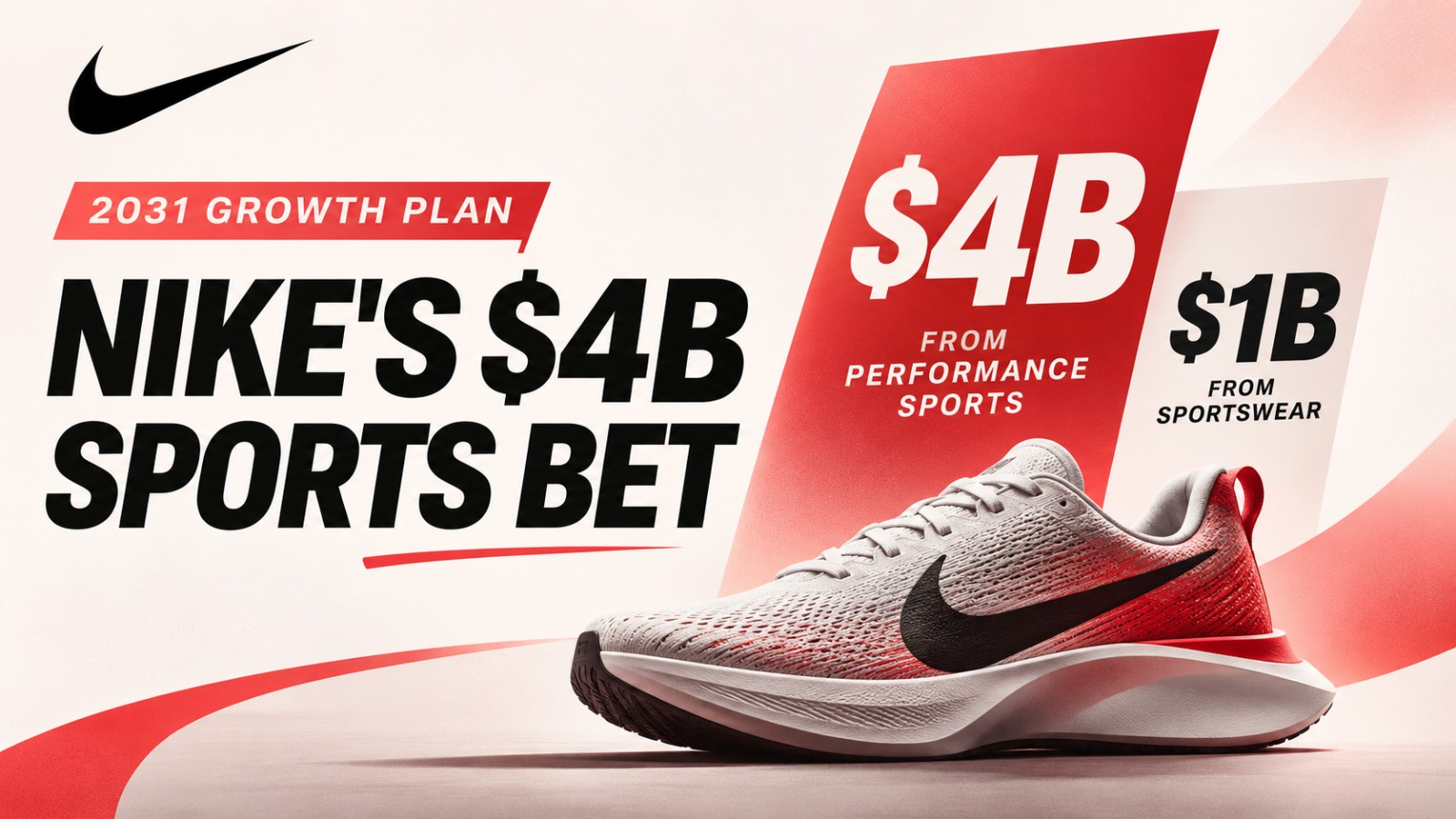
Nike has unveiled a new growth strategy that places performance sports at the centre of its long-term recovery, targeting approximately $5 billion in additional annual revenue by fiscal 2031 compared with fiscal 2027.
The company expects roughly $4 billion of that growth to come from Performance Sports, while Sportswear is projected to contribute the remaining $1 billion.
The targets form part of Full Stride Ahead, Nike’s new strategy announced at its 2026 Investor Day. The plan aims to strengthen product innovation, bring the company closer to local markets and improve operational efficiency.
However, the road to recovery is expected to be gradual, with Nike forecasting another decline in revenue during fiscal 2027.
Five Sports and 23 Countries at the Centre of Nike’s Strategy
Nike is concentrating its resources on five priority performance categories: Running, Training, Global Football, Basketball and Outdoor.
Alongside these categories, the company plans to strengthen its Sportswear business, which includes Nike Sportswear, Jordan and Converse.
Each brand has a distinct role in the strategy. Nike wants to introduce more distinctive and culturally relevant Sportswear products, restore Jordan’s premium positioning and sharpen Converse’s focus on lifestyle and creative culture.
Geography will also play a major role. Nike has identified 23 priority countries where it intends to concentrate resources and strengthen relationships with athletes and communities.
Together, its priority performance categories, Sportswear business and geographic focus are expected to generate more than 90% of the company’s revenue growth through fiscal 2031.
“We’re concentrating our resources where we have the greatest potential to win,” said Nike President and CEO Elliott Hill.
Nike Expects a Difficult 2027 Before Growth Returns
Despite its ambitious long-term targets, Nike does not expect an immediate turnaround.
The company reaffirmed its fiscal 2027 guidance, projecting a high-single-digit percentage decline in revenue. Operating income is expected to fall faster than sales.
Nike forecasts an adjusted operating margin of approximately 6% and adjusted earnings per share of $1.15 to $1.35 for fiscal 2027. The earnings forecast excludes approximately $0.15 per share in restructuring expenses.
The company expects revenue declines to ease in fiscal 2028 before returning to market-level growth in fiscal 2029.
Nike then aims to grow faster than the broader market in fiscal 2030 and fiscal 2031 as its investments and productivity initiatives begin delivering stronger results.
A $2.5 Billion Savings Plan to Support Profitability
Cost reductions are another important part of Nike’s recovery strategy.
Through its previously announced Pace initiative, the company expects approximately $2.5 billion in annualised savings by fiscal 2031, with benefits beginning in fiscal 2027 and increasing during fiscal 2029 and 2030.
Implementing the programme is expected to cost approximately $1.3 billion before tax, including $300 million already recognised in fiscal 2026 and another $300 million expected in fiscal 2027.
The projected savings are calculated before implementation charges and any future reinvestment.
Nike is targeting an operating margin of 12% to 14% and adjusted earnings per share of $3.00 to $3.50 by the end of fiscal 2031.
It also expects to return approximately $12 billion to shareholders through dividends from fiscal 2027 through fiscal 2031.
Faster Product Development and Local Decisions
Beyond its financial targets, Nike is changing how it plans to develop products and respond to consumer demand.
Its strategy is built around three priorities: EPIC, which focuses on innovation and athlete demand; CONNECTED, which aims to strengthen local relationships and market relevance; and FAST, which seeks to improve speed and operating efficiency.
The company plans to accelerate product creation, build a more responsive supply network and use data, technology and artificial intelligence to support faster decisions.
Nike also intends to give priority markets greater authority over local decisions, including product assortments and consumer experiences.
The approach reflects a shift towards responding more closely to demand in individual markets rather than relying solely on centrally driven decisions.
The Real Test Begins Before 2031
Nike’s new framework sets out a recovery that will take several years rather than a single strong financial cycle.
The immediate challenge is to manage declining revenue while investing in products, local market relationships and operational changes.
Fiscal 2029 will be an important milestone, as that is when Nike expects to return to market-level growth. Its longer-term targets depend on stronger sales, improved margins and the successful implementation of its cost-saving programme.
Those outcomes are not guaranteed. Nike has identified risks including changing consumer demand, competition, tariffs, currency fluctuations and potential delays in achieving planned savings.
For now, the clearest signal from its latest strategy is where Nike believes its next phase of growth will come from: performance sports, supported by a more focused global business.
Also Read: GTA 6 Is Reportedly So Massive That 50 Hours Won’t Be Enough