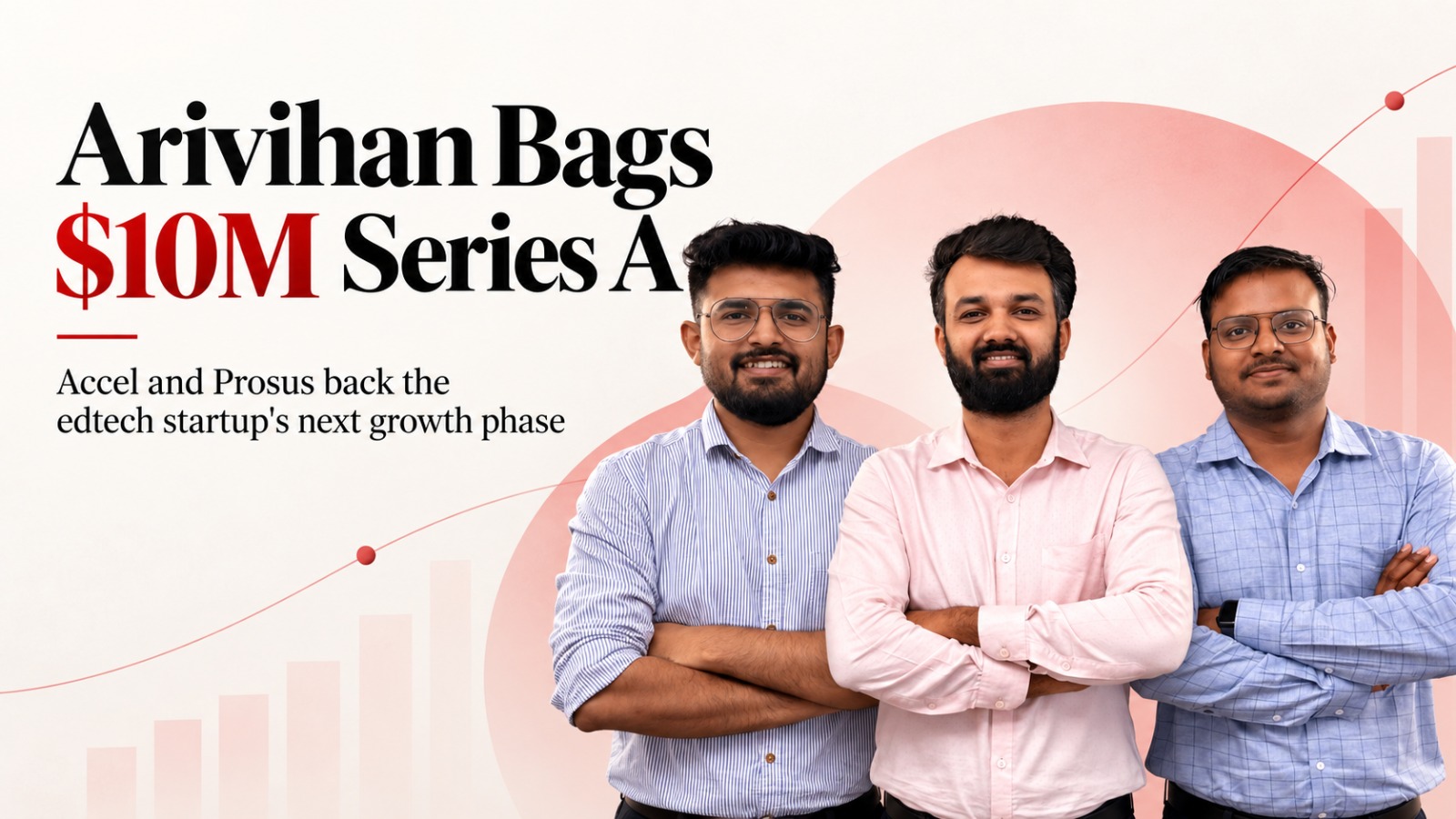
Accel and Prosus Ventures back the edtech startup again as Arivihan prepares to deepen its presence in Madhya Pradesh, Rajasthan and Bihar, expand CBSE offerings and step up AI research.
Edtech startup Arivihan has raised $10 million in a Series A funding round from existing investors Accel and Prosus Ventures, giving the company fresh capital to expand its reach among students outside India’s biggest urban centres.
The company also received an additional $200,000 from an existing GSF angel investor, taking its total funding raised so far to more than $15 million.
The new round arrives as Arivihan looks to build on a student base that is already heavily concentrated beyond metropolitan India. The company says around 80% of its subscribers come from towns and rural areas, an important part of its positioning as it prepares for its next phase of expansion.
Expansion beyond existing markets
A significant portion of the fresh capital will go towards geographic expansion.
Arivihan plans to strengthen its operations in Madhya Pradesh, Rajasthan and Bihar, while also entering new states. At the same time, the startup intends to broaden its CBSE offering, develop its vernacular-language capabilities and increase investment in artificial intelligence research.
That combination gives the expansion a wider scope than simply acquiring more students. The company is also working on the product and language layers needed to serve learners across different boards and regions.
Arivihan currently caters to students preparing for State Board, CBSE and NEET examinations, with a particular focus on learners in tier 2 and tier 3 cities as well as rural India.
An AI-led learning model without live teachers
Founded in 2022 by Ritesh Singh Chandel, Sonu Kumar and Rushabh Kothari, Arivihan operates an AI-based education platform for school students.
Its model includes interactive video lessons and AI-driven study plans and is designed to deliver learning support without depending on live teachers.
The approach places technology at the centre of lesson delivery rather than using AI only as an additional feature around a traditional live-class model.
The company is now preparing to invest further in that technology as part of the Series A deployment, alongside regional and language expansion.
Distribution and hiring also on the agenda
Arivihan’s next phase will also involve building the infrastructure required to reach more students.
The startup plans to scale its digital marketing and on-ground distribution network as it expands. It also intends to hire across key functions and introduce new crash courses.
The emphasis on physical distribution alongside digital marketing is particularly relevant to Arivihan’s existing audience, given the company’s concentration in smaller cities and rural markets.
Arivihan was previously part of Accel’s Atoms accelerator programme and received seed funding through the programme in March 2024.
With Accel now participating again alongside Prosus Ventures, the Series A represents continued backing from investors already associated with the business rather than an entirely new investor group.
Revenue climbs sharply, though losses remain
Arivihan has yet to file its financial statements for FY26, but its FY25 numbers show a substantial increase in revenue from a relatively small base.
Revenue rose to Rs 3.14 crore in FY25, compared with Rs 21.29 lakh in FY24, representing an increase of nearly 14.8 times. The company reported a loss of Rs 4.45 crore during FY25.
The figures indicate that Arivihan entered the current fundraising phase while still investing ahead of profitability, even as its revenue expanded considerably year on year.
The company has not yet disclosed FY26 financials in the material reviewed.
What the funding changes for Arivihan
The Series A gives Arivihan capital to pursue several growth tracks at once: entering additional states, strengthening existing markets, expanding CBSE content, improving vernacular support, increasing AI research, adding courses and building both digital and on-ground distribution.
The more distinctive part of that strategy is the audience already using the platform. With roughly four in five subscribers coming from towns and rural India, Arivihan’s expansion is centred on a segment that the company has already demonstrated an ability to reach, rather than being presented only as a future target.
How effectively it converts that reach into sustained revenue growth will become clearer once subsequent financial filings are available.
Also Read: What Is OpenAI Dots? How the New Always-On AI Agent Works