


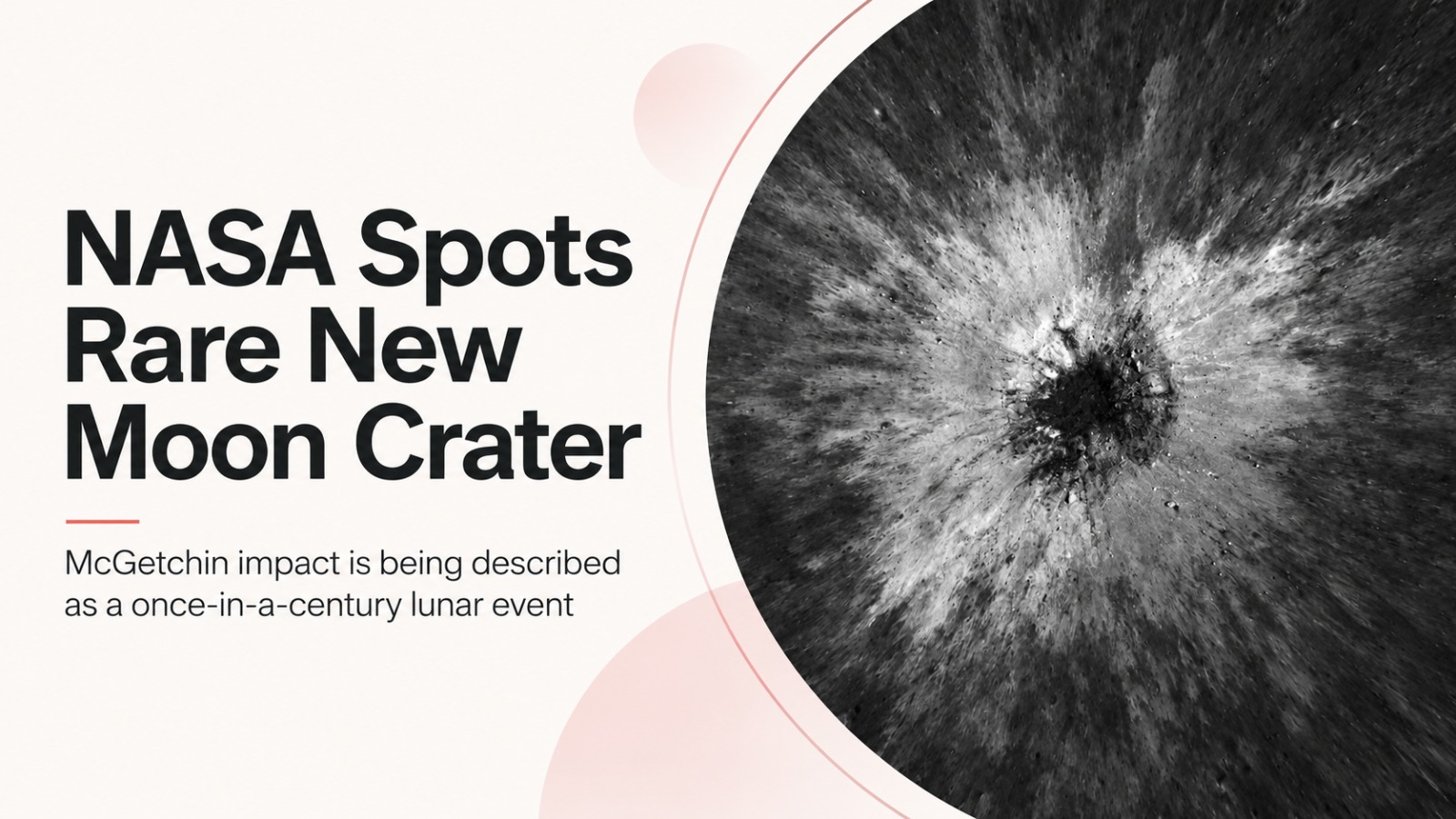
A routine check of lunar images has led scientists to one of the most striking impact discoveries yet made with NASA’s Lunar Reconnaissance Orbiter.
That which first seemed to be a brightly lit area with a surrounding dark circle proved to be the mark of a new crater formation on the moon. Through the comparison of photographs, researchers were able to prove that this was a result of a massive impact event, making it the largest new crater ever discovered in the solar system.
The crater has been officially named McGetchin, in honour of pioneering lunar scientist Tom McGetchin. Scientists estimate that it formed sometime between April 11 and May 22, 2024, when a comet or asteroid roughly the size of a three- to six-storey building struck the Moon’s eastern edge.
At 728 feet wide and 141 feet deep, McGetchin is unusually large for a newly identified lunar impact crater. Scientists estimate that an impact of this magnitude occurs on the Moon only about once a century, or possibly even less frequently.
How was the new Moon crater discovered?
The story began not with a planned search for a giant crater, but with a data-quality check.
On October 24, 2025, Robert Wagner, an image-processing specialist working with NASA’s Lunar Reconnaissance Orbiter Camera system, was examining a large map of the Moon. The map had been created by stacking hundreds of older and newer images and using software to expose changes on the lunar surface.
Areas that had remained unchanged appeared grey. Differences between the image sets showed up as bright or dark patches. The approach is useful, but it also produces many false alarms caused by small variations in lighting and shadows. Scientists therefore have to inspect the results carefully.
McGetchin was different.
Instead of a small, difficult-to-interpret feature, Wagner encountered an impact debris pattern spanning hundreds of pixels. He described it as “by far the most obvious impact debris pattern” he had seen in such imagery.
The discovery was then investigated with higher-resolution observations from LRO’s Narrow-Angle Camera. Those images allowed researchers to examine the crater’s dimensions, shape and the effects of the impact on the surrounding terrain.
What actually created the bright spot?
One important detail is that the bright feature that first caught Wagner’s attention was not the crater itself.
It was material blasted outward during the impact. Images show a bright deposit around the site, created when the incoming object slammed into the lunar surface and threw material across the surrounding landscape. NASA’s comparison imagery covers an area about 38 miles wide.
That difference matters because impact debris can reveal surface changes on a much larger scale than the crater alone.
Why do impacts leave such clear marks on the Moon?
The Moon does not have an atmosphere capable of slowing or burning up incoming objects before they reach the surface. As a result, rocks and other space objects can strike the lunar landscape directly.
McGetchin is an exceptional example, but smaller impacts are far more common.
During more than 17 years of Lunar Reconnaissance Orbiter observations, scientists have identified at least 1,000 new impact craters and flagged around 100,000 additional surface changes linked either to impacts or to debris thrown out by them.
The smallest new craters that scientists can distinguish in LRO images are about 30 feet wide. NASA says impacts large enough to create craters of roughly that scale are estimated to produce about 140 new craters across the Moon every year. Many additional impacts involve microscopic projectiles and leave marks too small to identify in orbital imagery.
McGetchin therefore sits at the opposite end of the scale. Its size makes it a rare opportunity to study how a comparatively large modern impact changes the lunar surface.
Scientists also found a four-mile-wide cold spot
Visible images revealed only part of what happened.
After McGetchin was identified, scientists used Diviner, LRO’s thermal instrument, to study temperatures around the impact site. They detected a roughly four-mile-wide area around the crater that is about 16 degrees Fahrenheit cooler at night than nearby terrain.
Researchers believe the cooling is caused by the impact disturbing and “fluffing up” the lunar regolith, the loose material covering the surface. The disturbed material becomes less dense and therefore does not retain heat as effectively as surrounding terrain.
That cold zone extends far beyond the crater itself.
Scientists say its size demonstrates that an impact can physically alter a much wider region of the lunar surface than the visible hole it creates. One potential consequence is a change in how rover wheels interact with the disturbed surface.
What makes LRO able to spot changes like McGetchin?
NASA’s Lunar Reconnaissance Orbiter has been repeatedly mapping the Moon for more than 17 years.
Its Lunar Reconnaissance Orbiter Camera system collects images from roughly 60 miles above the lunar surface as the spacecraft travels from pole to pole. The system includes two cameras designed for high-resolution black-and-white imaging and another camera that captures moderate-resolution multispectral observations.
That long record is important because scientists are not simply looking at isolated photographs. They can compare the same regions of the Moon across different years.
Researchers routinely inspect close-up images for smaller changes, while every few years they also construct global lunar maps to search for features wider than about 150 feet. Those repeated comparisons have helped scientists identify not only new craters, but also landslides, landers, seismic faults and possible signs of lava tubes.
McGetchin emerged from exactly this kind of before-and-after comparison.
Why is the McGetchin crater important?
The discovery offers scientists an unusually fresh example of what happens when a large object strikes the Moon.
Researchers now have observations of the impact site at several scales, including broad before-and-after imagery, sharper close-up pictures and thermal measurements showing how the surrounding terrain changed after the collision.
The crater also demonstrates how much scientific value can come from repeatedly observing the same world over long periods. McGetchin did not announce itself in real time. Its existence became clear later because scientists had older lunar images against which newer observations could be compared.
That is what transformed a bright patch on a computer screen into evidence of a rare lunar event.
For Wagner, the discovery began with a feature unusual enough to interrupt an otherwise routine review of data. For lunar scientists, McGetchin now provides a newly formed impact site large enough to study not just the crater itself, but the much wider physical and thermal changes created around it.
And in a landscape often imagined as static, McGetchin is a reminder that the Moon continues to change.
Also Read: Afghanistan vs India 3rd T20I Live Stream: Where-to-Watch?