

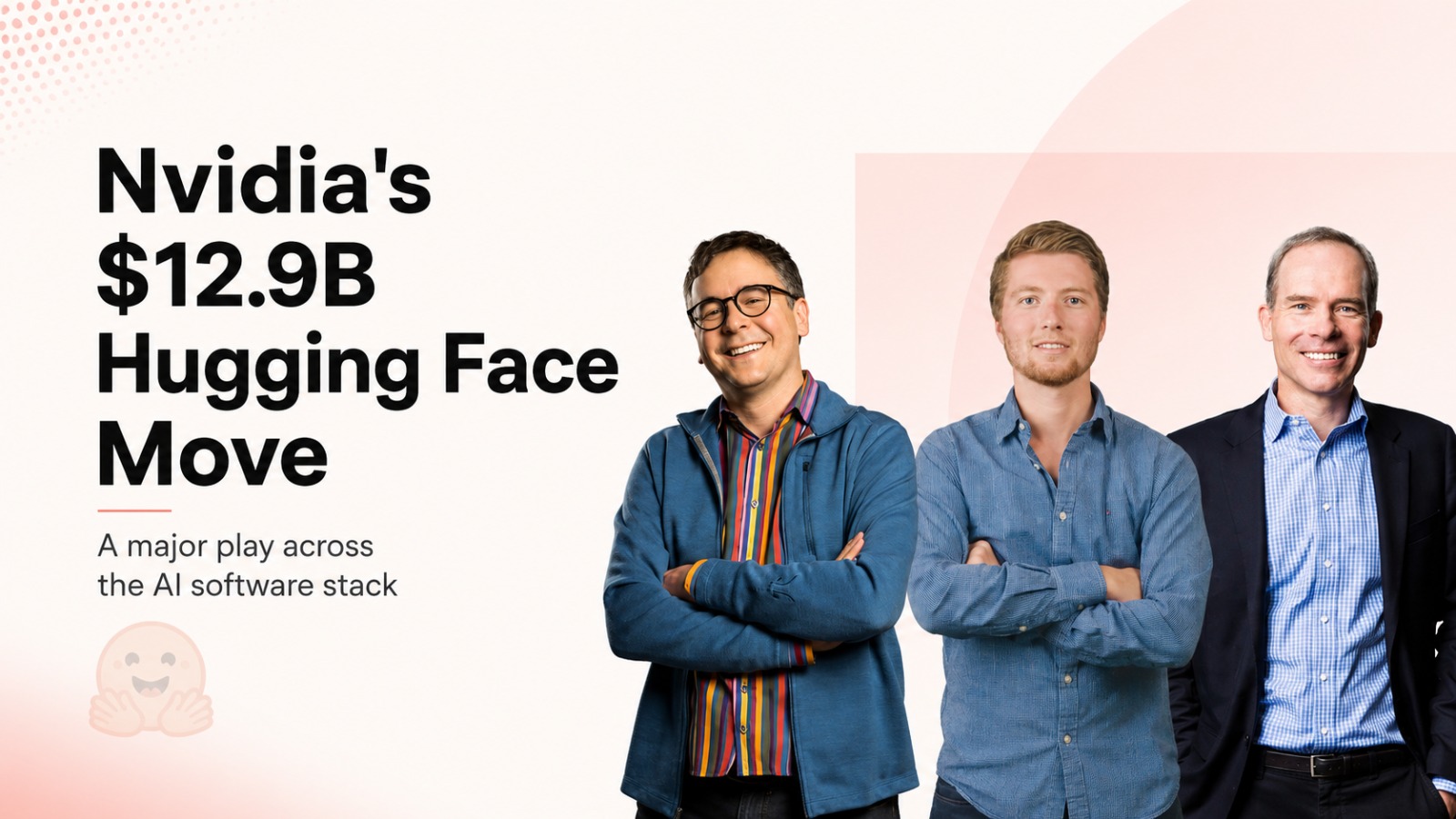
Nvidia has reportedly reached a $12.9 billion agreement to acquire Hugging Face, a move that would bring one of the best-known platforms for open-source artificial intelligence development significantly closer to the chipmaker at the centre of the AI hardware market.
The reported transaction is notable not simply because of its size, but because of what the two businesses represent at different points in the AI development process. Nvidia supplies hardware widely associated with AI computing, while Hugging Face has built a platform around models, datasets and developer tools used to build and deploy AI applications.
Earlier reporting cited discussions around a transaction worth more than $13 billion. The Information subsequently reported that an agreement had been finalized at approximately $12.9 billion. The acquisition therefore remains best described as reported on the basis of the information currently available.
Why Hugging Face matters to Nvidia
For Nvidia, the strategic logic extends beyond adding another software asset.
Hugging Face founded in 2016 by French entrepreneurs Clément Delangue, Julien Chaumond, and Thomas Wolf sits at an important point in the AI development workflow. Its platform provides access to pre-trained models, datasets and tools spanning areas including natural language processing and computer vision. That has made it a widely used destination for developers and researchers working on AI applications.
Bringing that platform into Nvidia’s business could create a much closer connection between the software developers use to discover and work with models and the hardware on which many AI workloads eventually run.
The potential significance lies in that connection.
Nvidia would gain more direct exposure to a large AI developer community while also controlling a platform positioned within the model-development workflow. The combination could give the company more room to optimize its hardware around popular open-source models and deepen the integration between its computing products and the software layer used by developers.
That does not mean such changes have been announced. The available information describes them as potential outcomes rather than confirmed plans.
A deal that stretches Nvidia further into AI software
The reported acquisition also points to a broader strategic expansion for Nvidia.
The company is principally associated with AI hardware, but acquiring Hugging Face would push its presence further into the software and platform side of the industry. Instead of participating primarily through computing infrastructure, Nvidia would gain ownership of a platform involved in how developers find, share and work with AI models and related resources.
That could make the relationship between AI hardware and software more tightly connected.
As models grow more complex and AI applications become more widespread, the infrastructure used to build, distribute and deploy them becomes increasingly important. Hugging Face’s role in that process is a central reason the reported transaction carries significance beyond the headline valuation.
The open-source question may become the biggest one
For Hugging Face users, the immediate question is not only what Nvidia could add to the platform. It is what might change.
A closer relationship with Nvidia’s own AI tools and hardware could potentially improve performance for models running on Nvidia GPUs. At the same time, ownership by a major hardware supplier could raise questions around platform neutrality, future product priorities and the degree to which Hugging Face continues to serve developers using competing infrastructure.
Those questions are particularly relevant because Hugging Face’s position has been built around a broad open-source ecosystem.
There is currently no verified indication in the supplied information of a specific change to Hugging Face’s services, terms or open-source approach. Any claim that such changes will occur would therefore go beyond what has been reported.
What is clear is that users are likely to pay close attention to Nvidia’s approach to platform neutrality, relationships with other hardware providers and the wider direction of open-source AI development if the reported acquisition proceeds as described.
More than a hardware acquisition story
The most interesting part of the reported $12.9 billion transaction may ultimately be the layer of the AI market Nvidia would be buying.
Hugging Face is not another chip business. Its value to the proposed combination comes from its position among the models, datasets, tools and developers that sit upstream of many deployed AI applications.
That creates a different kind of strategic opportunity for Nvidia. Rather than limiting its influence to the computing layer, ownership of Hugging Face could place the company closer to decisions developers make much earlier in the AI creation process.
It could also make Nvidia’s hardware and Hugging Face’s software ecosystem more closely connected over time.
For now, however, the details that matter most will come from formal announcements about the transaction and, eventually, any stated plans for Hugging Face’s platform, open-source commitments and services.
Until those details emerge, the reported $12.9 billion price tag tells only part of the story. The larger question is how Nvidia would manage a platform whose importance comes not just from its technology, but from the broad developer ecosystem built around it.
Also Read: Ireland Startup Funding: €1 Billion Plan Targets Growth-Stage Capital Gap















