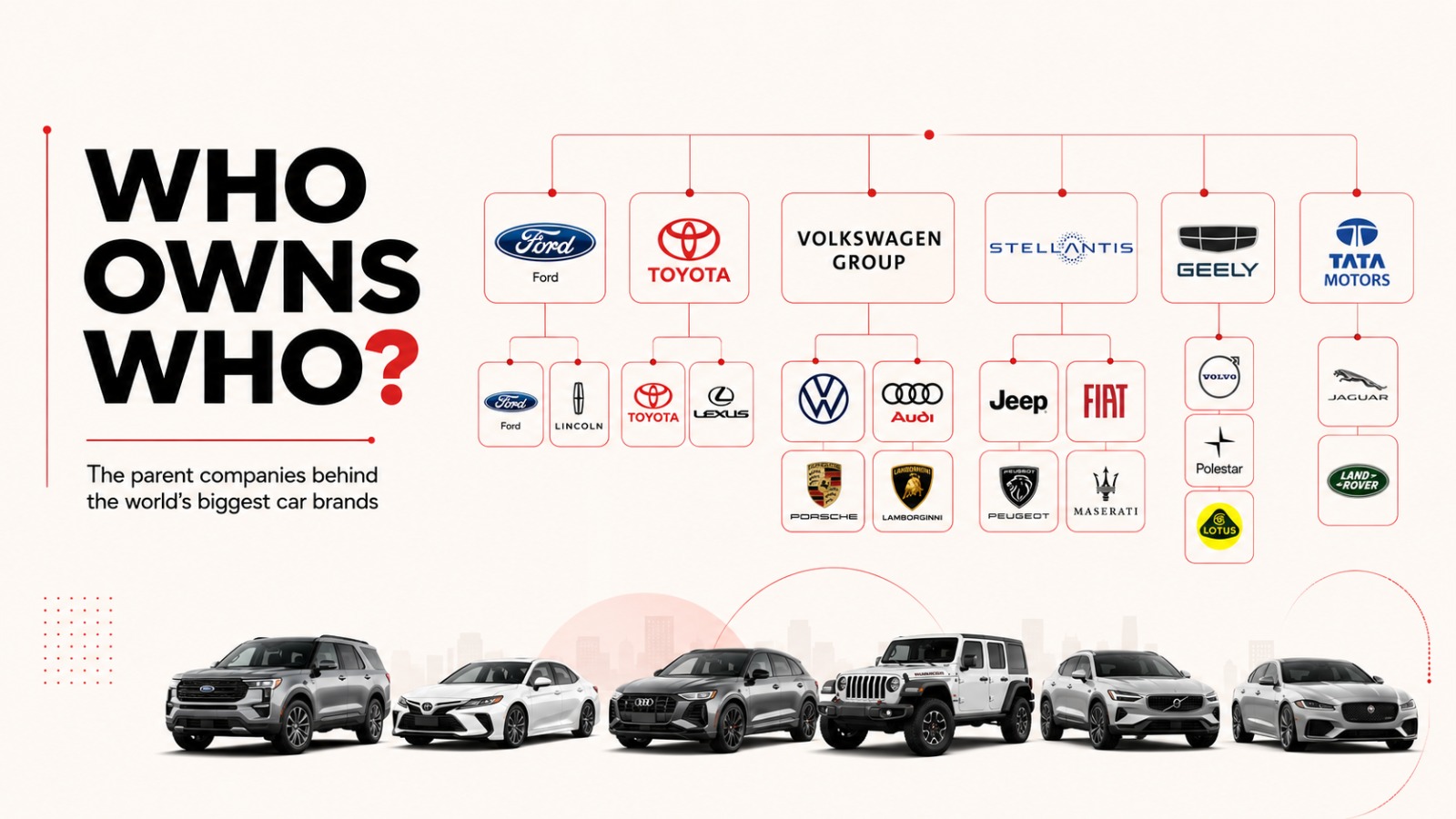
The global automotive industry may look like a crowded field of competing car brands, but the reality is quite different. A relatively small number of major automotive groups control many of the names seen on roads around the world.
From Ford and Toyota to Volkswagen Group, Stellantis and Geely, these parent companies operate portfolios that can include mainstream carmakers, luxury marques, electric vehicle brands and commercial vehicle businesses. At the same time, several manufacturers continue to operate independently.
Understanding this ownership structure can make the global car market much easier to follow.
America’s Auto Industry Is Led by Ford and GM
The traditional US automotive landscape has long been associated with the Big Three. Today, Ford Motor Company and General Motors remain two of the country’s major automotive groups.
| Parent Company | Brands / Companies |
|---|---|
| Ford Motor Company | Ford, Lincoln |
| General Motors | Buick, Cadillac, Chevrolet, GMC |
| Independent | Lucid, Rivian, Slate, Tesla |
Ford’s portfolio includes its mainstream Ford brand and luxury-focused Lincoln. General Motors operates four major brands: Buick, Cadillac, Chevrolet and GMC.
The US is also home to independent electric vehicle manufacturers, including Tesla, Rivian, Lucid and newer entrant Slate.
Also Read: Mahindra Targets Global Markets With New Scorpio Lifestyler Pickup
China Has the Most Complicated Brand Structure
China has one of the world’s largest automotive markets and an extensive collection of manufacturers and vehicle brands. Its industry includes several major state-linked and privately owned automotive groups, alongside independent companies.
| Parent Company | Brands / Companies |
|---|---|
| Anhui Jianghuai Automobile Group (JAC) | JAC Motors, JAC Refine, JAC Yiwei |
| BAIC Group | Arcfox, Beijing, Beijing Off-road, Foton |
| BYD Auto | BYD, Denza, Fangchengbao, Linghui, Yangwang |
| Chery Automobile | Chery, Exeed, iCar, Jetour |
| China Changan Automobile Group | Avatr, Changan Auto, Deepal, Kaicene |
| China FAW Group | Bestune, Hongqi, Jiefang, Yueyi |
| Dongfeng Motor Corporation | Aeolus, Dongfeng Nammi, Forthing, M-Hero, Voyah |
| Great Wall Motor | Haval, Ora, Tank, Wey |
| Guangzhou Automobile Group | Aion, Hyptec, Trumpchi |
| Seres Group | AITO, DFSK, Fengon, Seres |
| SAIC Motor | Baojun, IM, Maxus, MG, Nanjing-Iveco |
| Rising Auto | Roewe, Sunwin, Wuling, Yuejin |
| Zhejiang Geely Holding Group | Farizon, Geely, Ji Yue, Livan, Lynk & Co, LEVC, Lotus, Polestar, Proton, Smart, Volvo, Zeekr |
| Independent | Li Auto, Xpeng, Huawei, Rox Motor, Nio, Xiaomi Automobile, Leapmotor |
Geely has one of the broadest international portfolios, with interests spanning brands such as Volvo, Polestar, Lotus, Lynk & Co and Zeekr. Smart is jointly owned by Geely and Mercedes-Benz.
China’s independent manufacturers also include major electric vehicle players such as Nio, Xpeng, Li Auto, Leapmotor and Xiaomi.
Europe Is Dominated by Several Giant Groups
Europe has a particularly diverse automotive industry, with major groups controlling some of the world’s best-known luxury, performance and mainstream brands.
| Parent Company | Brands / Companies |
|---|---|
| BMW Group | BMW, Mini, Rolls-Royce |
| Bugatti Rimac | Bugatti, Rimac |
| Mercedes-Benz Group | Mercedes-Benz, Smart |
| Renault Group | Alpine, Dacia, Mobilize, Renault |
| Stellantis | Abarth, Alfa Romeo, Chrysler, Citroën, Dodge, DS, Fiat, Jeep, Lancia, Maserati, Opel, Peugeot, Ram, Vauxhall |
| Volkswagen Group | Audi, Bentley, Cupra, Lamborghini, Porsche, Seat, Scout, Skoda, Volkswagen |
| Independent | Aston Martin, Ariel, Caterham, Donkervoort, Ferrari, Gordon Murray, Ineos, Morgan Motor, Pagani, Koenigsegg, Zenvo |
Stellantis has one of the industry’s largest collections of automotive brands, covering everything from Fiat and Peugeot to Jeep, Maserati and Alfa Romeo.
Volkswagen Group also operates a broad portfolio, including Audi, Bentley, Lamborghini, Porsche, Škoda, SEAT, Cupra and Volkswagen.
BMW Group focuses on BMW, Mini and Rolls-Royce, while Renault Group operates Renault, Dacia, Alpine and Mobilize.
India’s Tata and Mahindra Have Global Connections
India is home to two major automotive groups with international reach: Tata Motors and Mahindra Group.
| Parent Company | Brands / Companies |
|---|---|
| Mahindra Group | Mahindra, Pininfarina |
| Tata Motors | Jaguar, Land Rover, Tata Daewoo, Tata Hitachi |
Tata Motors’ global automotive portfolio includes Jaguar and Land Rover through its ownership of JLR. Tata also operates Tata Daewoo Commercial Vehicles.
Mahindra is best known for its own automotive brand and also acquired a controlling stake in Italian design company Pininfarina in 2015.
Japan’s Major Brands Sit Under a Few Groups
Japan has several major automakers, with Toyota standing as the country’s largest automotive group.
| Parent Company | Brands / Companies |
|---|---|
| Toyota Motor Corporation | Toyota, Lexus, Daihatsu, Hino |
| Honda Motor Company | Honda, Acura |
| Nissan Motor Company | Nissan, Infiniti |
| Independent | Mazda, Mitsubishi, Subaru, Suzuki |
Toyota’s portfolio covers its core Toyota brand along with Lexus, Daihatsu and Hino. Honda operates Acura alongside Honda, while Nissan’s portfolio includes Infiniti.
Mazda, Mitsubishi, Subaru and Suzuki remain separate major Japanese manufacturers.
Hyundai Leads South Korea’s Automotive Industry
South Korea’s automotive sector is dominated by Hyundai Motor Group, which operates three major vehicle brands.
| Parent Company | Brands / Companies |
|---|---|
| Hyundai Motor Group | Hyundai, Kia, Genesis |
| Independent | KG Mobility (KGM) |
Hyundai serves the mainstream market, Kia operates as another major global automaker, and Genesis serves as the group’s premium brand.
KG Mobility, formerly known as SsangYong Motor, operates independently under the KGM name.
VinFast Represents Vietnam’s Growing Industry
Vietnam’s automotive industry has a major homegrown manufacturer in VinFast.
| Parent Company | Brand / Company |
|---|---|
| Independent | VinFast |
Founded in 2017, VinFast has focused heavily on electric vehicles and has expanded its ambitions beyond Vietnam into international markets.
A Global Industry Built Around Fewer Companies
The ownership structure of the automotive industry shows how interconnected the sector has become. A badge on a car may represent a familiar individual brand, but behind it can be a much larger corporate group with interests across several markets.
From Stellantis and Volkswagen Group in Europe to Toyota in Japan, Tata Motors in India and Geely in China, these parent companies play a major role in determining the direction of the global automotive industry. At the same time, independent manufacturers such as Ferrari, Tesla, Subaru and VinFast continue to maintain their own identities and strategies.
For consumers, knowing the parent company behind each badge provides a clearer picture of how the world’s biggest car brands are connected.
Also Read: Tesla Leads China’s Record 4.3 Million-Vehicle Recall Over Emergency Door Risks