

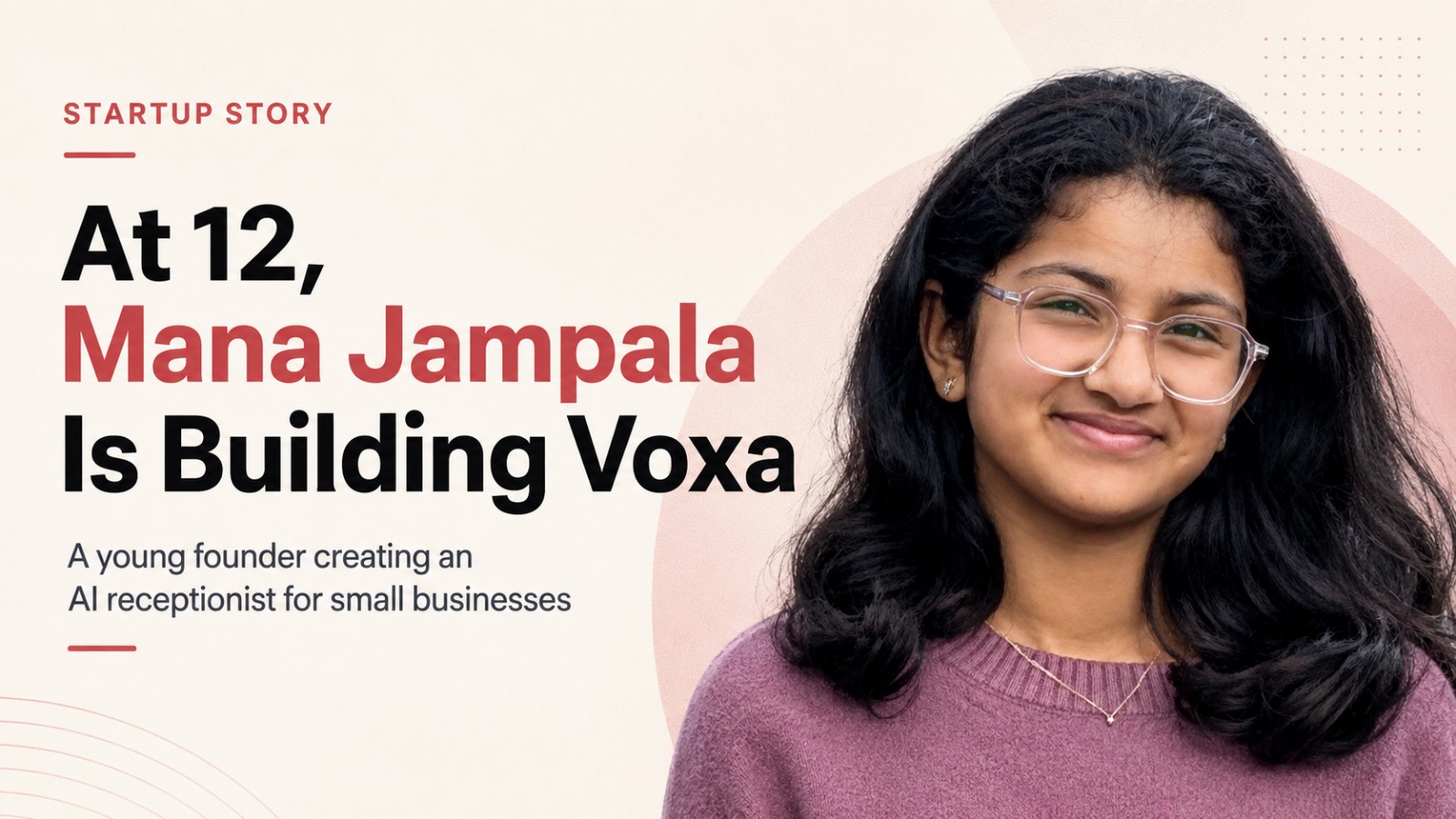
The Story of Mana Jampala & Voxa: The British Columbia entrepreneur says the idea came from watching her father’s small team miss customer calls. Her platform is designed to answer phones, book appointments, record orders and produce call summaries around the clock.
For a small business, an unanswered phone call can be more than a minor inconvenience. It may be a booking that never gets made, an order that goes elsewhere or a customer who does not call back.
Mana Jampala noticed that problem while spending time at her father’s workplace. She was 11 then, and the business operated with a small team that was often too busy to answer every incoming call.
“They’d either ignore them or not notice them at all,” she recalled in an interview with Business Insider.
That observation became the starting point for Voxa, an artificial intelligence-powered receptionist that Jampala launched in November 2025. Now 12 and based in British Columbia, she is developing the product for small businesses that may not have enough staff to manage their phones throughout the day.
Built around an everyday small-business problem
Voxa is intended to work as a 24-hour voice assistant. It can answer incoming calls, book appointments, take restaurant orders, manage missed calls and prepare summaries of conversations.
The idea is straightforward: give smaller businesses a way to remain reachable without requiring an employee to be available for every call.
Jampala said the platform was already processing hundreds of calls at the time of reporting. However, the business was still at an early commercial stage, and she was working to secure its first paying customer.
That distinction matters. Voxa has moved beyond being only an idea or a coding experiment, but its ability to become a sustainable company will depend on whether businesses are prepared to pay for it consistently.
Learning to code, then learning to sell
Jampala’s interest in artificial intelligence began when she was nine. Her early experience included attending Scratch coding camps and learning Python.
During a visit to India, she also won a special prize at a collegiate-level science competition. She later received a grant from the 1517 Medici Project, an initiative that supports young people working on startup ideas.
Her work is not limited to the voice receptionist. Jampala has also launched Voxa Agents, a platform that allows people to create AI agents by describing what they want through natural-language prompts.
Building the technology, however, has been only one part of the process. Finding customers has brought a different challenge.
Jampala said that some prospective clients she approached in person paid more attention to her age than to the product. Instead of asking detailed questions about Voxa, they sometimes wanted to know whether her parents had built it for her.
She responded by expanding her outreach online, where conversations were more likely to centre on the platform and what it could do.
Warm introductions over cold pitches
Like many early-stage founders, Jampala has relied on direct outreach and personal contacts to reach potential customers. Her efforts have included cold approaches, introductions through people she knows and a meeting with the chief executive of her city’s Chamber of Commerce.
Her current preference is to seek introductions through existing connections.
“My strategy right now is to use my connections and ask them for warm intros because they convert better than doing cold outreach,” she said.
It is a practical approach for a founder whose age can become the focus of an initial meeting. A trusted introduction gives the product a better chance of being considered before assumptions about its creator take over the conversation.
A cautious plan for growth
Jampala does not appear to be rushing towards outside investment. She has said she hopes to bootstrap Voxa for the next one to two years before considering an accelerator programme.
Among the programmes she has mentioned are Y Combinator and Andreessen Horowitz’s accelerator initiatives. Venture capital, she indicated, would be considered only after the business had established steady growth.
For now, the immediate task is more basic and more important: turning interest and product usage into paying customers.
Voxa began with a problem Jampala could see clearly inside a small workplace. Its next chapter will depend on whether that same problem is pressing enough for other business owners to adopt her solution.















