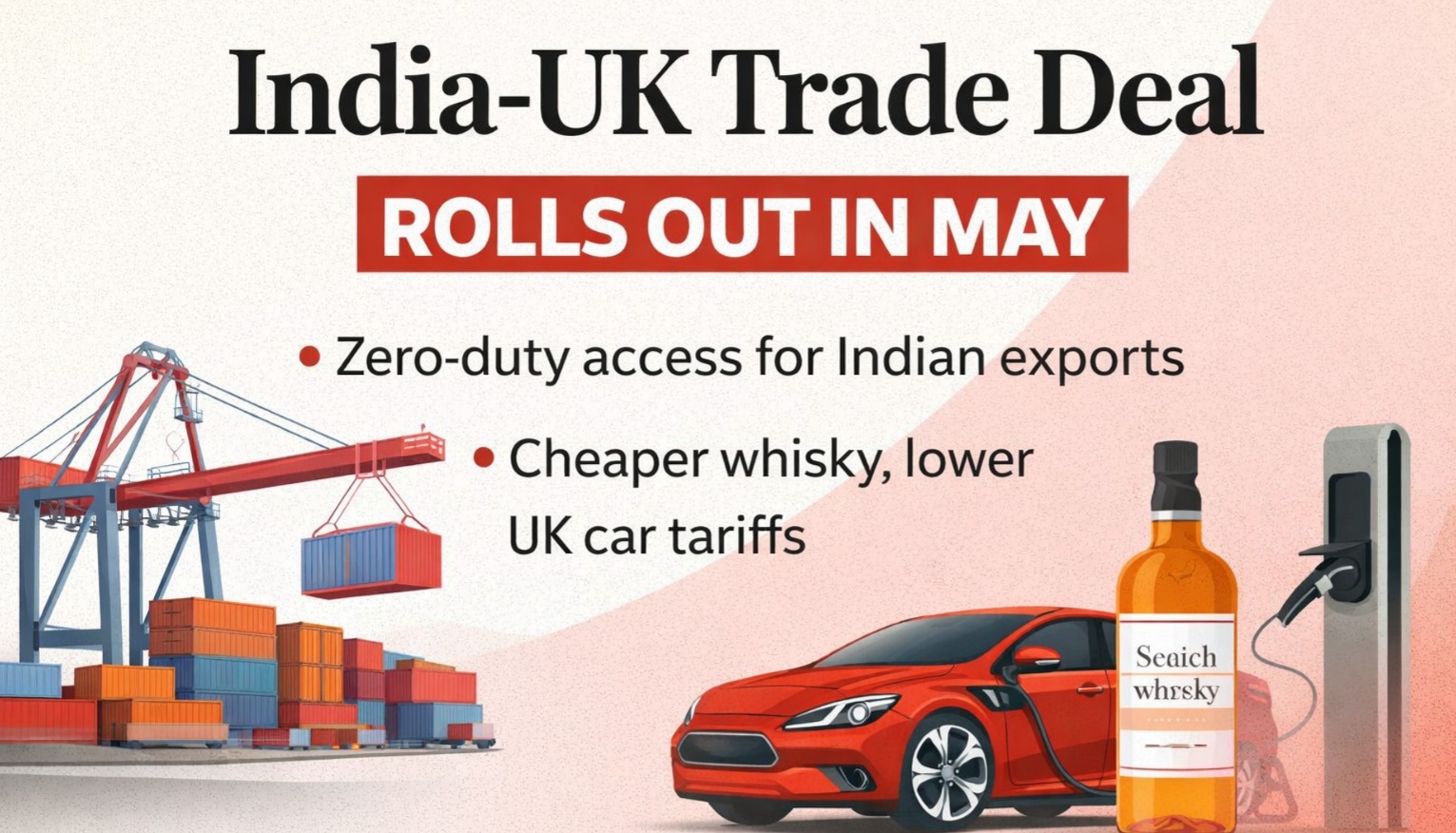
India and the United Kingdom are preparing to operationalise their long-awaited trade agreement, with implementation expected from the second week of May. The India UK trade deal rollout signals a shift in how goods will move between the two economies, with tariffs set to ease on both sides and market access widening across key sectors.
The new trade pact signed in July 2025 provides zero tariffs on 99 per cent of exports from India into Britain. As far as Indian firms are concerned, this provides them with much greater competitive advantage in products like textiles, footwear, gemstones and jewelry, sports goods, and toys, sectors where cost is of paramount importance.
In return, India will gradually lower tariffs on select British imports. Consumer goods such as chocolates, biscuits, and cosmetics are among the categories gaining easier entry into the Indian market, reflecting a calibrated opening of domestic demand to foreign brands.
One of the most notable changes comes in the premium spirits segment. Import duties on Scotch whisky will be reduced sharply, from 150 per cent to 75 per cent immediately, with a further reduction to 40 per cent scheduled by 2035. The phased approach indicates a balance between market liberalisation and domestic industry protection.
The automobile sector will also see a significant recalibration. India will bring down import duties on vehicles to 10 per cent over a five-year period, from levels that currently go as high as 110 per cent. This reduction will take place under a quota-based system, ensuring that the opening remains controlled rather than unrestricted.
In return, India’s industry will be able to sell its electric cars and hybrids in the British market under a quota system. This point in the deal shows an interesting forward-looking approach, combining the trade policy with the changing trends in the global arena for more environmentally friendly transportation systems.
Apart from the trade agreement, India and the UK signed a Double Contribution Convention in order to reduce the costs of temporary workers who should not pay contributions twice. This decision will presumably be beneficial for professionals and companies working across national borders.
The broader ambition behind the agreement is to double bilateral trade, currently valued at USD 56 billion, by 2030. While that target sets the long-term direction, the immediate impact will likely be felt in pricing, competitiveness, and supply chain decisions across sectors.
For India, benefits are expected to be confined to its ability to expand exports in labour-intensive sectors. For the UK, benefits include increased market access for one of the world’s largest consumer markets. In the next few months, it will become clear how successfully companies can convert their policies into business practices.
Also Read: Vaibhav Suryavanshi’s Rise Is Bigger Than a Net-Worth Number