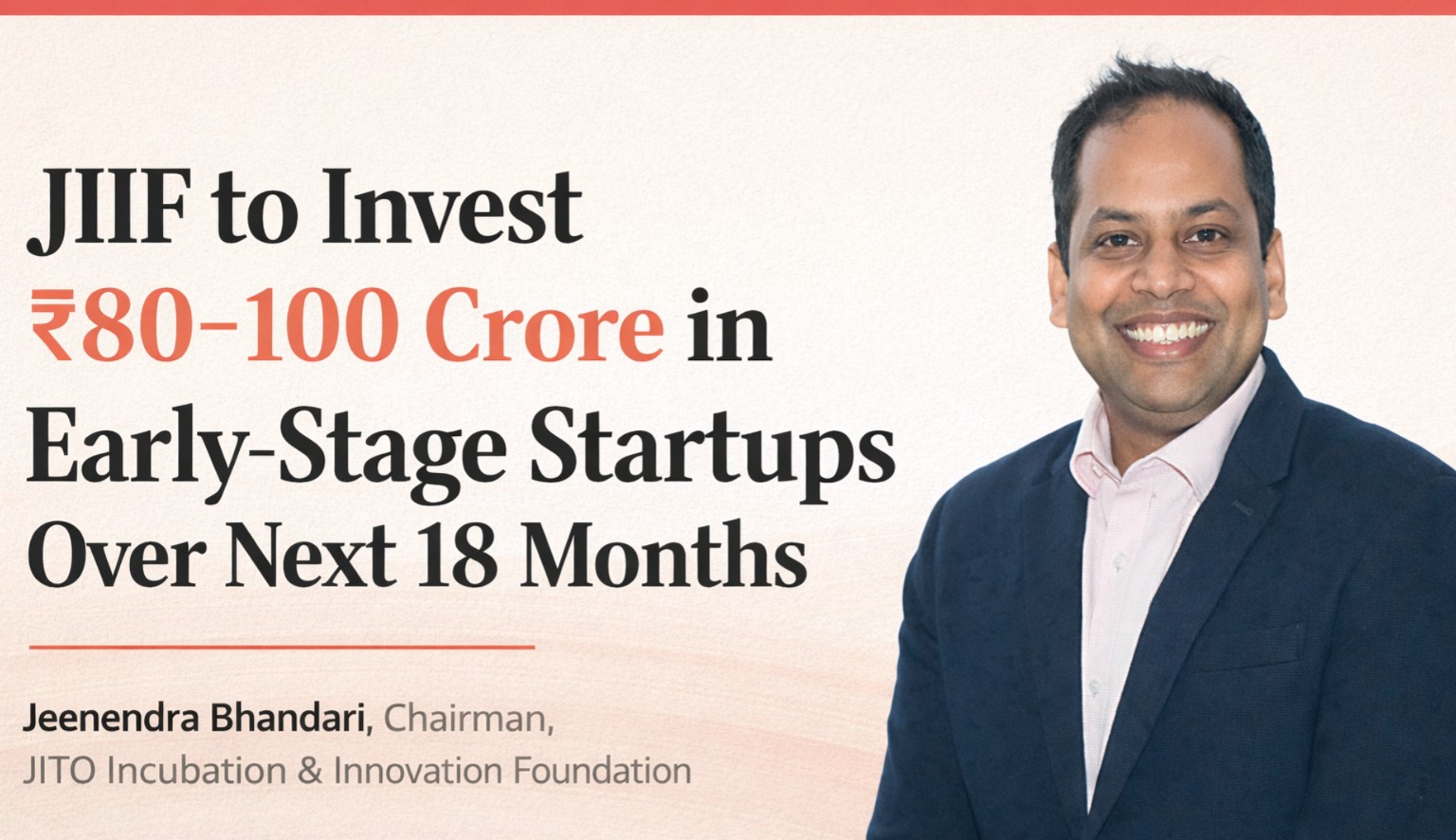
JITO Incubation and Innovation Foundation (JIIF) is preparing for its next phase of early-stage investments, setting aside ₹80 crore to ₹100 crore for deployment over the next 12 to 18 months. The move comes at a time when startup funding is becoming more selective, with investors prioritising quality and clearer paths to scale.
This is not a new arrival in the ecosystem. In the last two years, JIIF has already invested over ₹150 crore in over 100 pre-seed and seed-stage companies, exiting from over 15 deals. This makes it one of the most active early-stage investment platforms around today.
The foundation plans to back around 20 to 25 startups annually, with ticket sizes typically ranging between ₹1.5 crore and ₹2 crore. The strategy reflects a steady, portfolio-led approach, spread bets across sectors, stay early, and build exposure to companies that can mature into stronger follow-on opportunities.
At the same time, JIIF is widening its playbook. It has invested ₹26.5 crore in Mumbai-based Atomic Capital, a move that allows it to tap into a broader set of investment opportunities beyond its own sourcing network.
The platform is also looking beyond domestic boundaries. Plans are underway to launch an accelerator programme focused on the Asia-Pacific region, spanning India, the Middle East and Southeast Asia.
The programme will focus on early-stage startups across sectors such as artificial intelligence, fintech, climate, mobility and digital infrastructure.
“Our partnerships with platforms such as Startup Singham and Lead to Unicorn have helped us access high-quality opportunities. Our investment in Atomic Capital marks a significant step in expanding our investment capabilities and accessing differentiated opportunities. Alongside, the planned APAC accelerator programme will support founders at scale across geographies,” said Jeenendra Bhandari, Chairman, JIIF.
The portfolio itself reflects a diversified sectoral spread. Consumer and D2C account for 25 per cent, AI and deeptech 15 per cent, health 15 per cent, fintech between 15 and 20 per cent, and mobility and sustainability about 20 per cent.
There are also early signals on where liquidity is emerging faster. Consumer, mobility and fintech startups have seen relatively quicker exits, largely through secondary transactions and buybacks. For early-stage investors, such exits are critical, they recycle capital, validate bets, and shape how aggressively the next cycle of investments can be pursued.
What emerges from JIIF’s latest plans is a measured expansion rather than an aggressive sprint.
The combination of fresh capital, indirect investment exposure, and a regional accelerator points to a platform that is steadily building depth in early-stage investing, without losing sight of discipline in a changing funding landscape.
Also Read: Flipkart-Backed NeuroPixel.AI Shuts Down Amid Rising AI Competition