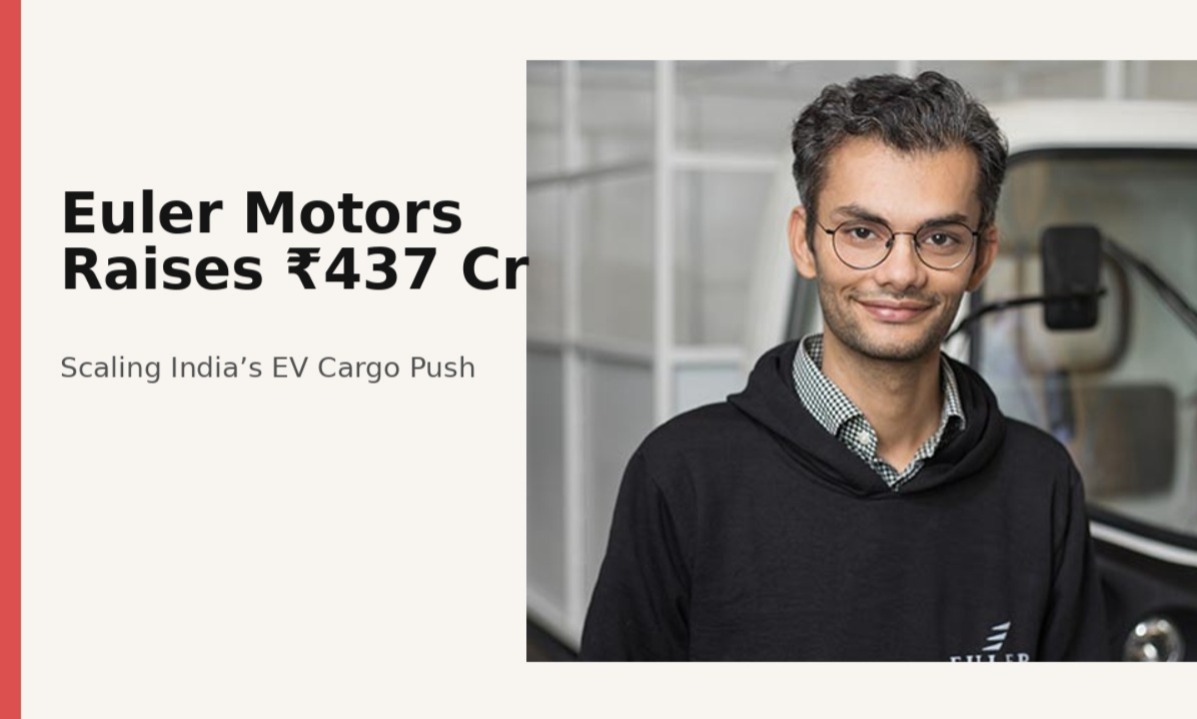
Euler Motors has raised Rs 437.5 crore in a fresh Series E round, giving the Delhi-based electric commercial vehicle maker new firepower at a time when India’s last-mile mobility market is becoming more competitive and more consequential.
The round was led by Lightrock, with participation from Hero MotoCorp and Blume Ventures. Alongside the equity infusion, the company also secured Rs 250 crore in debt from BlackSoil, Trifecta, InnoVen Capital and Alteria Capital. Together, the raise signals continued investor confidence in a company that has chosen to focus sharply on one of the toughest, but potentially most scalable, parts of the EV business: commercial cargo movement. That focus matters.
Unlike passenger EV stories, which often lean heavily on lifestyle, brand pull or consumer aspiration, Euler Motors is building for utility. Its vehicles are aimed at logistics fleets, e-commerce deliveries and hyperlocal movement, where purchase decisions are shaped less by buzz and more by uptime, economics and route performance.
In that sense, this is not just another funding headline. It is a sign that investors still see room in India’s commercial EV market for companies that can solve a real operating problem.
Founded in 2018 by Saurav Kumar, Euler Motors has built its business around electric three-wheelers and four-wheelers designed for cargo use. The company has also adopted an asset-heavy approach, combining manufacturing with financing partnerships and after-sales support.
That model is harder to scale than a pure software-led business, but in commercial mobility, it can also be harder to ignore. Fleet operators do not just buy vehicles; they buy reliability, service access and confidence that the machine will stay on the road.
The new capital is expected to go into expanding the product portfolio, increasing manufacturing capacity and widening the company’s reach across India. That suggests Euler is now moving beyond the stage of proving demand and is entering the tougher phase of industrial scale-up, where execution matters more than narrative.
The timing is notable. India’s commercial EV segment has been gaining momentum, but the field remains uneven. Even where electric adoption is rising, internal combustion vehicles still dominate much of the working fleet. For companies like Euler, the competition is not simply another EV startup. It is the deeply entrenched diesel, petrol and CNG ecosystem that businesses already understand, trust and can service almost anywhere.
That makes expansion capital especially important. Winning in this category requires more than product launches. It requires manufacturing depth, distribution, financing support, city-by-city execution and service infrastructure that can stand up to daily commercial use.
Euler appears to be pushing on all those fronts.
The company says it has more than 15,000 vehicles on the road, including over 10,000 electric three-wheelers. It also claims a 22 percent share in the four-wheel cargo segment and says it has expanded to 100 touchpoints across India.
In the four-wheeler cargo category, production has reportedly climbed from 50 units a month in 2025 to nearly 400 units a month now. Those numbers, if sustained, suggest that Euler is trying to move from a niche operator into a more visible national player.
Its network ambitions reflect that shift. The company is planning to expand from around 60 cities and 80 showrooms to 100 cities by the end of the current financial year. That is a meaningful jump, and it points to a strategy built not just on product adoption, but on physical presence. In commercial mobility, geography matters. A vehicle can be attractive on paper, but for fleet operators, the real test is whether service, support and replacement access exist where business happens.
Euler’s recent product momentum is also part of the story. The company’s Turbo EV1000, launched recently, has reportedly crossed 1,000 units sold within 80 days. That early traction may help explain why investors are still willing to back the company in a capital-intensive sector where profitability timelines are often longer and operating demands are steep.
Financially, the picture remains one of growth with continuing pressure, which is typical for manufacturing-led EV businesses. One report says Euler’s revenue rose 12 percent to Rs 192.26 crore in FY25 from Rs 170.82 crore in FY24, while losses narrowed by 12 percent to around Rs 200 crore. That does not mean the business has cracked the economics yet.
But it does suggest movement in the right direction: more revenue, slower burn expansion, and some operating improvement even while scaling.
There is also a larger strategic context here. Hero MotoCorp’s continued participation is not a small signal.
The company had earlier invested in Euler and, according to one report, acquired a 32.5 percent stake for Rs 525 crore in March 2025 after previously leading Euler’s Series D round. For Hero, Euler appears to be an important part of its broader EV positioning beyond the two-wheeler market.
For Euler, that kind of backing brings more than capital; it adds industrial credibility at a time when supply chains, partnerships and manufacturing discipline can make or break the next phase of growth.
The broader bet is clear: India’s delivery economy is not shrinking, and cleaner cargo mobility is no longer a fringe thesis. The real question is which companies can turn that demand into durable businesses.
Euler Motors is trying to show that the answer may lie in staying focused on the workhorse end of the EV market rather than chasing the glamour end of it. If the company can convert fresh capital into stronger capacity, wider reach and better operating performance, this round could mark more than a balance-sheet event. It could be the point at which Euler begins to shift from being an emerging EV startup to a more serious commercial mobility contender.
For now, the raise tells the market one simple thing: investors still believe there is value in backing the companies building the machines that keep India’s delivery economy moving.
Also Read: LetzRyd Secures $4 Million Series A Led by JIF Capital