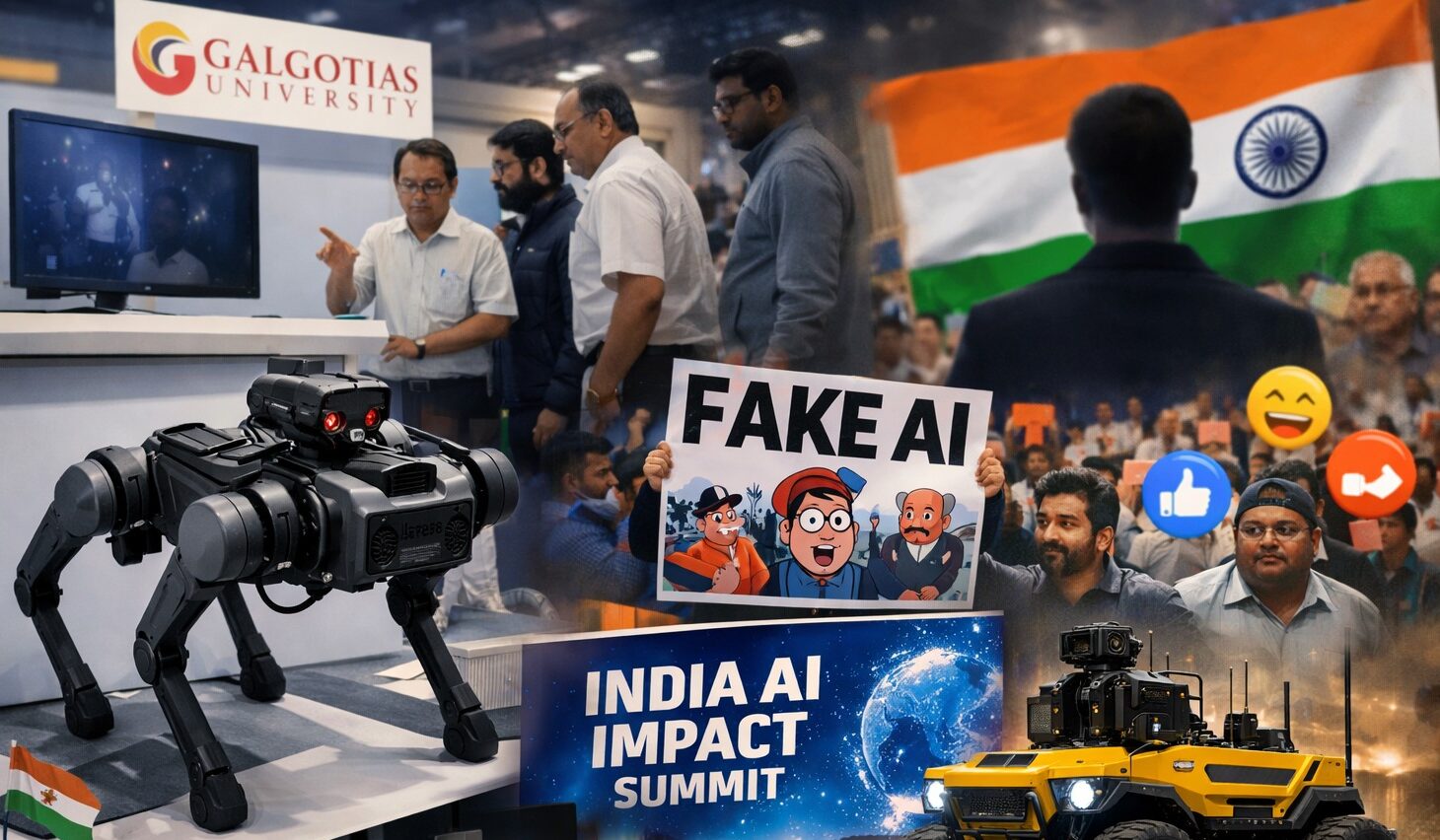
A controversy over a robotic dog at the India AI Impact Summit has sparked debate over authenticity, innovation, and the need to promote indigenous technology. What began as a routine exhibition display quickly turned into a widely discussed episode that drew attention from government officials, political leaders, and social media users.
A Showcase That Raised Eyebrows
The issue surfaced when Galgotias University presented a robotic dog named “Orion” at the summit, stating that it had been developed in-house. Observers at the event soon identified the machine as the Unitree Go2, a quadruped robot manufactured by Chinese robotics company Unitree Robotics.
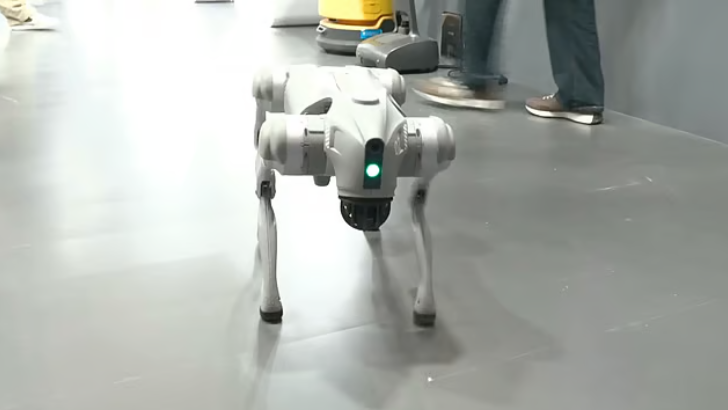
The Unitree Go2 is commercially available in India and is typically priced in the range of Rs 2 lakh to Rs 3 lakh, depending on specifications. Once the robot’s origin became widely known, questions were raised about whether it had been inaccurately represented as a locally developed product.
The situation escalated quickly. Organisers reportedly asked the university to vacate its stall, and power supply to the display was cut before the team exited the venue. Videos and posts about the incident began circulating online, turning the robodog into a viral talking point within hours.
Also Read: Kana Raises $15M to Reinvent AI-Driven Marketing Campaigns
Clear Message from the Government
Following the controversy, officials from the Ministry of Electronics and Information Technology underlined the importance of authenticity at national platforms. They emphasised that expos and summits must showcase genuine and original work rather than create confusion or misrepresent products.
IT Secretary S Krishnan stated that plagiarism or misrepresentation cannot be encouraged in such forums. Additional Secretary Abhishek Singh clarified that the objective was not to discourage innovation or experimentation but to ensure that no exhibitor’s display overshadows the work of others through misleading claims.
The Centre subsequently issued a formal warning to exhibitors, making it clear that participants must not present another company’s product as their own. The message reinforced the need for transparency and credibility in high-profile technology events.
University’s Changing Response
Galgotias University initially denied claiming that it had built the robotic dog from scratch. Representatives described the robot as a learning tool used for academic purposes and characterised the criticism as part of a “propaganda campaign.”
As the controversy grew, the university revised its stance. Registrar Nitin Kumar Gaur stated that the institution had “worked on its development” in an academic capacity. Professor Neha Singh later acknowledged that there had been communication lapses in how the project was presented at the summit.
By evening, the university issued a formal apology. It attributed the confusion to an “ill-informed” representative who had, in her enthusiasm, provided incorrect information about the robot’s origins. The apology aimed to contain the fallout and clarify that there had been no deliberate attempt to mislead.
Political Reaction and Online Backlash
The episode quickly took on political overtones. Opposition leaders, including Rahul Gandhi, criticised the summit, describing it as poorly organised and accusing the government of allowing an embarrassing situation to unfold.
The Congress party alleged that the incident had trivialised discussions around artificial intelligence and innovation. According to party leaders, showcasing a Chinese-made product as an Indian development undermined the credibility of the event.
On social media, the robodog became a subject of memes, satire, and political cartoons. Many users mocked the situation, while others debated the broader issue of technological self-reliance. The controversy quickly expanded beyond the summit venue, shaping online discourse around India’s AI ambitions.
Renewed Focus on Indigenous Robotics
Amid the uproar, attention also turned to Indian-developed robotics solutions displayed at the summit. One such example was the SVAN-M2 by xTerra Robotics, a startup backed by IIT Kanpur.
The SVAN-M2 features capabilities such as LiDAR-based mapping and monitoring in hazardous environments. It is designed for applications in security operations, construction sites, and inspections at power stations. The company is working to scale production and price the robot competitively against imported models, including Chinese alternatives.
The incident has intensified calls to strengthen domestic robotics research and manufacturing. Industry observers say that strategic and industrial sectors require dependable homegrown technologies to reduce reliance on imports.
While the robodog controversy may have cast a shadow over the summit, it has also sharpened conversations around transparency, accountability, and the importance of building credible indigenous innovation.
Also Read: Adani Initiative Rekindles Hopes for Formula 1 Return to India