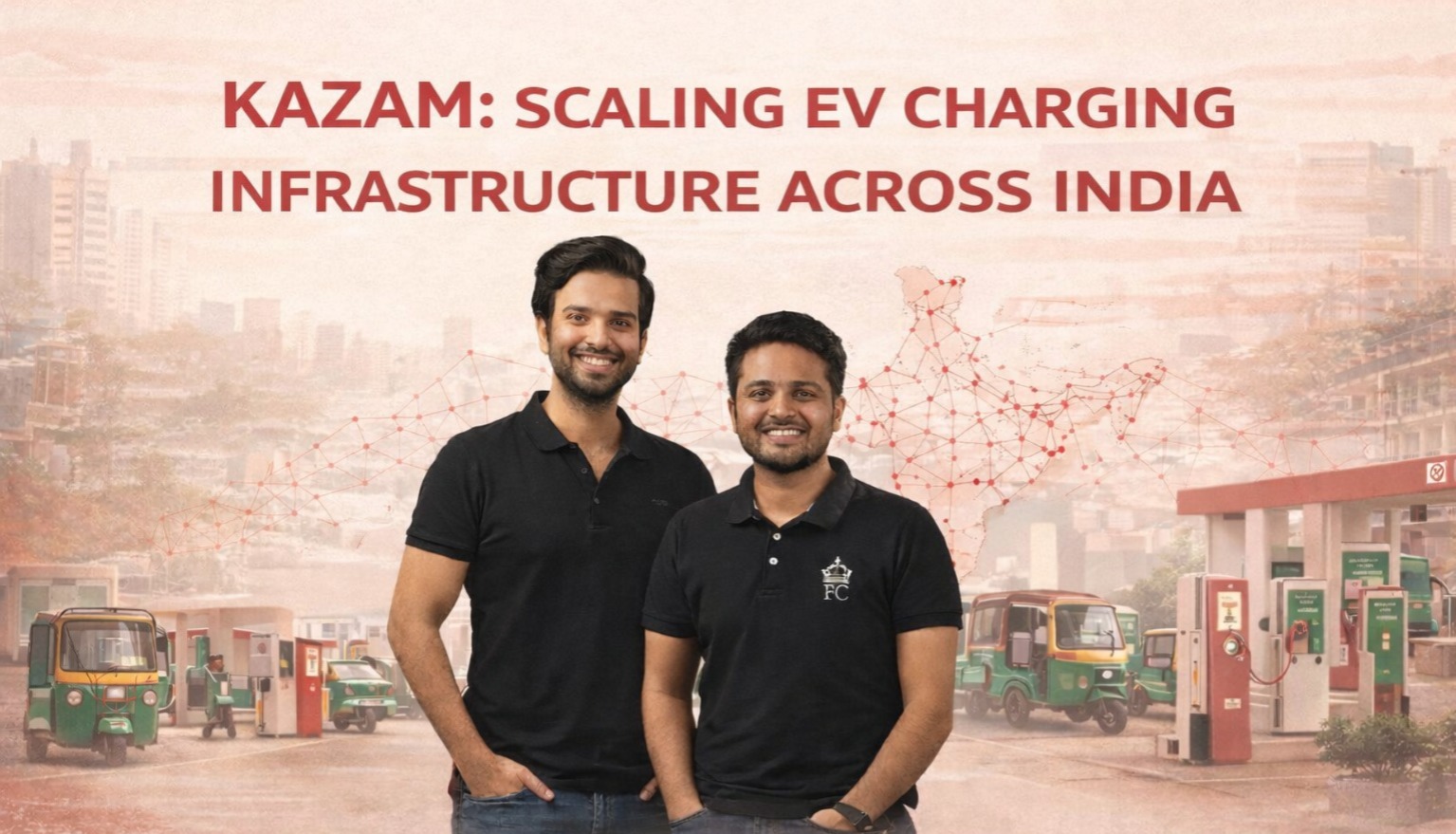
In 2025, electric vehicles were everywhere in the news. Sales numbers, new launches, policy announcements the spotlight was firmly on the vehicles themselves. But away from the noise, another story was unfolding quietly. Kazam, a Bengaluru-based startup, was steadily building something far less visible, yet absolutely critical to India’s EV future: charging infrastructure that actually works.
Kazam doesn’t make cars or scooters. Instead, it focuses on what happens when those vehicles need power. Founded in 2020 by Akshay Shekhar and Vaibhav Tyagi, the company started out solving specific EV charging problems. Over time, it grew into an energy-tech platform that connects chargers, vehicles, fleets, and power grids across homes, cities, and commercial locations.The founders saw early on that India’s EV journey wouldn’t be about just adding charging points on maps. It would be about building systems smart, reliable, and flexible enough to handle two-wheelers, three-wheelers, and commercial fleets all at once. That belief continues to shape Kazam’s direction today.
How Kazam EV Charging Is Scaling Across India
For FY 25, Kazam reported ₹40 crore in revenue, roughly 3.5 times higher than the previous year. In a crowded EV ecosystem, that kind of growth didn’t come from hype but from steady adoption. More chargers were used, more fleets came on board, and partnerships began to scale.
The company now expects to reach a ₹100 crore annual run rate by the end of 2025. According to CEO Akshay Shekhar, this isn’t just about growth numbers. It reflects a shift in how charging is being treated, from an afterthought to core infrastructure.So far, Kazam’s platform has supported over 7 million charging sessions and connected more than 120,000 chargers across India. Every month, it manages close to 9,000 MWh of energy transactions, a figure that has risen sharply since mid-2025. These aren’t abstract metrics; they represent daily charging for thousands of drivers who depend on uptime to earn a living.
Also Read: India’s Gig Economy Has Crossed a Line
Why Smaller Cities Matter More Than You Think
Unlike many startups that chase metro expansion first, Kazam found some of its strongest demand in tier-2 and tier-3 cities, places like Siliguri, Bareilly, Lucknow, and Agra. These are cities where electric three-wheelers and small commercial vehicles are growing fast and where charging reliability directly affects livelihoods.
Today, around 150,000 three-wheeler drivers use Kazam’s network as part of their daily routine. For them, charging isn’t about convenience; it’s about keeping their vehicles on the road.This focus also aligns with where the market is heading. India’s EV charging ecosystem crossed 1.56 million units in 2025, and industry estimates suggest it could grow at over 22% annually until 2035. Much of that growth is expected to come from exactly these smaller cities.
Funding That Supports a Long-Term View
In June 2025, Kazam raised $6.2 million in funding led by the International Finance Corporation (IFC), with backing from Vertex Ventures Southeast Asia & India and Avaana Capital. The round took Kazam’s total funding to about $19.2 million.The capital is being used not just to expand faster but to build better, investing in research, improving interoperability, and strengthening the platform’s ability to work across different charger brands and use cases.One example is Kazam’s partnership with Yuma Energy, a joint venture between Magna International and Yulu Bikes, to integrate battery swapping at Park & Charge hubs. For commercial EV users, this can mean less waiting and more time on the road.
What Kazam Is Really Building
At its core, Kazam is trying to solve a simple but overlooked problem: EV charging has to be dependable, invisible, and scalable. The company’s software works with over 100 charger brands, allowing fleets, OEMs, delivery companies, and public networks to manage charging without friction.
As EV adoption accelerates, especially in commercial and shared mobility segments, startups like Kazam are laying the groundwork that makes the transition possible. Most users may only see a charging point, but behind it is a network, a platform, and a team quietly ensuring that electric mobility doesn’t stall.
Also Read: India Issues Ultimatum to Elon Musk’s X Over AI-Generated Obscene Content