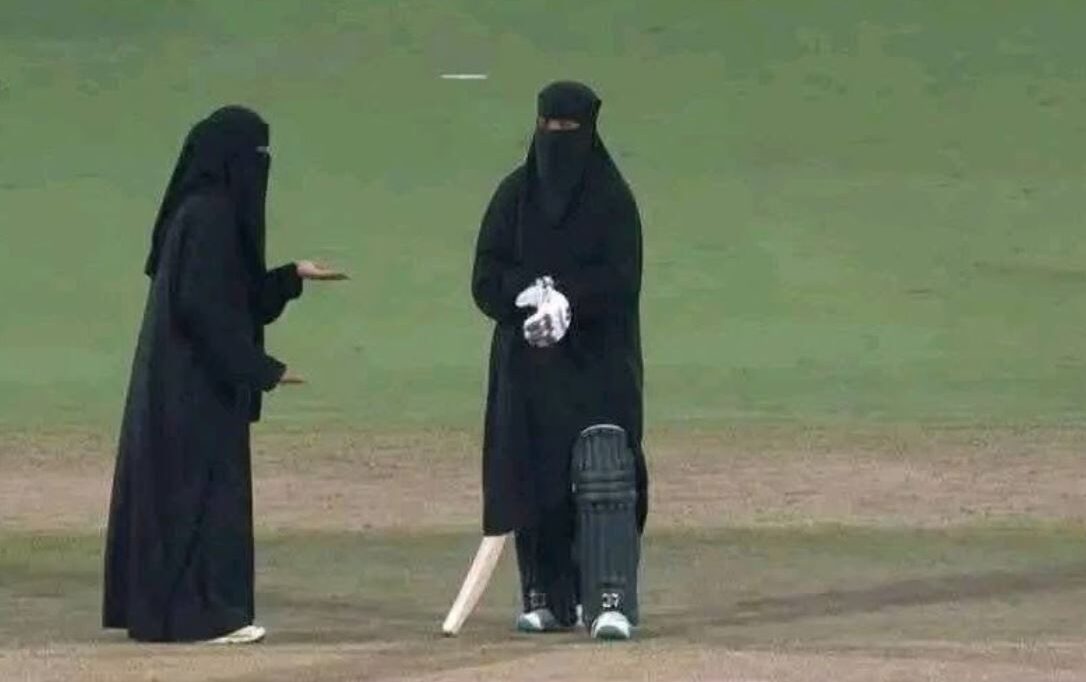
In an age where a doctored image can outpace real news, social media briefly convinced thousands that Bangladesh’s women cricketers had taken the field in burqas during the ongoing Women’s World Cup.
The claim spread like wildfire, fueled by political commentary, cultural insinuations, and an unmistakable undercurrent of Islamophobic stereotyping. But when the dust settled, the truth turned out to be far more ordinary and far more instructive about our digital gullibility.
What sparked the controversy
During Bangladesh’s match against South Africa, an image began circulating on X (formerly Twitter), Facebook, and WhatsApp groups showing two Bangladeshi players wearing what appeared to be full-length black burqas while bowling and fielding.
Posts accompanying the image claimed that the players had “defied Western dress codes” and “played in burqas as an act of religious assertion.”
Within hours, the picture gathered thousands of shares and comments, some praising it, others mocking it.
Mainstream fact-checking outlets soon noticed inconsistencies in the photo’s texture, light, and proportions.
A closer look revealed something even more damning, the lower right corner of the image carried the faint watermark of Gemini, Google’s AI image-generation tool.
Verified facts: Bangladesh never played in burqas
Multiple international broadcasters covering the ICC Women’s World Cup, including ESPNcricinfo and ICC’s official photo galleries, show the Bangladeshi squad wearing their standard green-red national jerseys with the Bangladesh Cricket Board logo.
There is no visual, broadcast, or eyewitness record of any player taking the field in religious attire.
The viral picture was digitally manipulated using an AI-based editing tool to replace their regular kits with black garments resembling burqas.
In other words: the “burqa match” never happened.
How the fake gained traction
Digital forensics experts explain that viral misinformation thrives when it taps into pre-existing social or cultural biases.
The photo’s spread coincided with global debates around sports uniforms and women’s rights in Muslim-majority countries, making it a ripe target for sensationalism.
Accounts on social media amplified the image using polarizing captions and hashtags, drawing engagement from users unaware of its artificial origins.
What’s striking is how even some mainstream handles reposted the photo without basic verification, underscoring how AI-generated hoaxes now demand newsroom-level scrutiny before sharing.
AI and misinformation: a growing threat
The Bangladesh “burqa” hoax isn’t an isolated case. Over the past year, several AI-generated visuals, from “celebrities protesting” to “politicians in compromising situations” have gone viral before being debunked.
Fact-checking platforms globally are now integrating forensic image analysis to detect AI signatures, shadows, and mismatched reflections that betray synthetic origins.
Experts warn that as AI image tools become more sophisticated, distinguishing real from fake will rely less on the naked eye and more on critical digital literacy.
The myth and the motive
The myth that a Muslim-majority team “chose religion over sport” feeds into a larger narrative of cultural othering.
Such fabrications not only misinform the public but also unfairly target athletes who already face structural barriers in international sports.
By the time the hoax was busted, the false claim had already garnered millions of views, while the actual story, a nail-biting match where Bangladesh lost narrowly in the final over, went largely unnoticed.
Lessons for readers and media
- Check the source : Verify if an image is from an official broadcaster, newswire, or ICC channel.
- Look for watermarks : AI-generated images often bear traces of creation tools like Gemini, DALL·E, or Midjourney.
- Cross-verify context : If a sensational claim seems out of step with official coverage, it probably is.
- Pause before sharing : Each repost multiplies misinformation’s reach and impact.
The “burqa-clad Bangladesh cricketers” narrative is a textbook example of how digital misinformation can hijack a sporting event and transform it into a cultural controversy.
No player wore a burqa; no rule was defied; no silent protest was staged.
What actually happened was far simpler, an AI-generated hoax exploited global attention around the Women’s World Cup.
For audiences, the takeaway is equally simple: in the age of synthetic media, seeing is no longer believing. Only verified sources and a healthy dose of skepticism, can keep truth from being lost in translation.
Verified through: ICC official match archives, ESPNcricinfo photos, and cross-checks with AI-forensic analyses by Indian fact-check portals.
Fact status: False claim: AI-generated image.
Also Read: Top 10 Richest Indian Cricketers in 2025