

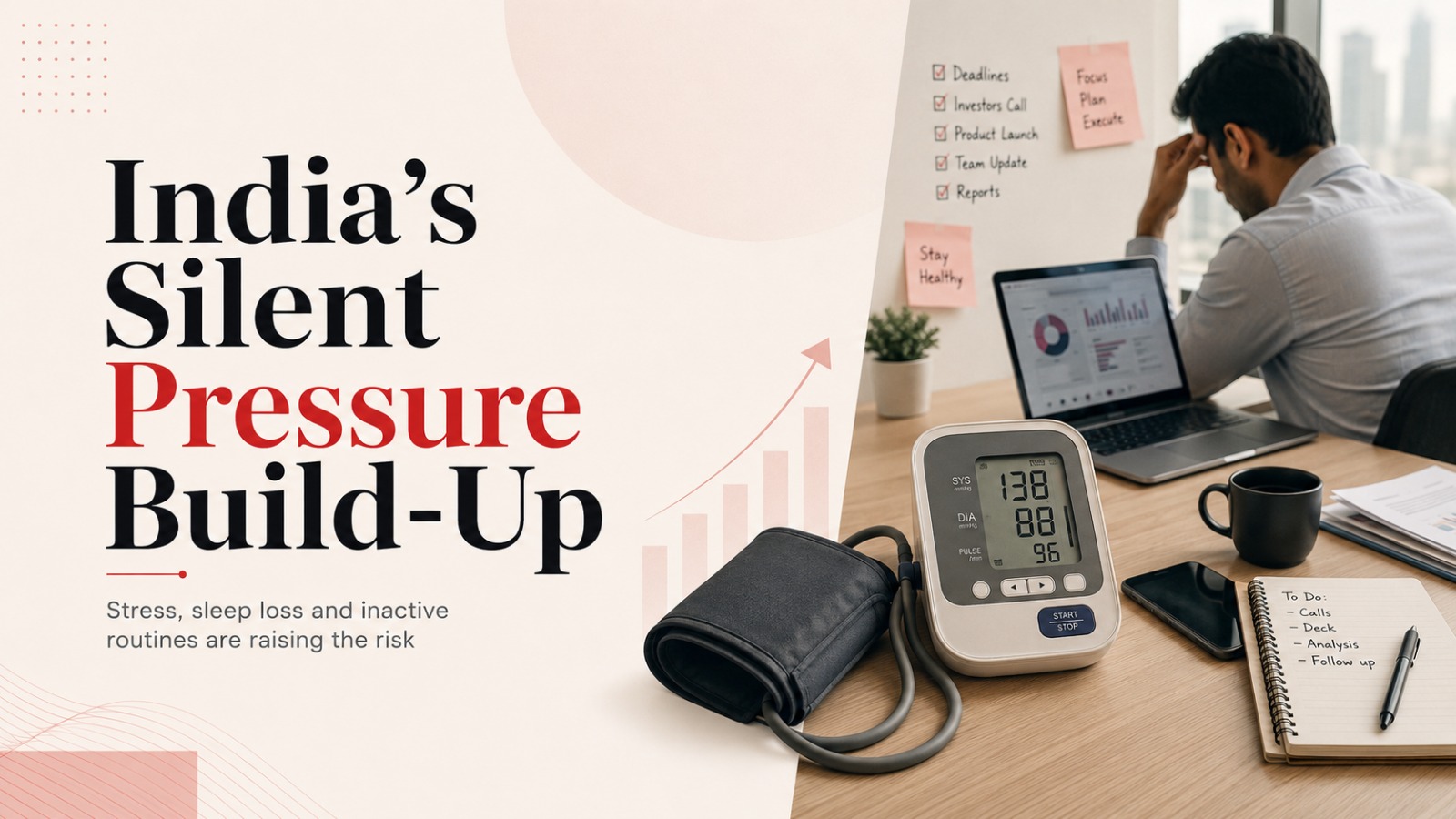
High Blood Pressure in India: India’s latest health data carries a warning that should worry not only doctors and policymakers, but also employers, founders, startup teams and young professionals building their lives around long workdays.
The National Family Health Survey-6 for 2023-24 shows that 19.4 percent of women and 22.1 percent of men aged 15 years and above have elevated blood pressure or are already taking medication to control it. In plain terms, more than one in five Indian men and nearly one in five Indian women are living with a condition that often remains invisible until it leads to serious complications.
Hypertension is often called a “silent killer” because it may not show clear symptoms while quietly increasing the risk of heart disease, stroke and kidney failure. That makes the latest findings important not only as a medical statistic, but as a lifestyle signal.
The numbers show a wider health shift
The survey points to a country dealing with two health realities at the same time. India has shown progress in areas such as child nutrition, vaccination coverage and maternal health. At the same time, adult health indicators are moving towards chronic, lifestyle-linked illnesses that need long-term care rather than one-time treatment.
Among men, 12.4 percent had mildly elevated blood pressure, while 3.3 percent had moderately or severely elevated blood pressure. Overall, 22.1 percent of men either had elevated blood pressure or were taking medicine for it.
Among women, 9.4 percent had mildly elevated blood pressure and 4.8 percent had moderately or severely elevated blood pressure. Overall, 19.4 percent of women were either hypertensive or on treatment.
The survey also shows that hypertension is no longer only an urban problem. Among women, 23.5 percent in urban areas had elevated blood pressure compared with 17.8 percent in rural areas. Among men, the figure stood at 26.2 percent in urban areas and 20.4 percent in rural areas.
That narrowing gap matters. Lifestyle changes once associated mainly with cities, including reduced physical activity, stress, changing food habits and rising obesity, are now showing up beyond metros too.
The startup angle: ambition, stress and the health cost no one tracks enough
India’s startup economy often celebrates hustle, speed and endurance. Founders work through uncertainty. Small teams chase deadlines with limited resources. Employees in digital-first companies spend long hours at laptops, switch between calls, dashboards and delivery targets, and often treat sleep, meals and exercise as optional.
The NFHS-6 data does not separately study startup workers, founders or high-pressure corporate jobs. So it would be wrong to claim that startup culture is directly responsible for India’s hypertension numbers.
But the warning is hard to ignore.
The risk factors highlighted in the health trend, stress, reduced physical activity, obesity, high salt consumption and diabetes, overlap with the kind of lifestyle many high-pressure desk jobs can produce. In startup and corporate environments, the problem may not be ambition itself. The danger lies in a routine where long sitting hours, poor sleep, irregular meals, constant stress and little physical activity become normal.
This is especially relevant because many people in their 20s, 30s and 40s may not regularly check their blood pressure. In a culture where productivity is praised and exhaustion is often hidden, hypertension can remain unnoticed until the body sends a much louder warning.
High Blood Pressure in India: A rural and urban concern now
One of the strongest messages from the survey is that India’s health transition is not limited to big cities. Rural India is also seeing the rise of non-communicable diseases, even though many healthcare systems remain more focused on maternal and child health.
This means the country is facing a broader metabolic health challenge. NFHS-6 also found that 27.3 percent of women were overweight or obese. High blood sugar levels or diabetes medication were reported among 17.8 percent of women and 20.9 percent of men.
The combination of obesity, diabetes and hypertension is especially serious because these conditions can reinforce one another and raise the risk of cardiovascular disease.
Why this is not just an individual problem
Hypertension is often treated as a personal lifestyle issue. Eat better, walk more, reduce salt, take medicine, sleep properly. All of that matters.
But the latest data also raises a larger question: are Indian workplaces, including startups, designed in a way that allows healthier living?
A founder who sleeps four to five hours, skips exercise and survives on stress may look committed in the short term. A young employee who spends the day seated, works late and ignores checkups may seem productive. But over time, these patterns can create a health burden that affects people, companies and the healthcare system.
The next phase of India’s public health challenge may not be only about building more hospitals. It may also be about building healthier routines into everyday life, including the workplace.
For startups, that could mean treating health checkups, walking breaks, realistic deadlines, better sleep culture and preventive screening not as luxury perks, but as risk management. For employees, it means not waiting for symptoms before checking blood pressure.
The real warning
India’s hypertension numbers are not just a medical headline. They are a mirror to how the country is living, working, eating and resting.
The rise in high blood pressure across men, women, urban India and rural India shows that the problem is spreading across social and geographic lines. The data does not blame one profession, one city or one lifestyle. But it does make one thing clear: modern pressure, whether physical, dietary or mental, is becoming a national health issue.
For India’s startup generation, the message is simple and uncomfortable. Building fast should not mean breaking silently.
Also Read: Who Owns Your Team Now? IPL’s Latest Ownership Breakdown
















