

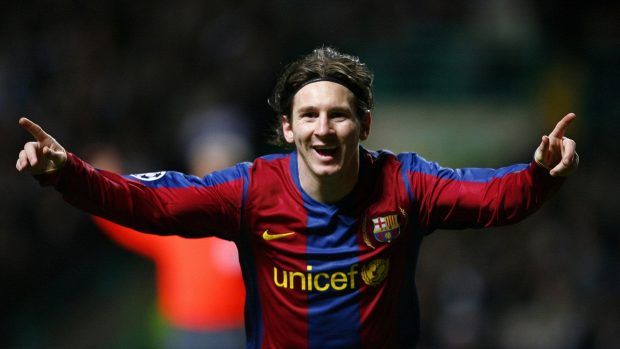
Lionel Messi’s career has been documented in almost obsessive detail. The goals, the trophies and the individual records have become part of football history. Yet some of the most revealing chapters of his story happened long before the world began measuring his greatness in numbers.
They involve a grandmother who pushed a four-year-old towards football, a medical condition that placed enormous financial pressure on his family, a contract written on an unlikely piece of paper, a painfully shy teenager living thousands of kilometres from home, and a moment when several future Barcelona stars headed to England while Messi stayed behind.
Here are 5 lesser-known stories from Lionel Messi’s early life and rise through Barcelona.
1. Messi’s grandmother was the person who first pushed him towards organised football
Before Barcelona, before Newell’s Old Boys and long before the No. 10 shirt became synonymous with his name, there was Grandoli.
Messi grew up playing football with his older brothers and his cousins, Maximiliano and Emanuel Biancucchi. But one of the most important figures in the earliest stage of his football life was his grandmother, Celia.
When Messi was just four years old, Celia introduced him to the Grandoli football club. His father coached him there.
Two years later, Messi joined Newell’s Old Boys in Rosario.
His progress there was extraordinary. Between the ages of six and 10, Messi was part of the youth side referred to as “The Machine of 87,” and the account credits him with scoring around 500 goals during that period.
For all the attention later given to Barcelona’s role in developing Messi, his football story had already taken shape in Rosario.
And it had begun with his grandmother taking him to a local club.
2. At 10, Messi’s football dream became tied to a treatment his family struggled to afford
Messi’s childhood changed dramatically when he was 10.
He was diagnosed with growth hormone deficiency after his physical development began falling noticeably behind that of children his age. Treatment required regular growth hormone therapy, with the cost described at approximately $1,500 a month.
That created a problem which had little to do with football ability.
His father’s health insurance could cover only two years of the medication. Newell’s Old Boys initially helped with the treatment costs, but the expense eventually became too much for the club to continue supporting.
River Plate also showed interest in Messi, but the financial situation described around the club meant it could not take on the cost either.
Messi therefore reached an unusual crossroads while still a child.
There was little question about whether he could play.
The question was whether the people around him could find a way to finance the medical treatment he needed while allowing his football development to continue.
That problem eventually helped lead the Messi family towards Barcelona.
3. One of football’s most important agreements was written on a paper napkin
Messi had relatives in Catalonia, which helped his family arrange an opportunity with Barcelona.
At the time, he was only 13.
Barcelona official Charly Rexach had already heard about the young Argentine’s ability. Messi travelled to Spain with his father and took part in a trial, with Barcelona offering to take responsibility for his medical expenses if things worked out.
Then came the detail that would become one of the most unusual stories of Messi’s career.
Rexach was sufficiently impressed that an agreement for Messi was written on a paper napkin.
There was no glamorous unveiling.
No packed press conference.
No indication that this teenager would eventually become one of the defining players associated with the club.
Just a young footballer, his father, a Barcelona decision-maker and an agreement written on something normally found on a restaurant table.
Messi crossed the Atlantic in February 2001 as his family moved to Spain. They settled near Camp Nou and his Barcelona education began.
At 13, he was listed at only 4 feet 9 inches tall.
What Barcelona had effectively bet on was not Messi’s size, but what happened when the ball reached his feet.
4. Messi was so quiet at Barcelona that some teammates reportedly thought he could not speak
Moving to Barcelona did not instantly turn Messi’s life into a football fairy tale.
He was a teenager living in another country, separated from much of his family and adjusting to unfamiliar surroundings.
His mother and siblings eventually returned to Argentina. His father remained with him in Spain so that Messi could continue pursuing his football career. The separation reportedly left the young player deeply homesick.
Then there was his personality.
Messi was so shy around his new teammates that he barely spoke to them at first. According to the account, some of them initially believed he was mute.
Away from the conversations he struggled to have, there was also a demanding routine continuing in private.
Messi trained during the day.
At night, he received his hormone injections.
It is one of the more revealing images from his Barcelona beginnings.
The player who would eventually perform in front of enormous crowds began his life at the club as a homesick teenager who barely spoke to his teammates, trained during the day and continued his medical treatment at night.
5. Fàbregas and Piqué left for England, while Messi chose to remain at Barcelona
By the 2002-03 season, Messi was beginning to make himself impossible to ignore inside Barcelona’s academy.
He became close with two other young footballers who would themselves go on to become major names: Cesc Fàbregas and Gerard Piqué.
Messi was part of the Barcelona youth group referred to as the “Baby Dream Team.” During that season, he is credited with scoring 36 goals in 30 matches.
Then English football came calling.
At the end of the season, Messi received an offer from Arsenal.
Fàbregas and Piqué both left Barcelona for England, but Messi did not follow them. He chose to remain at the club.
Looking backwards, it feels like an inevitable decision.
At the time, it was anything but that.
These were teenage footballers still trying to work out where their careers would take them. England offered another route. Two members of Messi’s close football circle took it.
Messi stayed.
That decision became another small but significant turning point in a Barcelona story that had already survived medical uncertainty, an international move, homesickness and the pressure of starting over in a new country.
The Messi story looked very different before the fame
It is easy to retell Lionel Messi’s career backwards.
Once you know what followed, every childhood goal can look like evidence that greatness was inevitable.
His early years tell a less predictable story.
A grandmother had to take the first step and bring a four-year-old to a football club. A medical diagnosis forced his family to search for financial help. Barcelona took a chance on a 13-year-old who stood 4 feet 9 inches tall. An agreement was written on a napkin. Messi then had to live away from much of his family, continue hormone treatment and find his place inside a dressing room where he was initially too shy to talk.
And when an opportunity emerged to take another path to England, he stayed in Barcelona.
The superstar came later.
These were the quieter moments that helped make everything that followed possible.
Also Read: Lionel Messi retires from Argentina at 39
















