

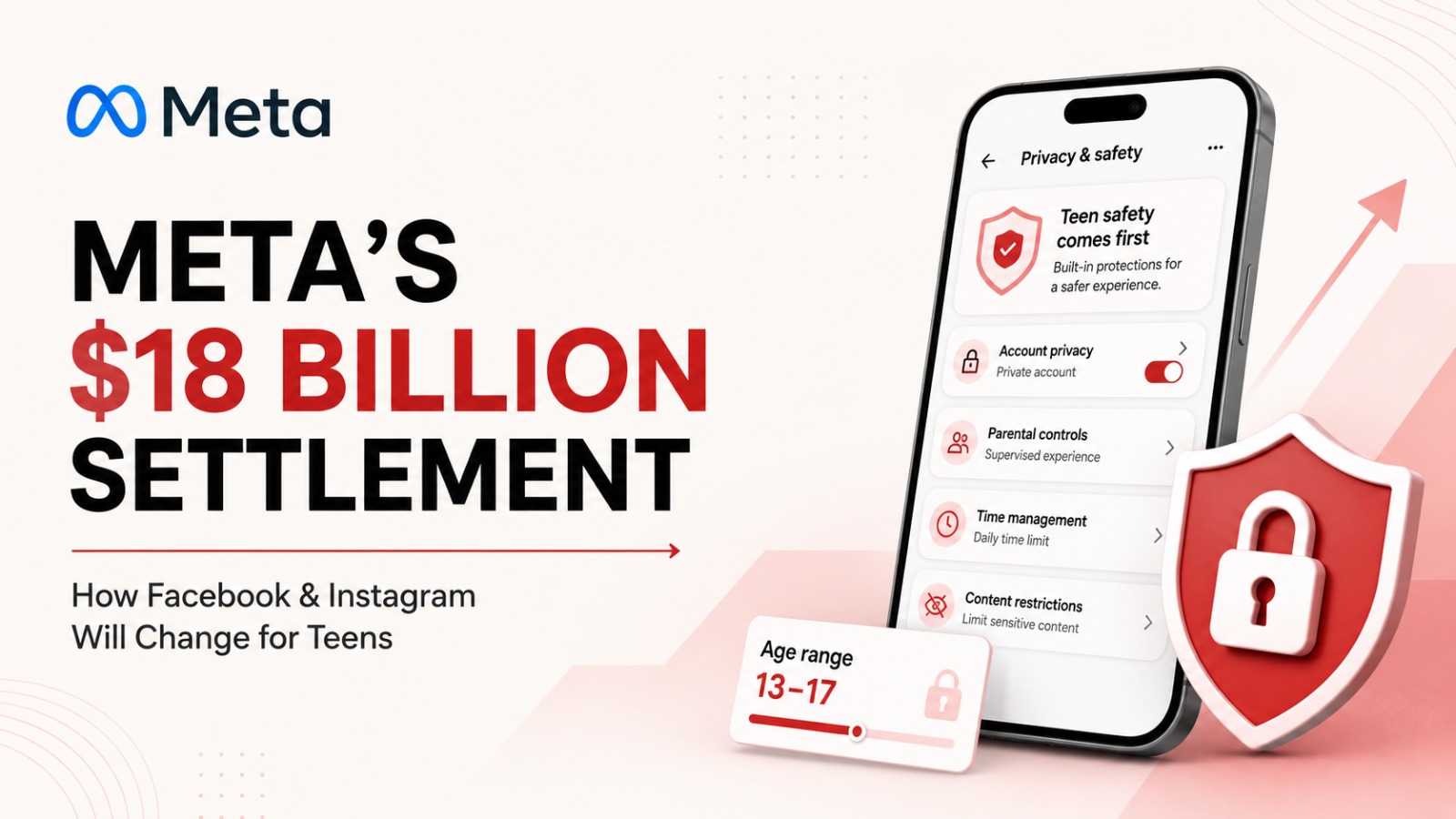
Meta has agreed to pay up to $18 billion to settle a sweeping legal battle with nearly all US states over allegations that Facebook and Instagram were designed to keep children and teenagers engaged, while failing to adequately address the risks posed to young users.
The agreement, announced on August 26, 2026, brings an end to a major federal trial in California. The settlement covers claims from 47 states, Washington, D.C., Puerto Rico, American Samoa and the Northern Mariana Islands. The allegations included claims that Meta used features that encouraged compulsive use, misled the public about the risks to children and collected personal information from users under 13 without proper parental consent.
Meta has denied wrongdoing. However, as part of the settlement, the company has agreed to make broad changes to how teenagers use Instagram and Facebook in the United States.
A Settlement That Could Reach $18 Billion
The financial terms are spread across several parts of the agreement and will be paid over a period of years.
Meta has agreed to pay $16.68 billion under the main multistate settlement. Texas has a separate agreement worth more than $1 billion, while another $459 million will address privacy claims involving the handling of user data, including allegations connected to the Cambridge Analytica scandal.
The overall value can reach about $18 billion when the separate payments are included.
The money will be distributed among participating states and territories, with funds intended for purposes including youth safety, mental health support and other programs addressing harms associated with social media use.
The agreement is also designed to put pressure on other major social media companies to adopt similar protections for younger users.
Two-Hour Daily Limit Becomes the Default
One of the most visible changes for teenagers will be a default two-hour daily usage limit.
Users under 18 will have the restriction enabled by default, although parents will have the ability to change or remove the limit. Meta is also required to introduce additional parental controls and strengthen systems used to verify the identity and age of users managing teen accounts.
The settlement also includes restrictions designed to prevent young users from creating additional accounts to get around safety settings.
Another major change is a nighttime access block. Teen accounts will be restricted from using Meta’s platforms between midnight and 6 a.m. The measure is intended to reduce overnight social media use.
School Hours and Social Pressure Get New Limits
Meta will also introduce a school mode that mutes notifications during school hours. The default setting is designed to reduce interruptions from Instagram and Facebook while teenagers are in class.
The settlement further requires Meta to hide like counts by default for young users. The change is aimed at reducing the emphasis on visible engagement numbers and the social pressure associated with likes.
The company must also restrict certain image-altering tools. Cosmetic-procedure and similar filters that can manipulate teenagers’ appearance will face new restrictions under the agreement.
Teenagers will also gain greater control over how content is displayed. Meta is required to introduce a non-personalized feed option, allowing young users to view content without relying on the company’s usual personalized recommendation system.
Stronger Age Checks and Parental Controls
Age assurance will become a more important part of Meta’s safety system. The company is required to strengthen methods for determining whether an account belongs to a minor and improve controls available to parents.
Meta will also face outside oversight of its implementation of several safety measures. The changes are expected to be introduced in stages, with some major protections arriving within months and broader age-assurance measures following later.
The settlement also places restrictions on certain messaging features and requires changes to how Meta’s recommendation systems operate for younger users.
Pressure on TikTok and YouTube
The agreement goes beyond Facebook and Instagram because part of the financial structure depends on whether competing platforms adopt comparable protections.
Up to $5 billion of the settlement is conditional on major competitors, including platforms such as TikTok and YouTube, taking similar steps to protect young users.
That condition gives Meta a strong incentive to push for broader industry adoption of teen safety measures rather than implementing the changes alone.
The settlement therefore represents more than a financial penalty for Meta. It could become a wider turning point in how major social media companies design and operate platforms used by teenagers, particularly around screen time, parental oversight, age verification and algorithmic recommendations.
Also Read: Marvel’s Iron Man Gameplay Leak Confirmed by EA Motive With ‘AUG26’ Watermark

















