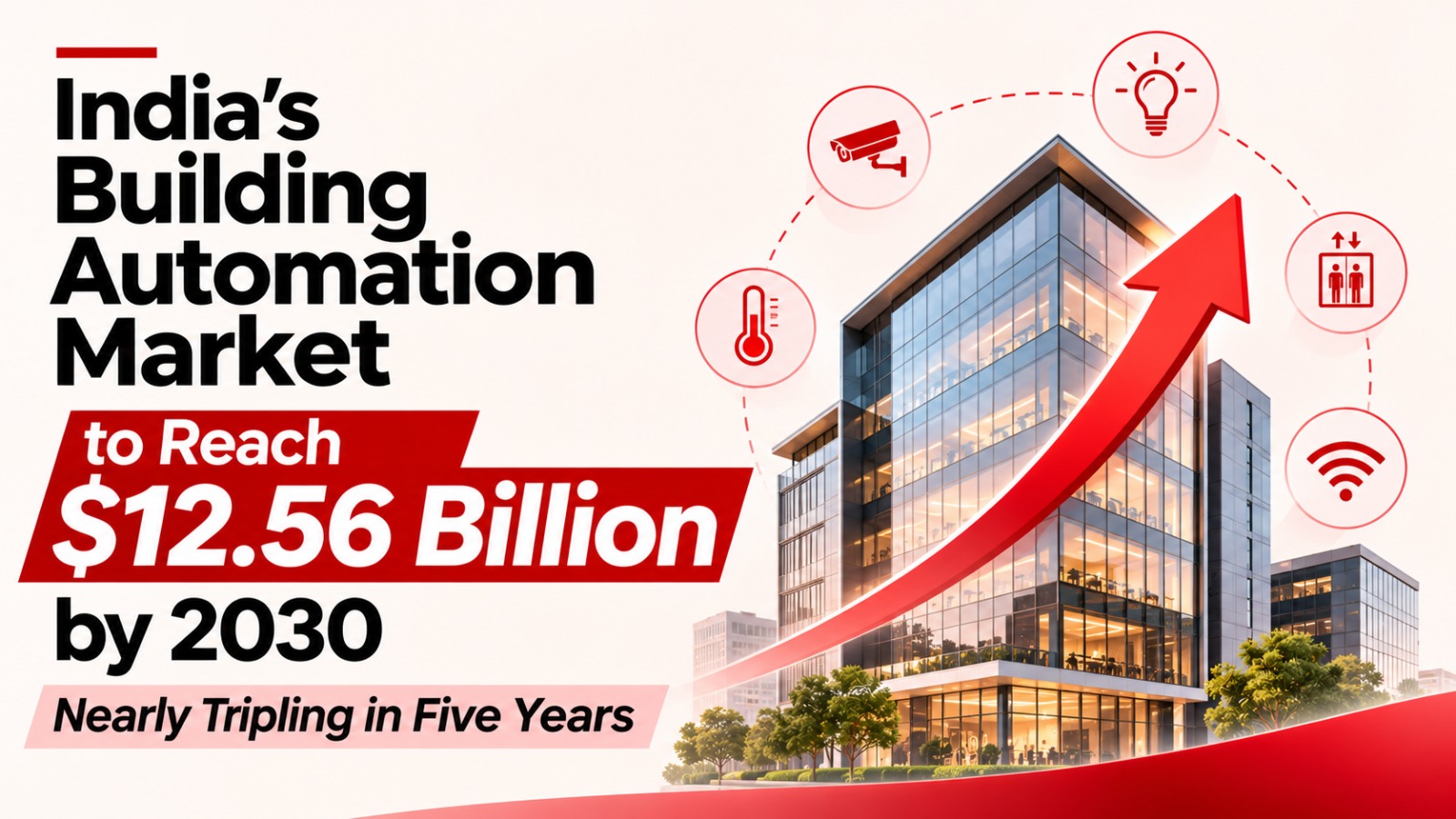
India’s building automation market is projected to grow from $4.32 billion in 2025 to $12.56 billion by 2030, reflecting a compound annual growth rate (CAGR) of 23.8%. The expansion highlights the growing role of artificial intelligence (AI), connected building systems and energy optimisation in reshaping the country’s commercial real estate and workplace infrastructure.
The projections were highlighted by Sakhee Chandrayan, Founder and President of the Integrated Building Automation Community (INBAC), during the second edition of ORGATEC India 2026 in Mumbai. The event brought together industry leaders to discuss the changing requirements of commercial workplaces, including smart infrastructure, sustainable office design and technology-led facility management.
Chandrayan also referred to projections from a CII–Cushman & Wakefield report, which estimates that IoT-enabled automation across organised commercial office built-up areas will increase from 25% to 45% by FY2030. The adoption of integrated building automation and management systems is also expected to rise from 8% to 23% over the same period.
Energy efficiency is emerging as another major driver of investment. Citing the International Energy Agency (IEA), Chandrayan noted that digital optimisation could deliver potential energy savings of 5% to 40%.
Ageing Office Buildings Create a Retrofitting Opportunity
The growing adoption of smart building technologies comes as India’s commercial real estate sector undergoes a broader transformation.
Commercial real estate investments increased 15% year-on-year during the first nine months of 2026, according to Savills. At the same time, the industry is facing an estimated Rs 50,000 crore retrofitting opportunity across 420 million square feet of ageing office stock.
The opportunity is driving interest in upgrading existing commercial properties with modern infrastructure, energy-efficient systems and connected technologies rather than relying exclusively on new construction.
Workplace requirements are also changing more frequently. Industry discussions at ORGATEC India highlighted how office design cycles have shortened from 10–15 years to three to five years, increasing the need for adaptable spaces and more predictive planning.
Taanmaay Ashok Khare, Vice President and Group Head of Administration at Bajaj Finserv and a contributor to CRISP, said India’s facility management industry covers more than 100 services and is growing at an annual rate of 20–30%.
He also pointed to the expansion of corporate real estate demand beyond traditional metropolitan markets, with infrastructure accessibility and operational efficiency supporting the development of emerging business hubs.
Khare said future workplaces would increasingly prioritise multifunctional spaces, employee well-being and experiential environments. He also highlighted the growing importance of environmental, social and governance (ESG) considerations and Business Responsibility and Sustainability Reporting (BRSR) requirements.
Furniture reuse, waste reduction and more efficient utilisation of natural resources are expected to become important elements of workplace development.
AI and Hybrid Work Reshape Office Design
Technology adoption is also changing the way companies approach office furniture and workplace planning.
Praveen Rawal, Vice President for Asia Pacific at Haworth, described India as a promising market for the regional office furniture industry. He estimated the addressable premium and performance-driven office furniture segment in India at $1.5 billion.
Rawal said increasing business unpredictability would create demand for adaptable workstations, modular meeting rooms and reconfigurable furniture systems.
He also highlighted the changing expectations of employees as organisations rethink hybrid working arrangements. With hybrid work increasingly limited to one day a week in many organisations, he said offices need to become more inviting and socially engaging.
According to Rawal, the growing influence of AI will push workplaces beyond conventional desk-based layouts towards interactive, digital and restorative environments that encourage collaboration, learning and employee empowerment.
Karan Sachdev, Managing Director of KOKUYO Workplace India, highlighted the importance of combining technology, research and engineering in workplace product development.
He said the company was introducing Japanese-developed innovations designed for Indian enterprises, with a focus on human-centric engineering and improving how workplace products function and respond to users’ needs.
ORGATEC India 2026 Brings Together Over 100 Brands
The second edition of ORGATEC India 2026 opened at the Jio World Convention Centre in Mumbai’s Bandra Kurla Complex (BKC) and runs until November 21.
Organised by Koelnmesse Pvt Ltd, the exhibition focuses on workplace design, office furniture and smart technologies. This year’s edition features more than 100 brands from 10 countries and over 100 speakers. Organisers expect more than 11,000 trade visitors from 20 nations.
The event follows the theme WorkNXT (Design × Technology × Experiences) and covers six interconnected areas: Design, Specify, Procure, Build, Operate and Experience.
It is supported by industry organisations including the Builders Association of India (BAI), CRISP, Electronics and Computer Software Export Promotion Council (ESC), Indian Green Building Council (IGBC), INBAC and the Manufacturers’ Association for Information Technology (MAIT).
Milind Dixit, Managing Director for India and SAARC at Koelnmesse Pvt Ltd, said the increase in commercial real estate investments was creating opportunities for the workplace industry. He described the exhibition as a business-to-business platform for companies seeking to expand their market presence.
Nalin Gagrani, Chairman and Managing Director of Blue Pebble, also highlighted opportunities emerging from the expansion of Global Capability Centres (GCCs) in cities such as Indore, Visakhapatnam, Coimbatore and Jaipur.
The discussions at the exhibition reflect a wider shift in India’s office infrastructure market, where building automation, sustainability, flexible furniture and employee experience are becoming increasingly important considerations for businesses investing in commercial workspaces.
Also Read: Anthropic Hits $2.1 Trillion Valuation in Nasdaq Debut, Raises $81 Billion